Tu plan de aprendizaje · Continuar · Revisar →
Tiempo / Verbo + 时 (cuando …)
IntroducidoTu posición guardada se conserva en este navegador. Continuar no completa la lección ni responde sus preguntas.
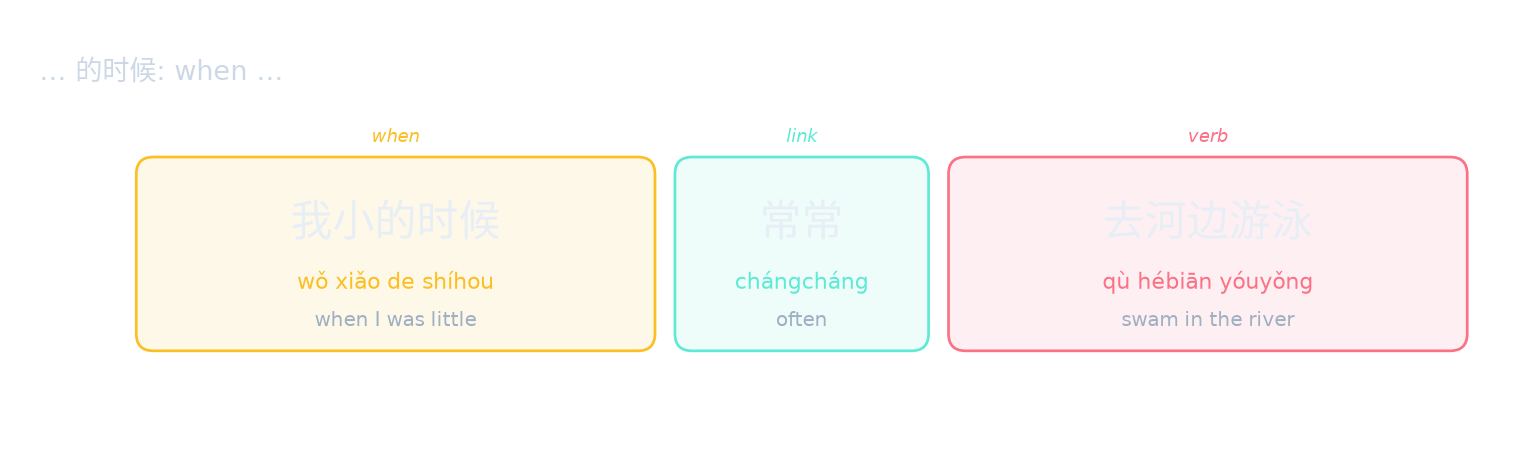
Cuando era pequeño
- Estás contando a un amigo una historia de tu infancia sobre aprender a nadar.
- I我small小(modifier / structural particle)的time; when时候often常常to go去river bank河边to swim游泳。 — "Cuando era pequeño, solía ir a nadar junto al río."
Tiempo / Frase verbal + when时 ((modifier / structural particle)的time; when时候)
- X + (modifier / structural particle)的time; when时候 = "cuando X". La forma hablada es (modifier / structural particle)的time; when时候; la más corta when时 es más escrita: in class上课when时, to rain下雨when时.
- Al igual que before以前, when时 va después de lo que indica.
in class上课when时,please请turn off关your phone手机。
Build: “In class, please turn off your phone.”
Dificultad 3/5 · 200 monedas + un pequeño bono en el primer intento de hoy
Clause + 时, then the request.
Hablado (modifier / structural particle)的time; when时候
- I我arrive到home家(modifier / structural particle)的time; when时候,he他already已经sleep睡(completed / change)了。 — "Cuando llegué a casa, él ya estaba dormido."
- you你to have time (to do sth)有空(modifier / structural particle)的time; when时候to / for / give给I我to make a telephone call打电话。 — "Llámacme cuando tengas tiempo."
I我arrive到home家when的时候,he他already已经sleep睡了。
Complete: “When I got home, he was already asleep.” 我到家____,他已经睡了。
Dificultad 1/5 · 100 monedas + un pequeño bono en el primer intento de hoy
Clause + 的时候 = when.
Orden y la palabra correcta
- when时 / (modifier / structural particle)的time; when时候 va después de la cláusula: to rain下雨(modifier / structural particle)的time; when时候, no time; when时候to rain下雨.
- En una cláusula de "cuándo", no uses what什么time; when时候 (que pregunta "¿cuándo?"): I我arrive到home家(modifier / structural particle)的time; when时候, no I我what什么time; when时候perfect到家.
Which says “Call me when you have time.”?
Dificultad 1/5 · 100 monedas + un pequeño bono en el primer intento de hoy
The 的时候 clause comes first; 什么时候 asks “when?”.
when时 versus (modifier / structural particle)的time; when时候
- Use (modifier / structural particle)的time; when时候 en conversaciones: eat吃饭(modifier / structural particle)的time; when时候don't别talk说话.
- when时 se adapta a señales, escritura y frases cortas fijas: to eat a meal用餐when时No smoking请勿吸烟 — "No fumar durante la comida."
eat吃饭when的时候don't别talk说话。
时 is more common than 的时候 in everyday conversation.
Dificultad 1/5 · 100 monedas + un pequeño bono en el primer intento de hoy
的时候 is the usual spoken form; 时 is more written.
Resumen
- X + (modifier / structural particle)的time; when时候 / when时 = cuando X; sigue a la cláusula a la que pertenece.
- (modifier / structural particle)的time; when时候 es oral, when时 es más escrito. what什么time; when时候 formula una pregunta; no equivale a "cuando" en una afirmación.
Lee la referencia completa: Gramática HSK 3 — Sustantivos.
You are telling a friend a story from your childhood about learning to swim. Close the examples. Say a Mandarin response, then write it in Chinese. Explain briefly in English what the lesson’s pattern adds. Compare with the model, then change one detail and try again.
This is supported productive practice. Compare meaning and structure; your answer need not copy the model. A partner or teacher must hear the spoken response to comment on pronunciation.