Tu plan de aprendizaje · Continuar · Revisar →
Adjetivos duplicados (AA / AABB)
IntroducidoTu posición guardada se conserva en este navegador. Continuar no completa la lección ni responde sus preguntas.
Describing a picture in a lively way
- You are describing a child's drawing: big eyes, a round face, a very tidy room.
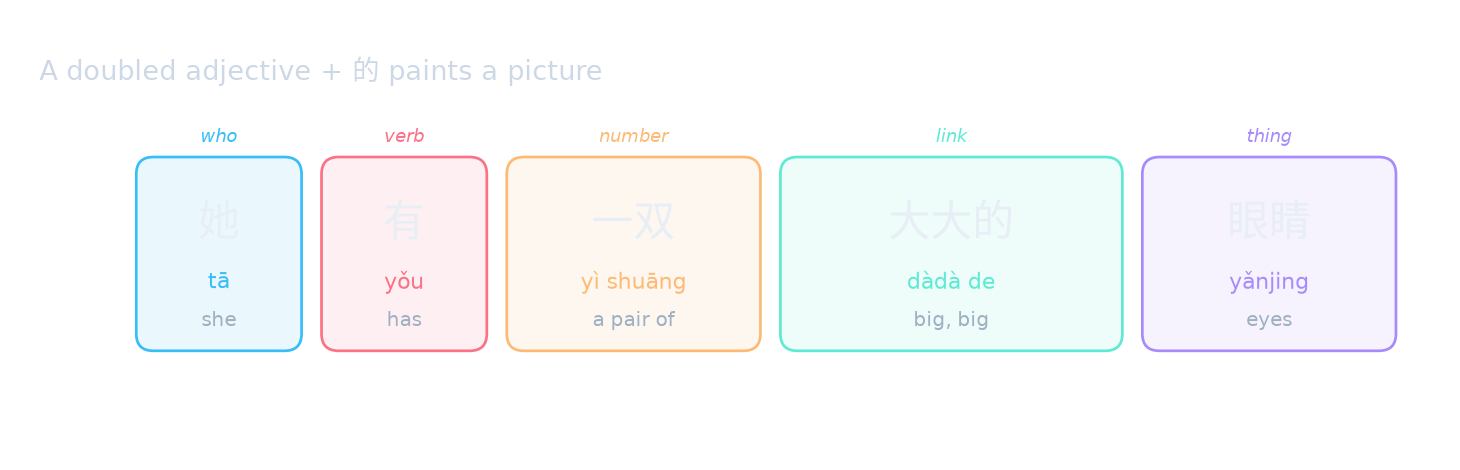
- she她has有a pair of一双big, big大大的eyes眼睛。 Tā yǒu yì shuāng dàdà de yǎnjing. — "She has big, big eyes."
- Goal: double an adjective (big大 → greatly大大, clean干净 → spotlessly clean干干净净) to make a description vivid, and put the doubled form in the right place with (modifier / structural particle)的 or (adverb -ly)地.
1 · How to double: AA and AABB
- One syllable → AA: big大 → greatly大大, red红 → 红红, slow慢 → slowly慢慢.
- Two syllables AB → AABB: clean干净 → spotlessly clean干干净净, happy; glad高兴 → cheerful and optimistic高高兴兴, distinct清楚 → 清清楚楚, pretty漂亮 → 漂漂亮亮.
- ✗ clean干净clean干净 is wrong for an adjective. Only the AABB shape works.
she她has有a pair of一双big, big大大的eyes眼睛。
Match each adjective to its doubled form.
Dificultad 2/5 · 140 monedas + un pequeño bono en el primer intento de hoy
One syllable gives AA; two syllables give AABB.
干净 can be doubled as 干净干净 to describe a room.
Dificultad 1/5 · 100 monedas + un pequeño bono en el primer intento de hoy
Adjectives double as AABB: 干干净净. ABAB is for verbs (休息休息).
2 · Three places it goes
- Before a noun + (modifier / structural particle)的: 红红的apple苹果 — "nice red apples".
- At the end + (modifier / structural particle)的: she她(modifier / structural particle)的face脸红红的。 Tā de liǎn hónghóng de. — "Her face is all red."
- Before a verb + (adverb -ly)地 (often left out): he他cheerful and optimistic高高兴兴(adverb -ly)地to return home回家(completed / change)了。 — "He went home happily."
- After a verb + (degree marker)得, too: he他(把: marks the object)把room房间cleaned打扫(degree marker)得spotlessly clean干干净净(modifier / structural particle)的。 Tā bǎ fángjiān dǎsǎo de gāngānjìngjìng de. — "He cleaned the room until it was spotless."
he他把room房间cleaned打扫得spotlessly clean干干净净的。
Double 清楚 (clear): 老师把问题说得____的。
Dificultad 1/5 · 100 monedas + un pequeño bono en el primer intento de hoy
A two-syllable adjective AB doubles as AABB, so 清楚 becomes 清清楚楚.
“The little boy's hands are all dirty.” Which is correct?
Dificultad 1/5 · 100 monedas + un pequeño bono en el primer intento de hoy
At the end of the sentence a doubled adjective takes 的: 冷冷的.
3 · Friendly advice: properly好好, slowly慢慢
- Doubled one-syllable words before a verb are very common in kind advice and requests:
- you你properly好好rest休息(suggestion)吧。 Nǐ hǎohāo xiūxi ba. — "Get some proper rest."
- please; to invite请慢慢说。 Qǐng mànmàn shuō. — "Please speak slowly." you你want / will / need要properly好好to study; to learn学习。 — "You must study hard."
you你properly好好rest休息吧。
Build: “Please speak slowly.”
Dificultad 3/5 · 200 monedas + un pequeño bono en el primer intento de hoy
慢慢 + verb, a friendly request.
4 · AABB adjective or ABAB verb?
- Adjectives double as AABB; verbs double as ABAB. The same word can change meaning:
- everyone大家cheerful and optimistic高高兴兴(adverb -ly)地to sing唱歌。 — "Everyone sang happily." (adjective: in a happy way)
- we / us我们to go去park公园happy; glad高兴happy; glad高兴(suggestion)吧! — "Let's go to the park and have some fun!" (verb: do it a bit)
Which means “Let's go out and have some fun”?
Dificultad 1/5 · 100 monedas + un pequeño bono en el primer intento de hoy
Used as a verb ("do it a bit"), 高兴 doubles as ABAB: 高兴高兴.
Common mistakes
- degree / adjective linker很 in front: ✗ degree / adjective linker很big, big大大的eyes眼睛 ✓ big, big大大的eyes眼睛. Doubling already means "very".
- not不 in front: ✗ not不spotlessly clean干干净净 ✓ not不clean干净. Doubled forms are never negative.
- Missing (modifier / structural particle)的 at the end: ✗ she她(modifier / structural particle)的脸红红。 ✓ she她(modifier / structural particle)的face脸红红的。
- Doubling every adjective: words like important重要 (important) or easy容易 (easy) are not doubled. Learn the common ones: greatly大大, very small小小, 红红, slowly慢慢, properly好好, spotlessly clean干干净净, cheerful and optimistic高高兴兴, 清清楚楚, 漂漂亮亮.
Which phrase is correct?
Dificultad 1/5 · 100 monedas + un pequeño bono en el primer intento de hoy
AA + 的 + noun. Doubling already means "very", so no 很, and no 不.
Recap
- AA (greatly大大, slowly慢慢) and AABB (spotlessly clean干干净净, cheerful and optimistic高高兴兴) make a description vivid and strong.
- Before a noun or at the end → (modifier / structural particle)的; before a verb → (adverb -ly)地. properly好好 / slowly慢慢 + verb for advice.
- No degree / adjective linker很, no not不. Verbs double as ABAB (happy; glad高兴happy; glad高兴 = have some fun).
Read the full reference: HSK 3 grammar — Reduplication of adjectives.
You are describing a child's drawing: big eyes, a round face, a very tidy room. Close the examples. Say a Mandarin response, then write it in Chinese. Explain briefly in English what the lesson’s pattern adds. Compare with the model, then change one detail and try again.
This is supported productive practice. Compare meaning and structure; your answer need not copy the model. A partner or teacher must hear the spoken response to comment on pronunciation.