Tu plan de aprendizaje · Continuar · Revisar →
Adjetivo + 地 + Verbo (formando un adverbio)
IntroducidoTu posición guardada se conserva en este navegador. Continuar no completa la lección ni responde sus preguntas.
¿Cómo se hace?
- Tu abuela cruza la calle transitada con cuidado; tu hermano pequeño hace la tarea seriamente por una vez.
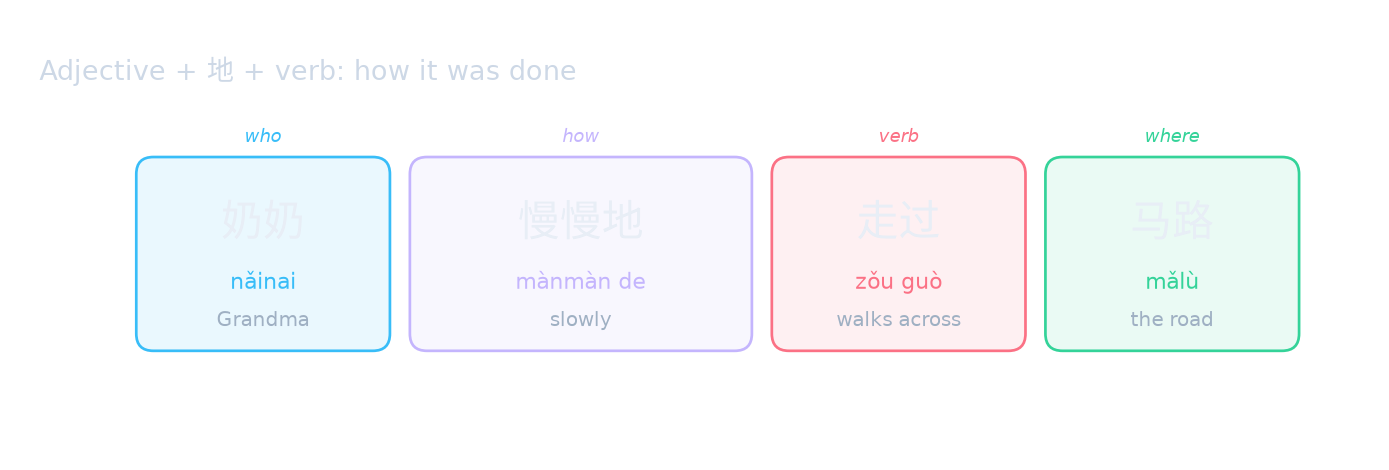
- grandma奶奶slowly慢慢(adverb -ly)地to walk past走过street马路。 — "La abuela atraviesa la calle lentamente." (adverb -ly)地 convierte una descripción en cómo se realiza la acción。
Adjetivo + (adverb -ly)地 + Verbo
- Sujeto + Adjetivo + (adverb -ly)地 + Verbo: la descripción va antes del verbo y (adverb -ly)地 (de) los une。
- Los adjetivos de dos sílabas son los más comunes: seriously认真(adverb -ly)地study学习, happy; glad高兴地说, quiet安静(adverb -ly)地to read看书。
he他seriously认真地study学习。
Fill in the particle: 她安静____看书。
Dificultad 1/5 · 100 monedas + un pequeño bono en el primer intento de hoy
Adjective + 地 + Verb. 安静地看书 = “read quietly”.
Adjetivos duplicados y descripciones fraseales
- Los adjetivos duplicados suelen llevar (adverb -ly)地: child孩子(plural)们happily高高兴兴(adverb -ly)地go home回家(completed / change)了。 — "Los niños regresaron a casa alegremente。
- Una frase corta también funciona: very很fast; soon快(adverb -ly)地to eat吃to finish完(completed / change)了cooked rice饭, very非常to be careful小心(adverb -ly)地to open打开box盒子.
the children孩子们happily高高兴兴地go home回家了。
Build: “Grandma walks slowly across the road.”
Dificultad 3/5 · 200 monedas + un pequeño bono en el primer intento de hoy
Subject + Adjective + 地 + Verb + Object.
Mantén el orden y distingue bien los caracteres
- (adverb -ly)地 va antes del verbo: seriously认真(adverb -ly)地study学习. Después del verbo necesitas (degree marker)得: he他学得very很seriously认真.
- Escribe (adverb -ly)地, no (modifier / structural particle)的, entre la descripción y el verbo; ambos se leen como de.
他学习认真地。 is a correct way to say “He studies seriously.”
Dificultad 1/5 · 100 monedas + un pequeño bono en el primer intento de hoy
地 + description must come before the verb (他认真地学习), or use 得 after it (他学得很认真).
(adverb -ly)地 antes del verbo, (degree marker)得 después
- he他seriously认真(adverb -ly)地writes写school assignment作业 indica cómo lo hace: con cuidado, mientras lo realiza.
- he他writes写(degree marker)得very很seriously认真 comenta sobre el resultado o la manera tras el hecho: "Él escribe muy cuidadosamente."
he他writes写得very很carefully认真。
Choose the particle for both blanks: 他高兴__说: “我考得__很好!”
Dificultad 1/5 · 100 monedas + un pequeño bono en el primer intento de hoy
高兴地说 (地 before the verb) and 考得很好 (得 after the verb).
Resumen
- Adjetivo + (adverb -ly)地 + Verbo = hacer algo de esa manera: slowly慢慢(adverb -ly)地to walk走, seriously认真(adverb -ly)地study学习.
- (adverb -ly)地 va antes del verbo; (degree marker)得 sigue al verbo. Usa (modifier / structural particle)的 para sustantivos.
Lee la referencia completa: Gramática HSK 3 — Adjetivos a adverbios.
Your grandmother crosses the busy road carefully; your little brother does his homework seriously for once. Close the examples. Say a Mandarin response, then write it in Chinese. Explain briefly in English what the lesson’s pattern adds. Compare with the model, then change one detail and try again.
This is supported productive practice. Compare meaning and structure; your answer need not copy the model. A partner or teacher must hear the spoken response to comment on pronunciation.