Resolución de problemas cuantitativos y datos
Introducido| English | Significado |
|---|---|
| numeric entry/njuːˈmerɪk ˈentri/ | entrada numérica |
| average/ˈævrɪdʒ/ | media |
A calculator cannot choose the equation
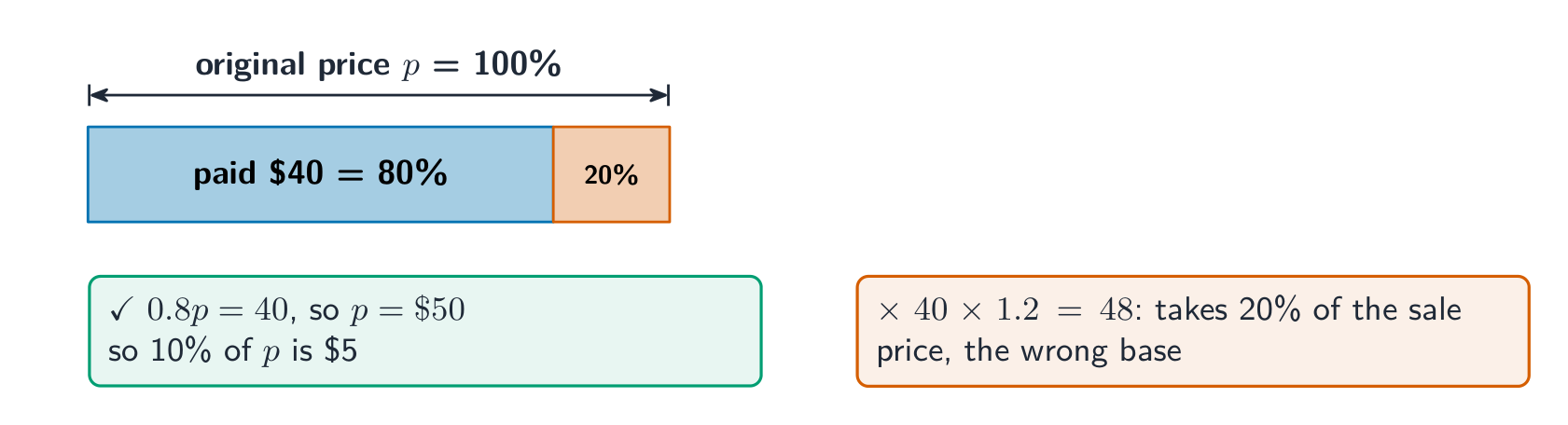
- A shop charges 40 dollars after a 20% discount. Multiplying 40 by 1.2 gives 48, but that does not undo the discount. The arithmetic can be correct while the model is wrong.
- Before calculating, identify the unknown, the starting quantity and the required answer form. A price before a reduction, a share of a total and a mean of several values need different equations.
Read the answer format separately from the maths
- A single-answer multiple-choice question asks for one choice. A multiple-answer question asks for the stated number of choices or all that apply; there may be one, several or all correct options. Check every listed option when asked for all.
- Numeric entry 数字填空 uses one box for an integer or decimal, or two boxes for a fraction's numerator and denominator. “Round to the nearest percent” describes precision, not necessarily the interface: a multiple-choice question can also ask for rounding.
Enter the quantity named by the box
- If 3 of 8 objects have a property, the proportion is $3/8=0.375$ and the percentage is 37.5%. A box labelled percent needs 37.5, while a decimal-proportion box needs 0.375. The same data can require different entries.
- Read units and scale labels: 1.25 million visits is 1,250 thousand visits. Use the requested fraction boxes or decimal box and check any printed unit beside it. Do not convert an exact fraction to a rounded decimal without a reason.
Round the final result to the stated precision
- Two out of seven is $200/7$ percent, approximately 28.5714%. To the nearest tenth of a percent, enter 28.6 in the percent-labelled box. To the nearest whole percent, enter 29. A different rounding instruction changes the required answer.
- Keep exact fractions or sufficient calculator digits through intermediate steps. Rounding $2/7$ to 0.3 before multiplying by 100 would give 30%, which is wrong at either of those requested precisions. If no rounding is requested, keep the exact answer.
¿Qué interfaz de respuesta se solicita explícitamente?
Cada tarjeta indica su instrucción de selección o sus casillas de respuesta. El redondeo o las unidades por sí solos no identifican una interfaz.
Two of seven objects have a property. Enter the percentage to the nearest tenth of a percent; the answer box is labelled percent.
Dificultad 2/5 · 140 monedas + un pequeño bono en el primer intento de hoy
The exact percentage is 200/7 = 28.5714… . Round only the final result to one decimal place: 28.6. Do not enter the proportion 2/7.
Work the original discount examples
- Let p be the original shirt price. A 20% discount leaves 80% of p, so $0.8p=40$ and $p=50$ dollars. Check: 20% of 50 is 10, leaving 40. Adding 20% of the reduced price uses the wrong base.
- For the original jacket exercise, 72 dollars remains after a 10% discount. Thus $0.9p=72$, giving $p=80$ dollars. A reduced positive price should be smaller than its original price, which is a useful final check.
A jacket costs 72 dollars after a 10% discount. What was the original price in dollars?
Dificultad 2/5 · 140 monedas + un pequeño bono en el primer intento de hoy
A 10% discount leaves 90% of the original p: 0.9p = 72, so p = 80. Check: 10% of 80 is 8, leaving 72.
Reverse a multiplier rather than changing its sign
- For a positive starting price, a 20% fall followed by a 20% rise gives $0.8\times1.2=0.96$ of the original. To undo the fall, multiply the reduced price by $1/0.8=1.25$: the required rise is 25% of the reduced price.
- “15% more than x” means $x+0.15x=1.15x$. Distinguish the new amount from the increase itself, $0.15x$. For a percentage change, name the base before choosing the multiplier.
A positive price that falls by 20% returns to its original value after a 20% increase.
Dificultad 1/5 · 100 monedas + un pequeño bono en el primer intento de hoy
The two multipliers give 0.8 × 1.2 = 0.96 of the original. Restoring the original needs a 25% rise from the reduced price, since 1/0.8 = 1.25.
“15% more than x” can be written as ____x.
Dificultad 1/5 · 100 monedas + un pequeño bono en el primer intento de hoy
The new amount is 100% + 15% = 115% of x, or 1.15x. The increase alone is 0.15x.
A positive price falls by 20%. By what percentage of the reduced price must it rise to return to its original value? Enter the percentage number.
Dificultad 2/5 · 140 monedas + un pequeño bono en el primer intento de hoy
The reduced amount is 0.8p. The missing 0.2p is 0.2p/(0.8p) = 0.25 = 25% of the reduced price.
Turn an average into a sum
- The arithmetic average 平均数, or mean, is sum divided by count. If five values have mean 12, their sum is $5\times12=60$. A mean does not say every value equals 12.
- In the original exercise, four values have mean 15, so their sum is 60. The three known values total $10+12+20=42$; the missing value is $60-42=18$. Check: the four values add to 60 and divide by 4 to give 15.
The average of 4 numbers is 15. Three of them are 10, 12 and 20. What is the fourth?
Dificultad 2/5 · 140 monedas + un pequeño bono en el primer intento de hoy
Four values with mean 15 total 60. The known three total 42, so the fourth is 18. Substitution gives (10 + 12 + 20 + 18)/4 = 15.
Weight group means by their counts
- Group A has 2 measurements with mean 10; group B has 6 with mean 20. Their sums are 20 and 120. The combined mean is $(20+120)/(2+6)=17.5$, not $(10+20)/2=15$.
- The larger group contributes more values. For groups with counts n and m and means a and b, combine their sums: $(na+mb)/(n+m)$. Averaging the two means directly works when group counts are equal; it can also happen to work when the means themselves are equal.

Group A has 2 measurements with mean 10. Group B has 6 with mean 20. What is the mean of all 8 measurements?
Dificultad 2/5 · 140 monedas + un pequeño bono en el primer intento de hoy
The sums are 2 × 10 = 20 and 6 × 20 = 120. Divide the combined sum 140 by the combined count 8 to obtain 17.5.
El grupo A tiene 3 valores con media 8 y el grupo B tiene 5 valores con media 16. Encuentre la media combinada y explique por qué promediar directamente 8 y 16 no está justificado aquí.
Compare su configuración, unidades, verificaciones y formato de respuesta requerido con el modelo y la lista de control.
Read data with the correct denominator
- This fictional table counts orders on three separate days, with each order counted once. The total is $120+150+180=450$. Tuesday's share is $150/450=1/3$, about 33.3% to one decimal place.
| Day | Orders |
|---|---|
| Monday | 120 |
| Tuesday | 150 |
| Wednesday | 180 |
- The increase from Monday to Tuesday is 30 orders, or $30/120=25\%$ of Monday's count. “Share of the three-day total” and “increase from Monday” use different bases. Neither asks for a percentage-point change between two percentages.
A fictional order table records Monday 120, Tuesday 150 and Wednesday 180 orders on separate days. What percentage of the three-day total was on Tuesday? Enter the percentage to one decimal place.
Dificultad 2/5 · 140 monedas + un pequeño bono en el primer intento de hoy
The total is 450. Tuesday’s share is 150/450 = 1/3, or 33.333…%, which rounds to 33.3%. The denominator is the total, not Monday’s 120.
Una tabla ficticia registra 80 pedidos el lunes, 100 el martes y 120 el miércoles, con cada pedido contado una sola vez. Encuentre (i) la participación del martes en el total de tres días a un lugar decimal como porcentaje; (ii) el aumento porcentual del lunes al martes. Nombre ambos denominadores.
Compare su configuración, unidades, verificaciones y formato de respuesta requerido con el modelo y la lista de control.
Separate area from perimeter
- A rectangle is 12 cm by 8 cm. Cut a right triangle from a corner, with perpendicular legs 3 cm and 4 cm along the rectangle's sides. The remaining area is $12\times8-\tfrac12\times3\times4=90\text{ cm}^2$.
- The triangle's sloping side is 5 cm by Pythagoras. The perimeter changes from 40 cm to $40-3-4+5=38\text{ cm}$. Removing area need not remove the same fraction of perimeter. Use the given dimensions, rather than estimating from a sketch.

A rectangle is 12 cm by 8 cm. A right triangle with perpendicular legs 3 cm and 4 cm is cut from one corner. Find the remaining area in square centimetres.
Dificultad 2/5 · 140 monedas + un pequeño bono en el primer intento de hoy
The rectangle has area 96 cm² and the triangle has area (1/2) × 3 × 4 = 6 cm². The remaining area is 90 cm².
Convert dimensions before using a formula
- A length of 1 cm is 10 mm, so an area of $1\text{ cm}^2$ is $100\text{ mm}^2$. The remaining area of $90\text{ cm}^2$ is therefore $9{,}000\text{ mm}^2$, not 900. Area conversions square the length factor.
- For mixed units, convert each length to one common unit before multiplying or adding. A rectangle 1.2 m by 80 cm is 1.2 m by 0.8 m and has area $0.96\text{ m}^2$. Keep a length answer distinct from an area answer.
Un rectángulo mide 1.2 m por 80 cm. Se elimina un triángulo rectángulo de una esquina, con catetos perpendiculares de 30 cm y 40 cm a lo largo de sus lados. Encuentre el área restante en metros cuadrados y su perímetro en metros.
Compare su configuración, unidades, verificaciones y formato de respuesta requerido con el modelo y la lista de control.
Check candidates in the original equation
- To solve $\sqrt{x+6}=x$, the right-hand side must be nonnegative, so $x\ge0$. Squaring gives $x^2-x-6=0$, or $(x-3)(x+2)=0$. This produces candidates 3 and $-2$.
- At 3, both sides equal 3. At −2, the sides are 2 and −2, so this candidate fails. Squaring can add candidates; a candidate is not a solution until it meets the original equation and its domain.
Which listed real values satisfy $\sqrt{x+6}=x$? Select all that apply.
Dificultad 2/5 · 140 monedas + un pequeño bono en el primer intento de hoy
Squaring gives candidates 3 and −2, but the principal square root is nonnegative. Only 3 satisfies the original equation; −2 gives 2 on the left and −2 on the right.
Apply every condition in a select-all task
- For the original options 2, 3, 4, 6 and 8, select the numbers dividing both 48 and 30. The answers are 2, 3 and 6. The options 4 and 8 divide 48 but not 30, so they fail the “both” condition.
- The common positive divisors are divisors of $\gcd(48,30)=6$: 1, 2, 3 and 6. But 1 is not offered in this task, so do not invent an extra option. “Divides both” requires two successful tests; dividing only one number is insufficient.
Which numbers divide both 48 and 30? Select all that apply.
Dificultad 2/5 · 140 monedas + un pequeño bono en el primer intento de hoy
2, 3 and 6 divide both 48 and 30. The offered 4 and 8 fail the second test because neither divides 30. Select every listed value that passes both conditions.
Bounds can make an option list manageable
- For an integer n satisfying $n^2<10$, $|n|\le3$: the integers from $-3$ through 3 work, while $4^2=16$ is already too large. For a positive integer n, only 1, 2 and 3 remain.
- Use bounds to narrow the candidates, then check the actual list and endpoint. A strict inequality excludes equality at its boundary. If a question says “select two,” give two; if it says “select all,” do not stop after finding two.
Which listed integers satisfy $n^2<10$? Select all that apply.
Dificultad 2/5 · 140 monedas + un pequeño bono en el primer intento de hoy
The integer solutions are −3 through 3. From the offered list, −3, −2, 0 and 3 work. Both −4 and 4 have square 16 and fail the strict inequality.
Para cada ecuación, seleccione todas las soluciones de $\{-3,-2,0,2,3\}$: (i) $\sqrt{x+6}=x$; (ii) $x^2=9$. Explique por qué verificar solo la versión cuadrada de (i) seleccionaría un valor adicional.
Compare su configuración, unidades, verificaciones y formato de respuesta requerido con el modelo y la lista de control.
Use the calculator after an estimate
- Before computing $198\times0.51$, estimate $200\times0.5=100$. The exact result is 100.98, close to that estimate. An entry of 10,098 should trigger a decimal-place check rather than immediate submission.
- Set up parentheses and units before keying numbers. A calculator can evaluate a weighted sum, but it cannot decide whether the correct denominator is 2, 8, 120 or 450. Exact arithmetic and a rough estimate provide different checks.
Solve the single-answer problem before matching choices
- Three identical notebooks plus a delivery fee of 2 dollars cost 17 dollars. If each notebook costs p, write $3p+2=17$. Subtract the fee before dividing: $p=(17-2)/3=5$ dollars.
- Substitute the chosen answer into the original total: $3\times5+2=17$. Working backwards from options is also valid when convenient, but check the same total and units. A plausible price alone does not establish the answer.
Check the result and its required form
- For two nonempty groups, the combined mean lies between their means; a share lies between 0 and 1, or between 0% and 100%. A discounted price is below its original positive price. Use checks suited to the actual assumptions.
- Then answer the stated question: original or final price, total or average, area or perimeter, percentage or proportion. Preserve exactness until any required final rounding, and review all selected options in a multiple-answer task.
Revise el planteamiento antes del cálculo.
Cada tarjeta incluye el problema y un planteamiento o entrada propuestos. Identifique la razón específica por la que funciona o falla.
Recap
- Model the problem before calculating. Track percentage bases, sums and counts, dimensions and units; verify candidates in the original conditions.
- Check the format separately: one choice, the requested set of choices, or a numerical entry with the required units and precision. Keep the final answer consistent with the question.
- numeric entry: A question type in which an answer is entered as a number rather than selected from choices.
- average: The arithmetic mean: the sum of the values divided by the number of values.