Análisis de escritura: Analizar un tema
Introducido| English | Significado |
|---|---|
| qualification/ˌkwɒlɪfɪˈkeɪʃn/ | calificación |
| counterargument/ˈkaʊntərɑːɡjuːmənt/ | contrargumento |
A persuasive answer must do the requested job
- A school committee asks whether its library should stay open every evening. “Libraries are useful” states a view, but it does not explain likely consequences or answer a serious objection about staffing.
- Issue writing needs a clear position, developed reasons and attention to the actual instruction. Qualifications 限定条件 can define a position's limits, but adding “it depends” is not a substitute for deciding what you support.
Understand the Issue task
- The GRE Analytical Writing measure has one 30-minute Analyze an Issue task. You develop and support your own evaluation of a claim or recommendation. Read the attached directions as well as the topic.
- Use the lesson's original statement: “Governments should place few, if any, restrictions on scientific research.” You might support, oppose or partly accept it. The writing task does not require one preferred view; it requires a reasoned response to the given instructions.
Turn the instruction into specific obligations
- An extent-of-agreement instruction needs a position and an explanation of its scope. A consequences instruction needs possible effects and an explanation of how those effects shape your position. Listing effects alone leaves the second job unfinished.
- If asked to address strong challenges, identify and answer a serious opposing reason. If asked about a claim and its stated reason, evaluate both. A prepared paragraph about the general topic cannot automatically satisfy these different requirements.
One unchanged essay can be assumed to fulfil every different GRE Issue instruction.
Dificultad 1/5 · 100 monedas + un pequeño bono en el primer intento de hoy
Different instructions can ask for consequences, strong challenges, or evaluation of a claim and its reason. A reusable plan must be adapted to the actual requirements.
Defend a position rather than choosing a supposedly safe side
- A qualified position is not automatically better than an unqualified one. What matters is whether your position is clear, responsive and well supported. A broad claim carries a broad burden: explain why it holds across the cases it covers.
- For this lesson, consider a qualified thesis: “Research should usually proceed freely, but review should become stricter when a project poses credible serious risks.” This is one position to develop, not the required answer or a guarantee of a particular score.
A qualified position automatically receives a higher score than an unqualified position.
Dificultad 1/5 · 100 monedas + un pequeño bono en el primer intento de hoy
The task evaluates the response to its instructions, development, organisation and expression. Adding a condition does not by itself establish stronger reasoning or guarantee a score.
Make the qualification change a real decision
- A useful limit tells the reader when your recommendation changes. “Use routine oversight for clearly low-risk work, with deeper review for identified serious hazards” gives a decision criterion. “Both sides have points” leaves the recommendation unclear.
- Define important terms when the argument needs them. Here “restriction” could mean a blanket ban or a safety review; those are different measures. Explain which measures your reasons support rather than switching meanings halfway through the essay.

Practice task on “Governments should place few, if any, restrictions on scientific research”: choose the thesis that states a general preference for few restrictions and identifies a risk-based exception.
Dificultad 1/5 · 100 monedas + un pequeño bono en el primer intento de hoy
This option fulfils both requested parts: a general preference and a risk-based exception. A qualified position is not automatically superior for every Issue task; a different position can also be well defended.
A condition or limit clarifying the scope of a thesis is a ____.
Dificultad 1/5 · 100 monedas + un pequeño bono en el primer intento de hoy
A qualification states where a claim applies or how a recommendation changes. Its value depends on the reasoning, not simply on making a thesis less absolute.
Give a reason that explains the position
- A reason answers why the thesis is justified. “Research is important” is broad; “A blanket approval process can delay routine work without identifying a benefit specific to that work” gives a mechanism you can examine.
- Keep reasons distinct from repetition of the thesis. If you argue for proportionate review, explain both why unnecessary delay matters and why credible hazards justify greater scrutiny. The second point can support the limit in your own position.
Use examples honestly
- A real example should be accurate and relevant. If you cannot support a remembered statistic, do not present it as fact. A clearly signalled hypothetical case can show your reasoning without inventing a study, a date or a percentage.
- Start a hypothetical case with “Suppose” or “Imagine,” then identify what it illustrates and what it does not establish. One invented case can clarify a mechanism; it does not measure how often that mechanism occurs in the real world.
No empirical source has been supplied. Which sentence honestly presents an illustrative case?
Dificultad 1/5 · 100 monedas + un pequeño bono en el primer intento de hoy
Suppose clearly signals an invented case. The other choices claim unsupported real data or use an invented case as a measured population result.
Connect a case to the claim
- “A uniform approval process can impose unnecessary delay. Suppose a team comparing two harmless paper coatings must wait in the same full-review queue as a project with identified hazards. The wait postpones a routine comparison without a safety benefit identified in this case.”
- “The relevant difference is the projects' risk, not the fact that both are research. This supports matching review depth to credible hazards, while retaining an initial assessment.” The second part explains why the case supports the thesis; the case alone would not supply that link.

For this practice paragraph, put the suggested reason-to-case plan in order.
Dificultad 3/5 · 200 monedas + un pequeño bono en el primer intento de hoy
This is one coherent practice sequence. Other paragraph structures can work, but a case needs an explained connection to the argument; no fixed order is mandatory for every essay.
A hypothetical case shows harmless routine work waiting in the same full-review queue as work with identified hazards. Which sentence best links that case to proportionate review?
Dificultad 1/5 · 100 monedas + un pequeño bono en el primer intento de hoy
It identifies the relevant difference and explains how it bears on the proposed policy, without turning the case into a universal ban on review.
Escriba un párrafo breve que apoye la profundidad de revisión en función del riesgo de investigación. Incluya un caso hipotético claramente etiquetado, explique su relevancia e identifique un límite sobre lo que establece dicho caso.
Esta es una posible respuesta, no una postura requerida ni una predicción de calificación. Utilice la lista de verificación para revisar su razonamiento.
State a serious counterargument fairly
- A counterargument 反驳论点 challenges your reasoning or recommendation. For the research thesis: “Researchers may underestimate hazards, so outsiders should assess risks before a project proceeds.” This challenges who decides that work is low-risk.
- “Opponents dislike science” is a weak substitute: it attacks motives rather than answering the concern. Present the strongest relevant version you can explain, not a deliberately foolish view that is easy to dismiss.
Answer the objection and revise when needed
- Concede the point that risk may be missed. Then explain a response: an initial assessment can identify which projects need deeper review. The objection supports screening; it does not by itself establish that every project needs identical full review.
- A reply must show why your position survives or how it should change. You may narrow a claim, accept part of the objection or revise your recommendation. Simply inserting “however” does not answer the opposing reason.
¿Qué función cumple esta oración?
Estas oraciones pertenecen al argumento de revisión proporcional de la lección. Clasifica su rol principal, manteniendo separados los casos inventados de la explicación.
A serious opposing reason challenges your proposed policy. Which response best develops your analysis?
Dificultad 1/5 · 100 monedas + un pequeño bono en el primer intento de hoy
Fair evaluation can support a reply, a narrower claim or a changed recommendation. Automatic dismissal and automatic agreement both avoid the reasoning.
Para la tesis “La profundidad de revisión debe coincidir con los riesgos creíbles de la investigación”, plantee una objeción seria sobre la identificación de riesgos. Responda a ella sin inventar estadísticas y determine si su posición cambia.
Esta es una posible respuesta, no una postura requerida ni una predicción de calificación. Utilice la lista de verificación para revisar su razonamiento.
Organise around the argument's needs
- A workable plan introduces the position, develops reasons in a logical order, handles relevant limits or objections, and ends with the resulting judgment. Each paragraph should have a clear job and connect to the next.
- This is a flexible plan, not a fixed paragraph quota. A counterargument can appear beside the reason it challenges, and a qualification can be developed throughout. In the conclusion, draw together the reasoning instead of adding an unexplained new case.
Make the consequences shape the recommendation
- For an instruction about consequences, consider benefits, costs and who bears them. A broader review requirement might improve risk detection but also delay routine work. These are possible effects to reason through, not measured facts about every review system.
- State the decision link: “Because scrutiny is valuable where credible hazards exist but delay has costs, I support review depth matched to risk.” Explain any assumptions behind that trade-off. Merely naming a benefit and a cost does not yet show which policy you favour.
An instruction asks you to consider a policy’s possible consequences and explain how they shape your position. What must you do beyond listing benefits and costs?
Dificultad 1/5 · 100 monedas + un pequeño bono en el primer intento de hoy
The instruction requires a decision link: explain why those effects lead to your recommendation or to a limit on it.
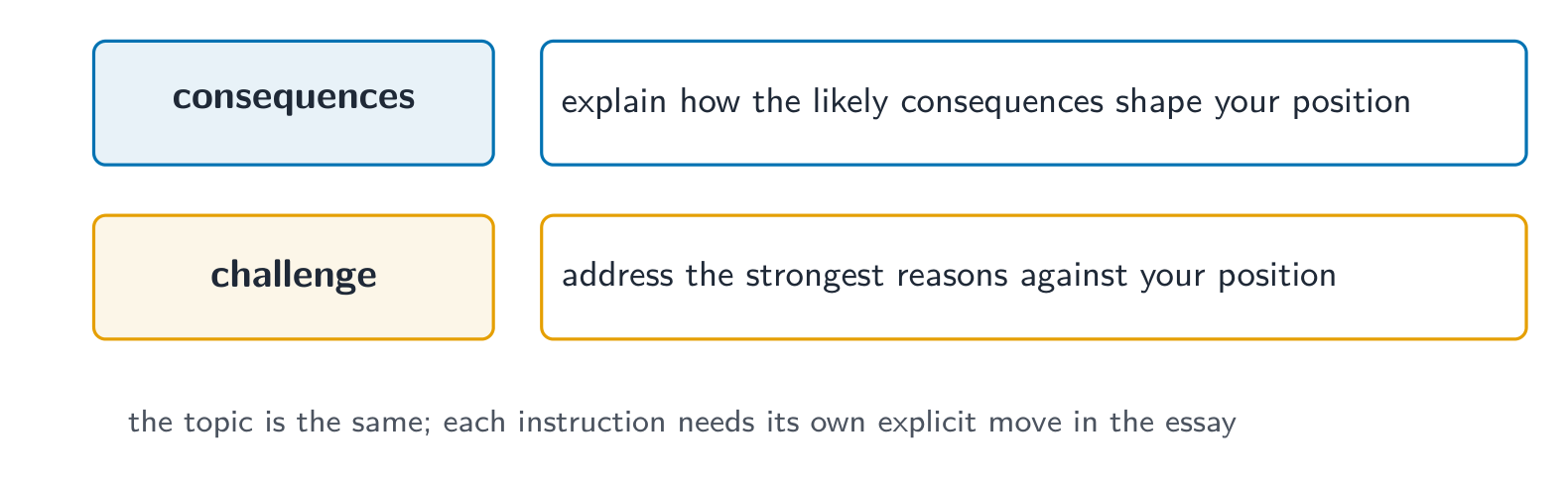
Utilice el tema de la escuela-biblioteca dos veces. Para la instrucción A, describa cómo los efectos moldean su posición. Para la instrucción B, bosqueje una respuesta al desafío más fuerte contra su posición. Mantenga el tema igual pero haga explícitas las dos acciones solicitadas.
Esta es una posible respuesta, no una postura requerida ni una predicción de calificación. Utilice la lista de verificación para revisar su razonamiento.
Separate a claim from the reason offered for it
- Consider this invented argument: “All projects need identical full review because every project has the same risk.” You can reject the stated reason by explaining that projects can differ in their hazards; the proposed policy still needs its own evaluation.
- Rejecting one reason does not automatically disprove its conclusion: another reason might support the same policy. If an instruction asks about both the claim and its rationale, make your judgment on each explicit rather than treating them as one sentence to praise or dismiss.
Match each instruction focus to the response it requires.
Dificultad 2/5 · 140 monedas + un pequeño bono en el primer intento de hoy
The response must do the instruction’s specified job; the topic alone does not determine that job.
Budget time for planning and revision
- One possible practice budget is 4 minutes to plan, 22 to draft and 4 to revise within 30 minutes. Adjust it through timed practice. These are suggested allocations, not official scoring requirements.
- In the plan, identify the instruction, position, main reasons, useful case and strongest challenge. During revision, prioritise a missing task requirement, unsupported leap or contradiction before polishing individual words.
Repair unsupported claims before adding style
- Weak draft: “Review is pointless because it delays 97% of studies.” No evidence has been supplied for that number, and the sentence ignores possible benefits. Confident wording cannot repair either gap.
- Better: “In a clearly low-risk project, lengthy review may delay work without an identified safety benefit. Review should therefore match credible hazards, with an initial assessment to check them.” This states a limited mechanism and retains the opposing concern, without inventing a statistic.
A draft says, “Review is pointless because it delays 97% of studies,” but gives no source. Which revision best repairs the reasoning?
Dificultad 1/5 · 100 monedas + un pequeño bono en el primer intento de hoy
Remove the invented precision, analyse a limited mechanism and address review’s possible purpose. Another invented number or stronger wording does not fix the gap.
Revise for clear relationships
- Replace vague references such as “They are bad because they delay it” with named ideas: “A blanket approval queue can postpone routine tests.” Then explain why that delay matters to your recommendation.
- Use precise ordinary words and sentences whose relationships are easy to follow. Check agreement, complete sentences and unclear pronouns. A longer word or sentence is not automatically more persuasive; the reader must be able to follow the reasoning.
¿Hace que la respuesta realice el movimiento solicitado?
Cada tarjeta indica su instrucción y una respuesta propuesta. Identifique el movimiento realmente realizado o la falta de él.
Select all revisions that directly repair substantive problems in an Issue response.
Dificultad 2/5 · 140 monedas + un pequeño bono en el primer intento de hoy
A missing required move and an internal contradiction directly affect the argument. Extra length or difficult vocabulary does not repair those problems.
Transfer the method to a different issue
- Practice statement: “Schools should keep the library open every evening.” Instruction: discuss possible consequences and explain how they shape your view. One thesis is to extend hours where demand and staffing justify them, rather than require identical hours everywhere.
- A hypothetical school with many students needing quiet study space illustrates an access benefit. A school with very low evening use illustrates a staffing cost with less benefit. Explain why those differences favour a demand-based decision; do not claim that these invented schools establish national usage rates.
Escribe una respuesta de práctica breve para “Las escuelas deberían mantener la biblioteca abierta todas las noches”. Discute posibles consecuencias y explica cómo estas influyen en tu posición. Usa un ejemplo hipotético con honestidad y aborda una limitación relevante. Esta es una mini-respuesta, no un ensayo completo cronometrado.
Esta es una posible respuesta, no una postura requerida ni una predicción de calificación. Utilice la lista de verificación para revisar su razonamiento.
Recap
- Follow the specific instruction, state a defensible position and develop reasons with examples and an explanation of their relevance. Use limits when your reasoning supports them, not as a ritual.
- State serious challenges fairly, evaluate their force and revise as needed. Keep hypothetical cases distinct from facts; revise reasoning, organisation and language before claiming the response is finished.
- qualification: A condition or limit that clarifies the scope of a claim or recommendation.
- counterargument: A reason that challenges a position or the reasoning used to support it.