Las palabras para los números
Introducido| English | Significado |
|---|---|
| factor/ˈfæktə/ | factor |
| integer/ˈɪntɪdʒə/ | número entero |
| rational number/ˈræʃənl ˈnʌmbə/ | número racional |
| irrational number/ɪˈræʃənl ˈnʌmbə/ | número irracional |
| prime number/praɪm ˈnʌmbə/ | número primo |
| significant figures/sɪɡˈnɪfɪkənt ˈfɪɡəz/ | cifras significativas |
| highest common factor/ˈhaɪɪst ˈkɒmən ˈfæktə/ | máximo factor común |
| lowest common multiple/ˈləʊɪst ˈkɒmən ˈmʌltɪpl/ | mínimo común múltiplo |
Explain a number as well as calculate it
- A factor 因数 divides a number exactly; a multiple is obtained by multiplying it by an integer. Naming the relationship helps another person check a calculation.
- A terminology logbook can combine a definition and example.
Distinguish number families
- An integer 整数 includes zero and negative whole numbers. A rational number 有理数 is a ratio of integers with a nonzero denominator; an irrational number 无理数 cannot be written that way.
- A prime number 质数 is a positive integer greater than 1 with exactly two positive factors. A terminating or eventually repeating decimal is rational; an irrational decimal neither terminates nor eventually repeats.
Ordena cada número en su familia correspondiente
Indica a qué familia pertenece un número y por qué.
¿Por qué 1 no es un número primo?
Dificultad 1/5 · 100 monedas + un pequeño bono en el primer intento de hoy
Un primo es un entero positivo mayor que 1 con exactamente dos factores positivos. El número 1 tiene solo un factor positivo.
Empareja cada término con su definición.
Dificultad 2/5 · 140 monedas + un pequeño bono en el primer intento de hoy
Use definiciones precisas; una aproximación finita mostrada no establece si el número exacto subyacente es racional.
Work through operations in order
- Calculate brackets and powers first. Multiplication and division share a level and go left to right; addition and subtraction share the next level.
- In $18-3(4-7)$ the bracket is negative 3, so the product is negative 9. Subtracting that negative gives 27, not 9.
Evalúa 5 + 3 × 2² − 4.
Dificultad 2/5 · 140 monedas + un pequeño bono en el primer intento de hoy
Primero los exponentes (2² = 4), luego la multiplicación (3 × 4 = 12), y de izquierda a derecha: 5 + 12 − 4 = 13.
Keep the percentage base visible
- Increase by 15% uses multiplier 1.15; decrease by 15% uses 0.85. Reverse a change by dividing by its multiplier.
- Significant figures 有效数字 state retained precision, not proof of measurement accuracy. $0.004072$ becomes $0.00407$ to three significant figures; keep unrounded values for intermediate steps.
Un precio de 240 aumenta un 15%, luego el nuevo precio disminuye un 15%. ¿Cuál es el precio final?
Dificultad 2/5 · 140 monedas + un pequeño bono en el primer intento de hoy
240 × 1.15 = 276, luego 276 × 0.85 = 234.60. Los dos porcentajes actúan sobre cantidades diferentes, por lo que no se vuelve a 240.
Escribe 0.004072 con tres cifras significativas.
Dificultad 1/5 · 100 monedas + un pequeño bono en el primer intento de hoy
Las cifras significativas comienzan en el primer dígito distinto de cero, así que 4, 0 y 7 son las tres. Los ceros iniciales solo fijan la magnitud.
Un precio que aumenta un 20% y luego disminuye un 20% vuelve a su valor original.
Dificultad 1/5 · 100 monedas + un pequeño bono en el primer intento de hoy
Disminuye al 96% del original: 1.20 × 0.80 = 0.96. El segundo porcentaje actúa sobre la cantidad mayor.
Encuentra el mínimo común múltiplo de 24 y 36.
Dificultad 2/5 · 140 monedas + un pequeño bono en el primer intento de hoy
24 = 2³ × 3 y 36 = 2² × 3². Toma la potencia mayor de cada primo: 2³ × 3² = 72.
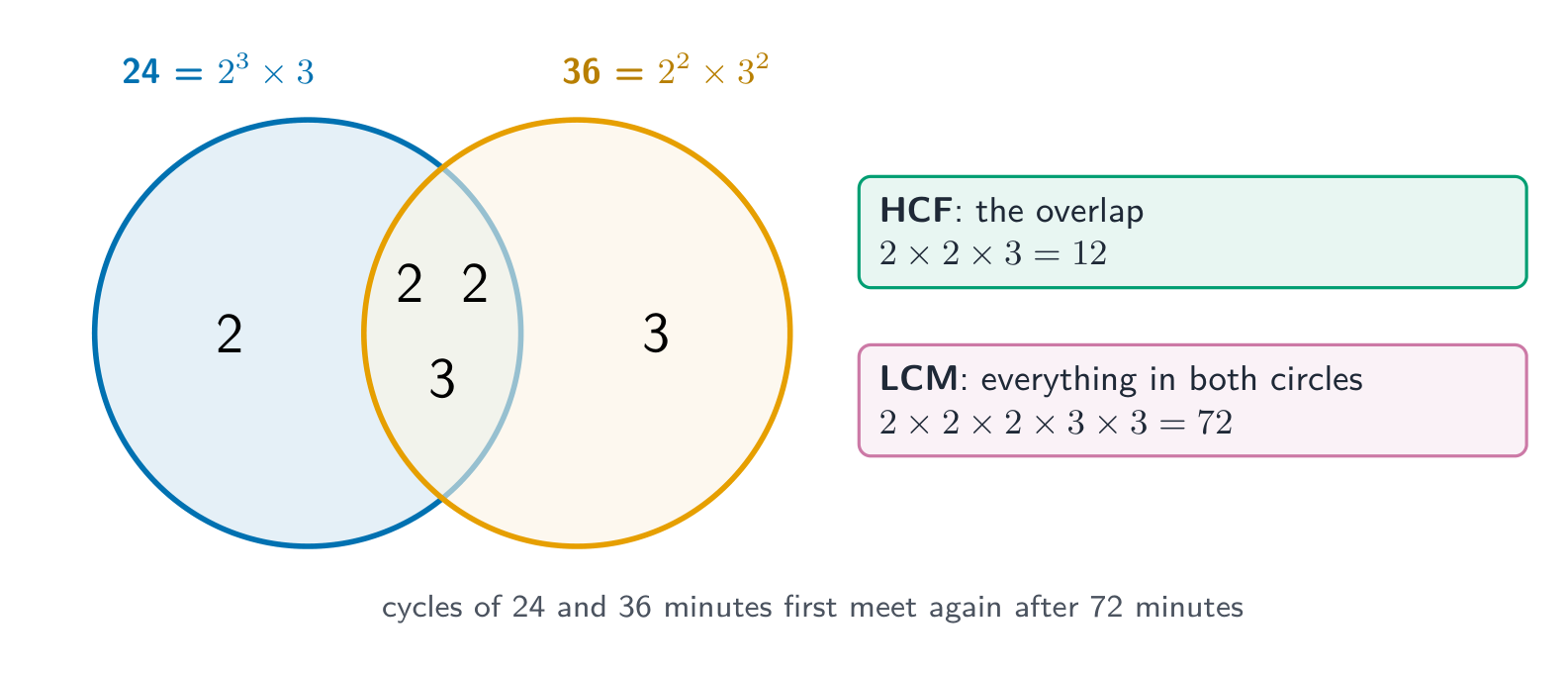
Factors connect with repeating schedules. For positive integers 24 and 36, $24=2^3\times3$ and $36=2^2\times3^2$. The highest common factor 最大公因数 uses the shared lower powers, giving 12. The lowest common multiple 最小公倍数 uses the highest powers needed, giving 72. Two cycles of 24 and 36 minutes next coincide after 72 minutes.
- Number families: integers include zero and negatives; a rational number is a ratio of integers, and an irrational number cannot be written that way.
- Order of operations: brackets and powers first, then multiplication and division left to right: $18-3(4-7)=27$.
- Percentage base: multiply by 1.15 to increase by 15%; reverse a change by dividing by its multiplier.
- HCF and LCM: shared lower powers give the HCF, the highest powers give the LCM.
A 20% fall followed by a 20% rise multiplies by $0.8\times1.2=0.96$. The second percentage uses a different base. Name that base before deciding whether two changes cancel.