Comparar puntos de vista en un seminario de decisión pública
IntroducidoThe same proposal can serve different priorities
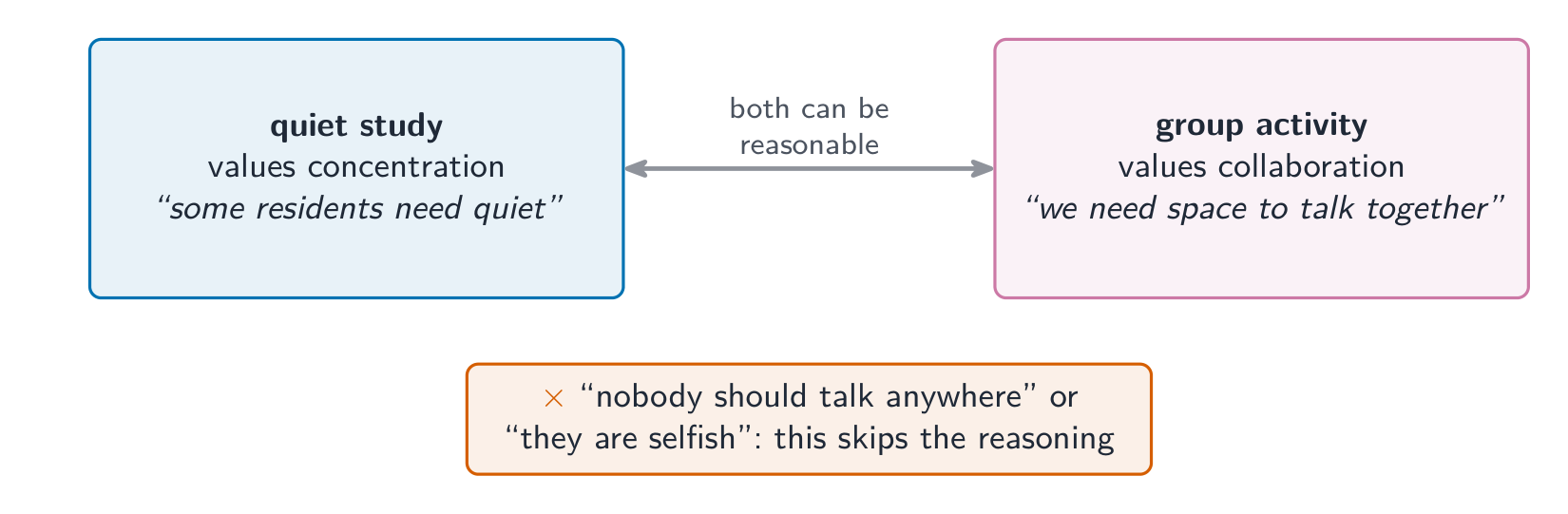
- A fictional neighbourhood hall must choose how to use one spare room. A quiet-study proposal values concentration; a group-activity proposal values collaboration. Calling one group “selfish” skips the task of examining evidence and competing priorities.
- This GAC014-aligned policy-discussion lesson uses a neutral local planning scenario. It makes no claims about real political institutions or current events. Printed contributions and partner rehearsal support argument analysis; reviewed audio remains a separate need.
Represent each view before judging it
- Read each contribution and note desired outcome, support and remaining question. To represent a position fairly, use words its speaker could recognise. Do not change “some residents need quiet” into “nobody should talk anywhere.”
- A vote can inform a decision, but who took part matters. The example’s voluntary survey is not a representative census. Keep participation and the number selecting each option visible when presenting it.
Chair: Thirty residents voluntarily answered our fictional room survey. Eighteen preferred quiet study; twelve preferred group activities. Speaker A: Quiet access matters to residents without a calm space at home. These answers suggest demand, but they may miss people who did not respond. Speaker B: Group projects also need space. We could try scheduled uses, although sound and setup time may make switching difficult. Chair: We have not measured room demand by time of day, so let us compare possible schedules before committing.
¿Cuántos encuestados prefirieron actividades grupales?
Dificultad 2/5 · 140 monedas + un pequeño bono en el primer intento de hoy
La encuesta ficticia indica que doce prefirieron actividades grupales.
Distinguish a value from an empirical claim
- “Quiet access matters” states a priority. “Eighteen respondents selected quiet study” states an observed count. Both can matter, but they need different support. A count cannot by itself settle how much weight to give access needs.
- “Switching may be difficult” raises a possibility, not a measured failure. Ask what observation could test it: sound levels, setup time or actual use during a trial. Do not report the proposed schedule as already adopted.
Una encuesta voluntaria puede no representar a los residentes que optaron por no responder.
Dificultad 1/5 · 100 monedas + un pequeño bono en el primer intento de hoy
Verdadero. Los no respondientes pueden tener necesidades diferentes, por lo que la muestra no queda establecida como representativa de todos los residentes.
¿Qué afirmación expresa una prioridad en lugar de un conteo medido?
Dificultad 1/5 · 100 monedas + un pequeño bono en el primer intento de hoy
Identifica un valor; los otros dos describen conteos de encuesta observados.
Disagree while keeping the discussion useful
- Begin by restating the point: “You want access for people without a quiet room.” Then add your concern and a question: “How could we also provide group time?” This opens a decision problem without assigning bad motives.
- Use a turn-taking rule in a four-person rehearsal: chair invites each view, participants ask one clarifying question, then compare options. Each person can pass on speaking; silence should not be counted as agreement or opposition.
Compare options against explicit criteria
- Consider quiet-only, group-only and a trial schedule. Compare access, noise, setup effort and observable demand. The exercise has no single compulsory policy winner. A reasonable recommendation identifies the priority it serves and the cost it leaves unresolved.
- Give a one-minute recommendation with a proposed evaluation point. For example, test a schedule and record use by time slot before a final decision. Do not claim the voluntary survey guarantees equal access or represents every resident.
¿CUÁLES DOS preguntas podrían informar un cronograma de ensayo?
Dificultad 2/5 · 140 monedas + un pequeño bono en el primer intento de hoy
El esfuerzo de configuración y la demanda específica por hora son brechas de evidencia práctica relevantes.
Produce an accurate seminar record
- Summarise each viewpoint, the survey’s scope, the suggested trial and the unresolved practical questions. Mark decisions separately from suggestions. The chair asked for comparisons; the script does not show that a final schedule was approved.
- Ask another participant whether your record represents their contribution fairly. Correct any misstatement before sharing the classroom notes. Good academic discussion allows disagreement while preserving what people actually said.
Eighteen of thirty survey respondents preferred quiet study, but participation was voluntary. A trial schedule could explore both needs; room demand by time of day and switching effort remain unknown.
A majority of voluntary respondents is not automatically a majority of all residents, and a suggestion is not a decision.
Compare viewpoints fairly, distinguish values from measurements, and record both decisions and unresolved questions.
¿Qué decisión registra el guion?
Dificultad 1/5 · 100 monedas + un pequeño bono en el primer intento de hoy
El presidente solicita mayor comparación; no se adopta ninguna opción final.