Building a paragraph
Introducido| English | Significado |
|---|---|
| supporting sentences/səˈpɔːtɪŋ ˈsentənsɪz/ | oraciones de apoyo |
| concluding sentence/kənˈkluːdɪŋ ˈsentəns/ | the final sentence of a paragraph that sums up its point |
| unity/ˈjuːnɪti/ | unidad |
| cohesion/kəʊˈhiːʒn/ | cohesión |
Rules for the paragraph, 1866
- In 1866 the Scottish philosopher Alexander Bain published English Composition and Rhetoric. He set out rules for the paragraph that teachers still use: one main subject, stated near the start, with every sentence serving it.
- A strong paragraph has a topic sentence, supporting sentences 支撑句 and a concluding sentence 结论句, held together by unity 统一性 and cohesion 衔接.
What was Bain's main rule for a paragraph?
Dificultad 1/5 · 100 monedas + un pequeño bono en el primer intento de hoy
Unity of subject.
Topic and support
- The topic sentence states the main point. Supporting sentences give reasons, examples, facts or explanation.
- Each supporting sentence should answer "how?" or "why?" about the topic sentence.
Which sentence supports "Studying abroad builds independence"?
Dificultad 1/5 · 100 monedas + un pequeño bono en el primer intento de hoy
It answers how.
Unity
- Unity means every sentence is about the main point. A sentence on a different subject — however interesting — belongs in another paragraph.
- Test each sentence: does it support the topic sentence?
An interesting sentence on a different subject keeps the paragraph's unity.
Dificultad 1/5 · 100 monedas + un pequeño bono en el primer intento de hoy
Move it to another paragraph.
Cohesion
- Cohesion links sentences: pronouns (it, this), repeated key words, and connectives (first, however, as a result).
- "This change" points back to the previous sentence; the reader follows the thread.
Which are cohesive devices?
Dificultad 2/5 · 140 monedas + un pequeño bono en el primer intento de hoy
They link sentences.
Worked example: a field-trip notice
Topic: The field trip on Friday starts early, so please arrive on time.
- Support: Meet the group at the main gate at 08:10. The coach departs at 08:20 and cannot wait for latecomers.
- Condition: If heavy rain closes the boardwalk, we will hold an indoor workshop instead; the visit is not cancelled.
- Conclusion: Please arrive by 08:10 whatever the weather.
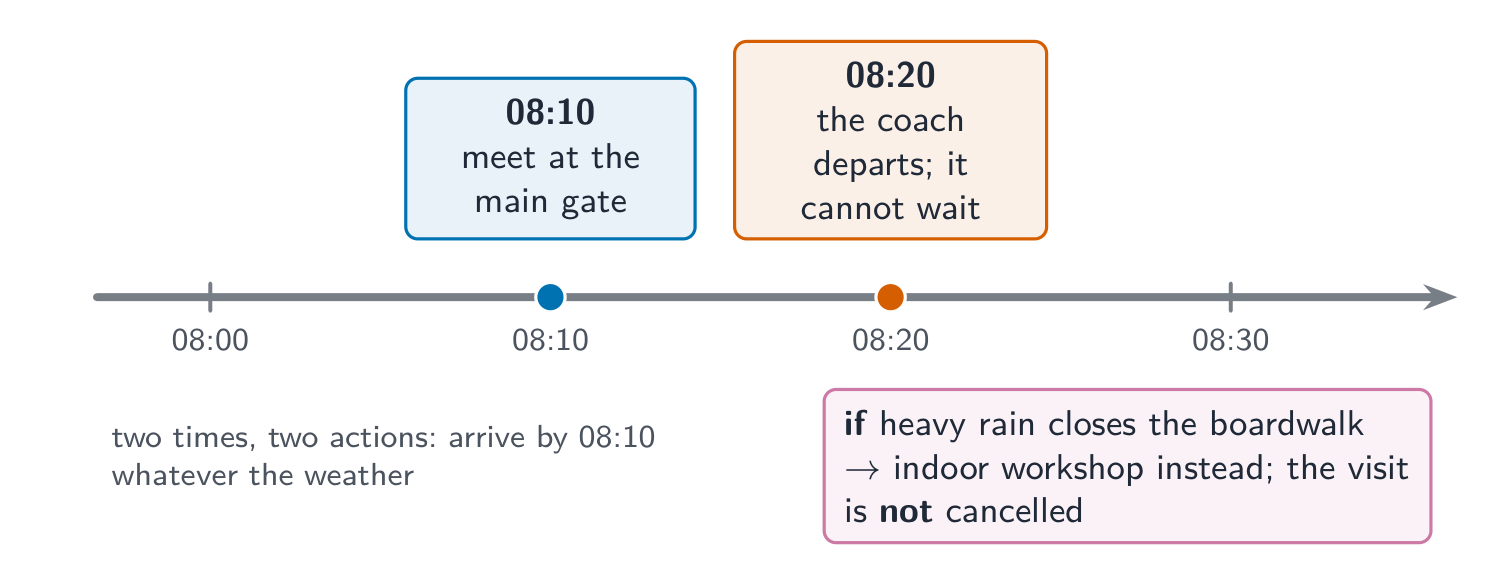
Match each time in the notice to its action.
Dificultad 2/5 · 140 monedas + un pequeño bono en el primer intento de hoy
Two different actions.
How many minutes are there between meeting and departure?
Dificultad 2/5 · 140 monedas + un pequeño bono en el primer intento de hoy
08:20 − 08:10.
Concluding sentences
- A concluding sentence sums up or gives the result of the paragraph, often with "so", "therefore" or "overall".
- It should not add a new main idea.
A concluding sentence should introduce a new main idea.
Dificultad 1/5 · 100 monedas + un pequeño bono en el primer intento de hoy
It sums up.
Do not merge two times into one. "The trip is at 08:10" hides two actions: meeting at 08:10 and departure at 08:20. Give each time its own action.
Open with a topic sentence, support it with reasons and details, keep unity by cutting off-topic sentences, link with cohesive devices, and close without new ideas.
Write a five-sentence paragraph telling classmates about a library workshop, with a topic sentence, support, a condition and a conclusion.
Paragraph structure.