Contribuir a una discusión
Introducido| English | Significado |
|---|---|
| evidence/ˈevɪdəns/ | evidencia |
| support a claim/səˈpɔːt ə kleɪm/ | respaldar una afirmación |
| consensus/kənˈsensəs/ | consenso |
Answer the group’s actual question
- A group task may ask you to compare choices, agree on a recommendation or identify an unresolved concern. Check which response is required before preparing an opinion.
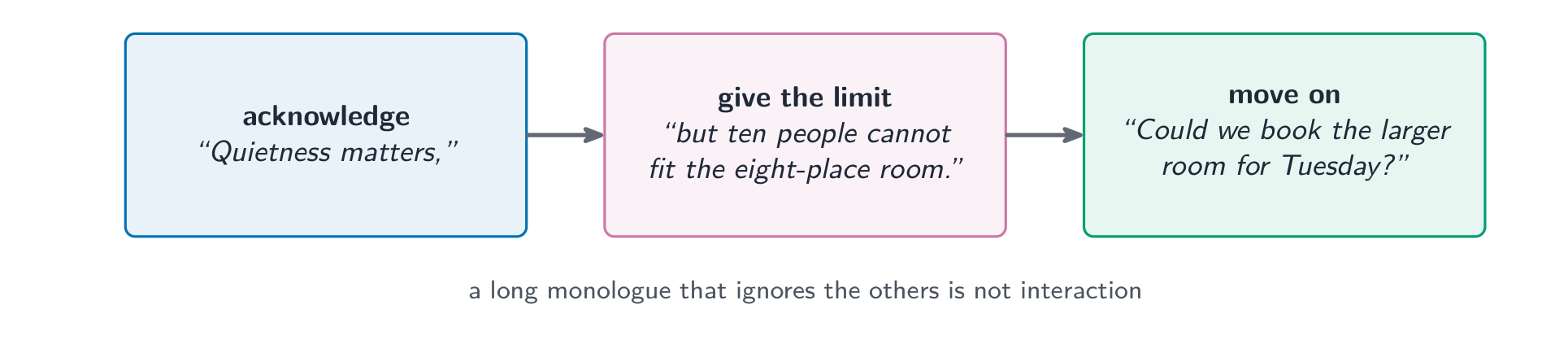
- Interaction includes listening and responding. A long monologue or a fixed speaking schedule does not by itself show a useful contribution or establish a mark.
Disagree with a reason
- Acknowledge the relevant point, then explain the limit: “Quietness matters, but ten people cannot fit the eight-place room.” Respectful disagreement can advance a decision.
- Do not treat a classmate’s concern as a personal fault. Ask a specific question if the evidence or intended meaning is unclear.
¿Qué desacuerdo mantiene viva la discusión?
Dificultad 1/5 · 100 monedas + un pequeño bono en el primer intento de hoy
Concede algo y luego restringe la afirmación, lo que le da al otro hablante un punto desde el cual continuar.
Support a claim at the right strength
- Support a claim 支持观点 with a reason and relevant evidence 证据. One person’s experience can illustrate an issue without proving what everybody prefers.
- Explain how the evidence bears on the task. A twelve-place room answers a ten-person capacity constraint; “everyone likes it” needs different evidence.
¿Cuál de estos es un argumento en lugar de una opinión?
Dificultad 1/5 · 100 monedas + un pequeño bono en el primer intento de hoy
Da una razón y un ejemplo concreto. Los demás afirman sin apoyo.
Keep a recommendation distinct from permission
- A consensus 共识 is an agreement the group accepts. Check it explicitly; silence, a draft preference or an unanswered proposal is not a confirmed group decision.
- State remaining checks: the exact meeting time or booking permission may still be pending. An available room is not automatically a completed booking.
Ordena una intervención sólida.
Dificultad 3/5 · 200 monedas + un pequeño bono en el primer intento de hoy
El último paso es lo que diferencia un discurso de una intervención en una discusión.
Invite, respond and record
- Refer to what another student said and invite a meaningful response: “Dan, would this option address your concern?” Respond to the answer instead of returning to an unrelated script.
- Summarise the proposed decision, reasons and unresolved checks, then ask whether the group agrees. Record an objection honestly rather than reporting agreement that was never confirmed.
Hablar durante la mayor parte de una discusión grupal garantiza interacción útil.
Dificultad 1/5 · 100 monedas + un pequeño bono en el primer intento de hoy
La cantidad de habla sola no muestra escucha, respuestas relevantes o espacio para otros. Revise la calidad y el propósito de las contribuciones.
¿Cuáles de estas intervenciones incluyen a otro estudiante en la discusión? Selecciona todas las que correspondan.
Dificultad 2/5 · 140 monedas + un pequeño bono en el primer intento de hoy
Refiérase a un punto relevante de un compañero y pida una respuesta significativa. Un nombre solo no demuestra escucha; responda a lo que realmente dicen.
Escribe una frase que resuma la decisión del grupo y verifique que todos están de acuerdo.
Dificultad 3/5 · 200 monedas + un pequeño bono en el primer intento de hoy
Ejemplo: "Entonces, acordamos el teléfono, con el portátil en segundo lugar — ¿verdad?" Resume y luego verifica.
A useful contribution responds to the task and other speakers. Check group agreement and pending permission before recording a decision.
Contribution: “The library is quiet, but it has eight places for ten people. Could we recommend classroom 204 and check the booking steps? Dan, would that address your concern?” This proposes a choice without inventing consensus or a booking.