Past perfect — the past before the past · Pasado perfecto — el pasado antes del pasado
Which happened first?
- The past perfect is for an action that happened before another past action.
- When I arrived, the train had already left.
- It puts two past events in order.
By the time I reached the station, the train had started its own adventure.
¿Qué ocurrió primero?
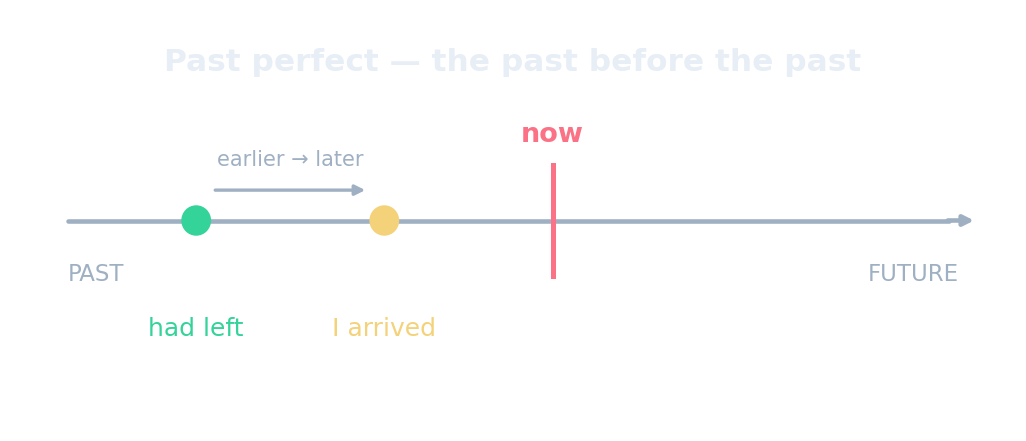
- El pasado perfecto se usa para una acción que ocurrió antes de otra acción pasada.
- When I arrived, the train had already left. (Cuando llegué, el tren ya se había ido).
- Sirve para ordenar dos eventos en el pasado.
By the time I reached the station, the train had started its own adventure. (Para cuando llegué a la estación, el tren ya había iniciado su propia aventura).
Form: had + past participle
- had + past participle, the same for every subject.
- I had finished. She had gone. They had eaten.
- Short form: I'd, she'd, they'd.
Forma: had + past participle
- had + past participle, igual para todos los sujetos.
- I had finished. She had gone. They had eaten. (Yo había terminado. Ella se había ido. Ellos habían comido).
- Forma abreviada: I'd, she'd, they'd.
Complete: When we got home, the guests had already ___ (leave). · Completa: When we got home, the guests had already ___ (leave).
had + past participle: leave → left. · had + participio pasado: leave → left.
Which happened first?
- The earlier action → past perfect (had done).
- The later action → past simple (did).
- The film had started when we arrived. (started first)
¿Qué ocurrió primero?
- La acción anterior → pasado perfecto (had done).
- La acción posterior → pasado simple (did).
- The film had started when we arrived. (La película había empezado cuando llegamos). (Empezó primero).
Two past events, in order · Dos eventos pasados, en orden
The earlier action takes the past perfect; the later one takes the past simple. · La acción anterior toma el pasado perfecto; la posterior toma el pasado simple.
Which happened FIRST? “When I arrived, the train had left.” · ¿Qué ocurrió PRIMERO? “When I arrived, the train had left.”
“had left” (past perfect) is the earlier action — it happened first. · “had left” (pasado perfecto) es la acción anterior: ocurrió primero.
Does the past perfect show the EARLIER of two past actions? · ¿El pasado perfecto indica la ACCIÓN ANTERIOR entre dos acciones pasadas?
Yes — past perfect (had + p.p.) = the action that happened first. · Sí — pasado perfecto (had + p.p.) = la acción que ocurrió primero.
Translate into English: 我到的时候,火车已经开走了。 · Traduce al inglés: 我到的时候,火车已经开走了。
Earlier action → past perfect: “When I arrived, the train had left.” · Acción anterior → pasado perfecto: “When I arrived, the train had left.”
When you need it
- Use it when the order matters or could be confusing.
- A simple story in order can stay in the past simple.
Cuándo usarlo
- Úsalo cuando el orden sea importante o pueda ser confuso.
- Una historia simple narrada cronológicamente puede permanecer en pasado simple.
Common mistakes
- ❌ After he had left, I had cleaned the room. → only the earlier action takes had.
- ❌ I had seen this film. (no other past event) → ✓ I have seen this film.
- by the time + past simple → the other action usually takes the past perfect.
Errores comunes
- ❌ After he had left, I had cleaned the room. → solo la acción anterior lleva had.
- ❌ I had seen this film. (sin otro evento pasado) → ✓ I have seen this film.
- by the time + pasado simple → la otra acción generalmente toma el pasado perfecto.
By the time we arrived, the film ___ .
The start came before our arrival — earlier of two past events → past perfect. · El inicio ocurrió antes de nuestra llegada — anterior de dos eventos pasados → pasado perfecto.
Two past actions told in the order they happened — do you NEED the past perfect? · Dos acciones pasadas narradas en el orden en que ocurrieron — ¿NECESITAS el pasado perfecto?
No — in-order stories use the past simple. The past perfect is for jumping back. · No — las historias en orden usan el pasado simple. El pasado perfecto es para retroceder.
- Past perfect = had + past participle = the past before the past.
- Earlier action → past perfect; later action → past simple.
- Use it when the order of two past events matters.
- Pasado perfecto = had + past participle = el pasado antes del pasado.
- Acción anterior → pasado perfecto; acción posterior → pasado simple.
- Úsalo cuando el orden de dos eventos pasados sea relevante.
Write one sentence about two past events, using the past perfect for the one that happened first. · Escribe una oración sobre dos eventos pasados, usando el pasado perfecto para aquel que ocurrió primero.
Example: “The class had started when I arrived.” · Ejemplo: “The class had started when I arrived.”