Competition and labour
Introducido| English | Significado |
|---|---|
| labour demand/ˈleɪbə dɪˈmænd/ | demanda de mano de obra |
| monopoly/məˈnɒpəli/ | monopolio |
Lorry drivers wanted, 2021
- In 2021 Britain ran short of lorry drivers: many had left the country or retired, and testing had stopped during lockdown. Some haulage firms offered pay rises of over 20% and joining bonuses to attract drivers.
- Wages are prices too, set by demand and supply in labour markets.
Labour demand
- Labour demand 劳动力需求 is the number of workers firms want to hire at each wage.
- It comes from demand for what workers make: more houses being built means more demand for electricians.
Why did demand for lorry drivers rise when online shopping grew?
Dificultad 1/5 · 100 monedas + un pequeño bono en el primer intento de hoy
Labour demand comes from product demand.
Labour supply
- Labour supply is the number of people willing and able to work in a job at each wage.
- It depends on the skills needed, training time, working conditions and wages in other jobs.
Which reduce the supply of workers for a job?
Dificultad 2/5 · 140 monedas + un pequeño bono en el primer intento de hoy
A wage rise is a movement along supply.
Worked example: electricians
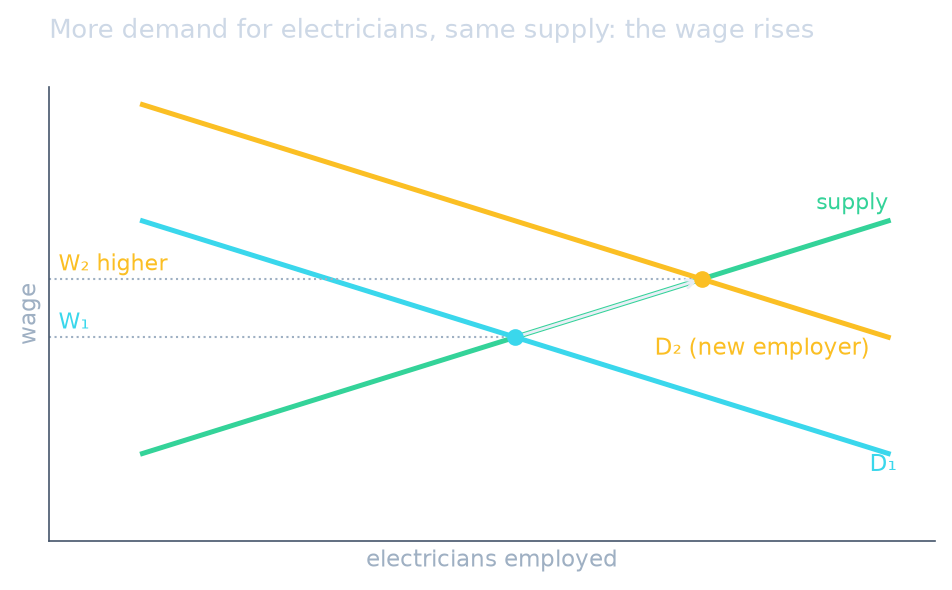
At 200 yuan a day, 100 electricians are wanted and 100 are available. A boom in solar-panel fitting raises demand: at 200 yuan, firms now want 130.
- At the old wage: a shortage of $130 - 100 = 30$ electricians.
- Firms compete: they offer more, and the wage rises — say to 230 yuan.
- New equilibrium: the higher wage draws more people into the trade, and more electricians (say 115) are hired.
At a wage of 150 yuan a day, firms want 80 workers but only 60 are available. What is the shortage?
Dificultad 2/5 · 140 monedas + un pequeño bono en el primer intento de hoy
80 − 60.
Demand for nurses rises while supply is unchanged. What happens?
Dificultad 1/5 · 100 monedas + un pequeño bono en el primer intento de hoy
Demand shifts right.
Competitive markets
- In a competitive market many firms sell similar products. Prices are kept down, and firms that are inefficient lose customers.
- Consumers gain choice, low prices and new ideas.
Monopoly
- A monopoly 垄断 is a market with one dominant seller. For much of the 20th century, the De Beers group controlled most of the world's sales of rough diamonds.
- A monopoly can charge higher prices and offer less choice, but it may also fund large research.
Which is a likely effect of monopoly compared with competition?
Dificultad 1/5 · 100 monedas + un pequeño bono en el primer intento de hoy
One dominant seller.
A rise in wages does not shift labour demand. A higher wage moves firms along their demand curve to hire fewer workers. Demand shifts only when something else changes, such as demand for the product.
A rise in the wage shifts the labour demand curve to the left.
Dificultad 1/5 · 100 monedas + un pequeño bono en el primer intento de hoy
It is a movement along the curve.
Wages are set by labour demand and supply. Demand for workers rises when demand for their products rises. Competition keeps prices low and choice wide; a monopoly can raise prices and limit choice.
Use labour demand and supply to explain why lorry drivers' wages rose in Britain in 2021.
Labour market.