Trade and comparative advantage
Introducido| English | Significado |
|---|---|
| comparative advantage/kəmˈpærətɪv ədˈvæntɪdʒ/ | ventaja comparativa |
| absolute advantage/ˈæbsəluːt ədˈvæntɪdʒ/ | The ability to produce more output with the same resources, or the same output with fewer resources, than another producer. |
| opportunity cost/ɒpəˈtjuːnɪti kɒst/ | The value of the best alternative forgone when a choice is made. |
| infant industries/ˈɪnfənt ˈɪndʌstriz/ | New industries that may need protection until they can compete with foreign firms. |
| current account/ˈkʌrənt əˈkaʊnt/ | cuenta corriente |
The world's factory
- When China joined the World Trade Organization in 2001, it made about 4% of world exports. By 2020 it made about 15%.
- In 2018 the US put tariffs on hundreds of billions of dollars of Chinese goods, and China answered with its own.
- Why do countries trade — and why do they sometimes restrict it?
Absolute and comparative advantage
- A country has an absolute advantage when it can make a good with fewer resources.
- It has a comparative advantage 比较优势 when it can make a good at a lower opportunity cost — giving up less of other goods. David Ricardo showed in 1817 that trade by comparative advantage benefits both sides.
A country with an absolute advantage in every good cannot gain from trade.
Dificultad 1/5 · 100 monedas + un pequeño bono en el primer intento de hoy
It still gains by specialising in its comparative advantage.
Worked example: who should make what?
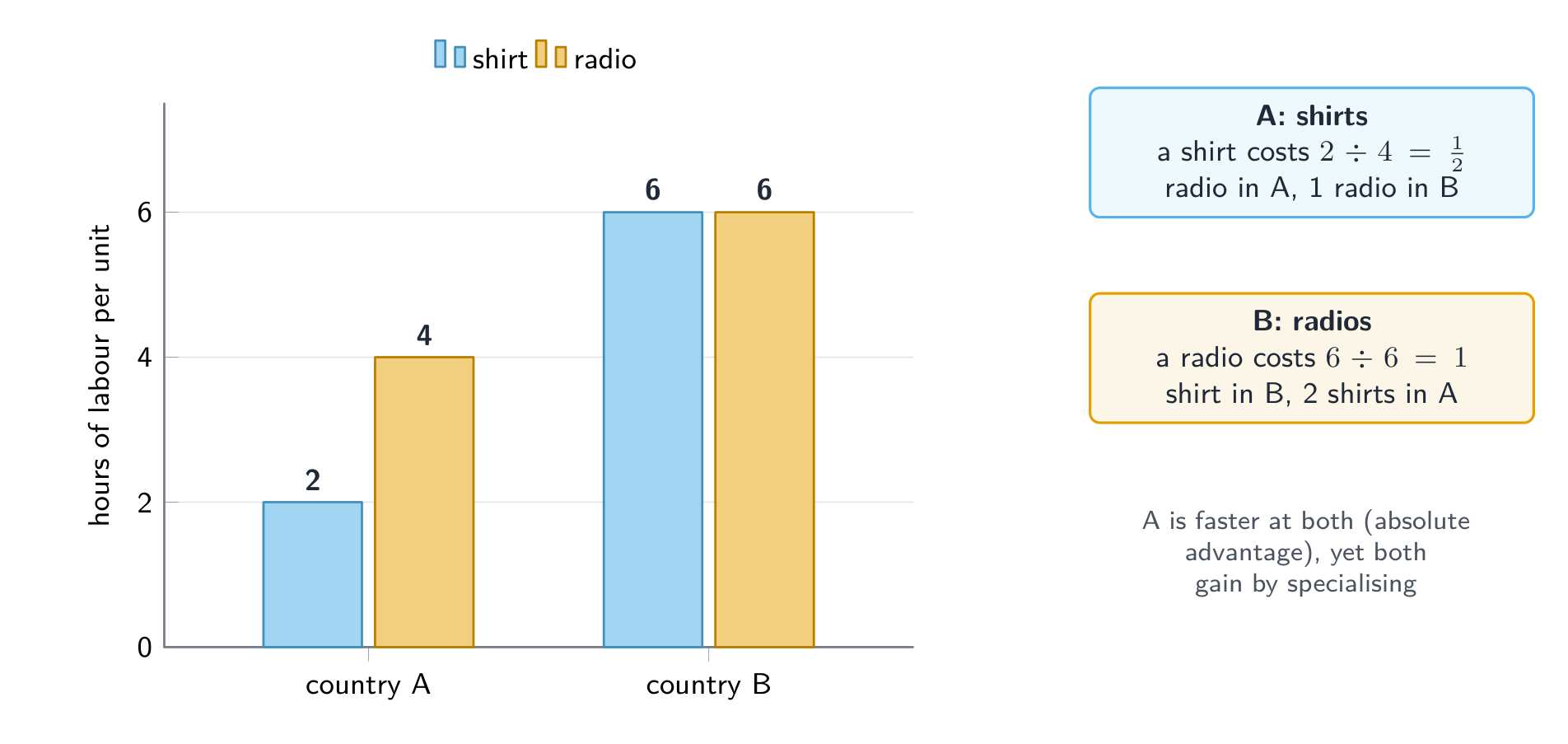
Country A needs 2 hours for a shirt and 4 for a radio. Country B needs 6 hours for each.
- A has the absolute advantage in both goods.
- Opportunity cost of a radio: in A, $\dfrac{4}{2} = 2$ shirts; in B, $\dfrac{6}{6} = 1$ shirt. B has the comparative advantage in radios.
- Of a shirt: in A, $\dfrac{1}{2}$ radio; in B, 1 radio. A has the comparative advantage in shirts. If each specialises and trades, total output rises.
Faster at both but cheaper at one
A needs 2 hours per shirt and 4 per radio; B needs 6 and 6. A has the absolute advantage in both, but in A a radio costs 2 shirts and in B only 1, so B has the comparative advantage in radios and A in shirts (half a radio against one).
Country X needs 3 hours for a bag of rice and 9 hours for a bicycle. What is the opportunity cost of a bicycle, in bags of rice?
Dificultad 2/5 · 140 monedas + un pequeño bono en el primer intento de hoy
$\dfrac{9}{3} = 3$.
Country Y needs 4 hours for rice and 8 for a bicycle. Compared with X (3 and 9), which has the comparative advantage in bicycles?
Dificultad 1/5 · 100 monedas + un pequeño bono en el primer intento de hoy
Y gives up less rice for each bicycle.
Protectionism
- Tariffs (taxes on imports), quotas (limits on quantity), subsidies to domestic firms and rules that favour local producers.
- Reasons: to protect infant industries until they can compete, to save jobs, for national security, or against dumping.
Match each tool to its description.
Dificultad 2/5 · 140 monedas + un pequeño bono en el primer intento de hoy
All three protect domestic firms.
What is the infant-industry argument?
Dificultad 1/5 · 100 monedas + un pequeño bono en el primer intento de hoy
The protection should end once the industry can compete.
Costs of protection
- Consumers pay higher prices and have less choice; firms that use imported inputs face higher costs.
- Other countries may retaliate, as in 2018–2019, so exporters lose too. Protected firms may never become efficient.
Which are costs of protectionism?
Dificultad 2/5 · 140 monedas + un pequeño bono en el primer intento de hoy
Protection reduces choice.
Trade and the current account
- Exports and imports of goods and services make up most of the current account 经常账户.
- Protection may cut imports for a while, but if trading partners retaliate, exports fall too.
A country that is better at everything still gains from trade. What matters is opportunity cost, not absolute efficiency. Country A in the example gains by making shirts and buying radios from B, even though A could make radios faster.
Comparative advantage — lower opportunity cost — is the basis for gains from trade, even when one country has an absolute advantage in everything. Protection can help infant industries or jobs, but raises prices, cuts choice and invites retaliation.
Evaluate the use of tariffs to protect domestic jobs.
Count jobs saved and jobs lost.