Information gaps and adverse selection
Introducido| English | Significado |
|---|---|
| asymmetric information/ˌeɪsɪˈmetrɪk ˌɪnfəˈmeɪʃn/ | información asimétrica |
| symmetric information | When buyers and sellers know the same facts about a good. |
| adverse selection/ædˈvɜːs sɪˈlekʃn/ | selección adversa |
A market for lemons
- In 1970 the economist George Akerlof asked why good used cars sell for so little. In America a bad used car is called a "lemon".
- Sellers know whether their car is good; buyers cannot tell. So buyers pay only an average price — and good cars leave the market.
- Akerlof won the Nobel Prize in 2001 for showing how missing information can break a market.
Symmetric and asymmetric information
- With symmetric information 对称信息, buyers and sellers know the same things.
- With asymmetric information 信息不对称, one side knows more. Used-car sellers know more than buyers; patients know less than doctors.
- An information gap leads people to make choices they would not make with full information — a market failure.
Which is an example of asymmetric information?
Dificultad 1/5 · 100 monedas + un pequeño bono en el primer intento de hoy
One side knows more than the other about the good.
Worked example: good cars disappear
Half the used cars are good (worth ¥100,000) and half are lemons (worth ¥40,000). Buyers cannot tell which is which.
- Buyers' offer: the average value, $\tfrac{1}{2}(100\,000) + \tfrac{1}{2}(40\,000) = ¥70\,000$.
- Good-car owners refuse: ¥70,000 is below their car's value of ¥100,000, so they keep it.
- Result: only lemons remain, so buyers soon offer only ¥40,000. Trades that would benefit both sides never happen.
60% of used bikes are good (worth ¥1000) and 40% are poor (worth ¥500). Buyers cannot tell them apart. What is the average value buyers will offer?
Dificultad 2/5 · 140 monedas + un pequeño bono en el primer intento de hoy
$0.6 \times 1000 + 0.4 \times 500 = 600 + 200 = ¥800$.
At that offer, which sellers leave the market?
Dificultad 1/5 · 100 monedas + un pequeño bono en el primer intento de hoy
Good bikes are worth ¥1000, so their owners refuse ¥800. The average quality falls.
Adverse selection in insurance
- Adverse selection 逆向选择: when one side has hidden information before a deal, the wrong people are drawn into the market.
- Health insurance: people who know they are unwell are the most eager to buy. The insurer must raise premiums, healthy people leave, and premiums rise again.
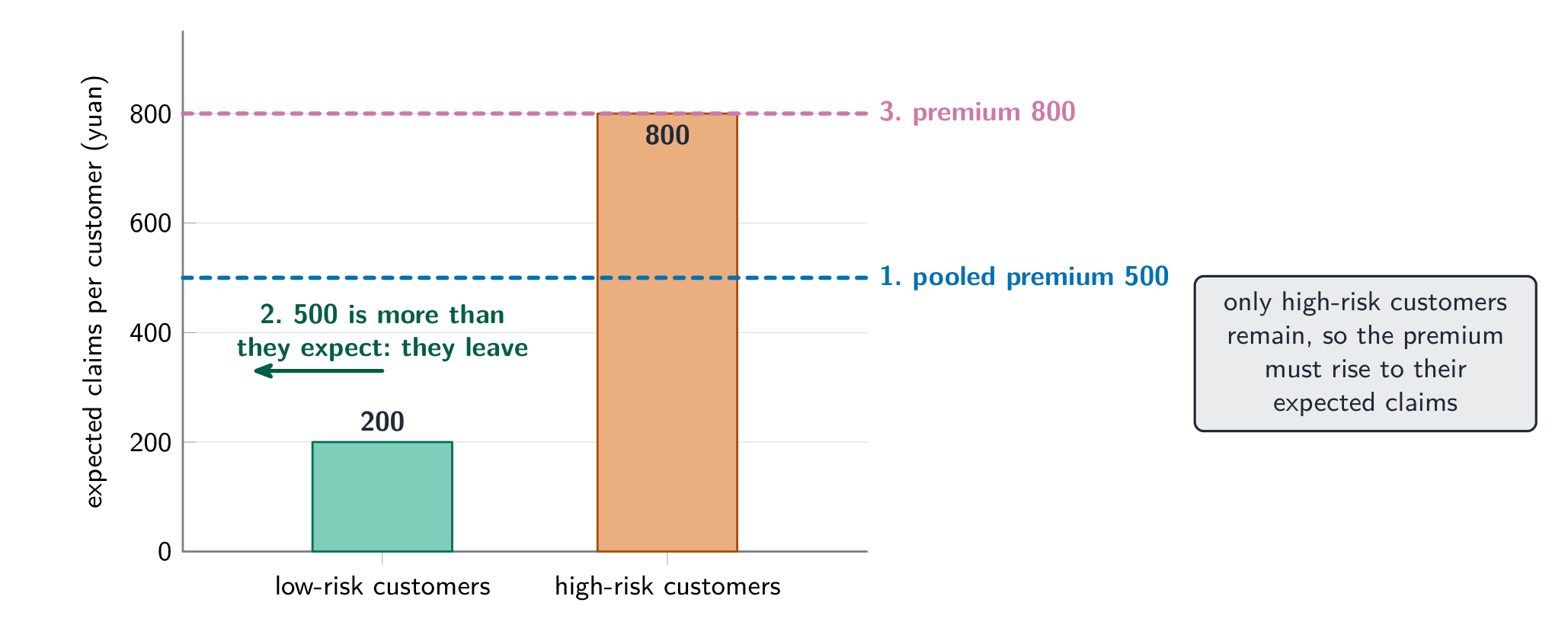
In health insurance, adverse selection means the people most likely to buy cover are those with the highest risk.
Dificultad 1/5 · 100 monedas + un pequeño bono en el primer intento de hoy
People with hidden high risk gain most from insurance, so they are drawn in.
Asymmetric information is not the same as "people are badly informed". The problem is that one side knows more than the other and the price cannot reflect it. If both sides are equally unsure, the price simply reflects the average risk.
Both a buyer and a seller of a painting are unsure whether it is genuine. Is this asymmetric information?
Dificultad 1/5 · 100 monedas + un pequeño bono en el primer intento de hoy
Asymmetry needs one side to know more.
How markets and governments respond
- Market responses: warranties, inspection reports, brands and online reviews signal quality.
- Government responses: laws that require disclosure, food labels, licences for doctors, and compulsory insurance so that the healthy cannot opt out.
Which help to reduce an information gap in the used-car market?
Dificultad 2/5 · 140 monedas + un pequeño bono en el primer intento de hoy
A tax does not give buyers any information.
With asymmetric information one side knows more than the other. Buyers then offer only an average price, so good products leave the market — adverse selection. Warranties, reviews, disclosure laws and compulsory insurance help close the gap.
Explain how asymmetric information can lead to market failure in the market for used cars.
The chain is hidden quality → average price → good cars withdrawn.