Reverse reactions: energy transfers reverse direction
Introducido| English | Significado |
|---|---|
| hydrated copper sulfate/haɪˈdreɪtɪd ˈkɒpə ˈsʌlfeɪt/ | sulfato de cobre hidratado |
| anhydrous copper sulfate/ænˈhaɪdrəs ˈkɒpə ˈsʌlfeɪt/ | sulfato de cobre anhidro |
A colour test for water
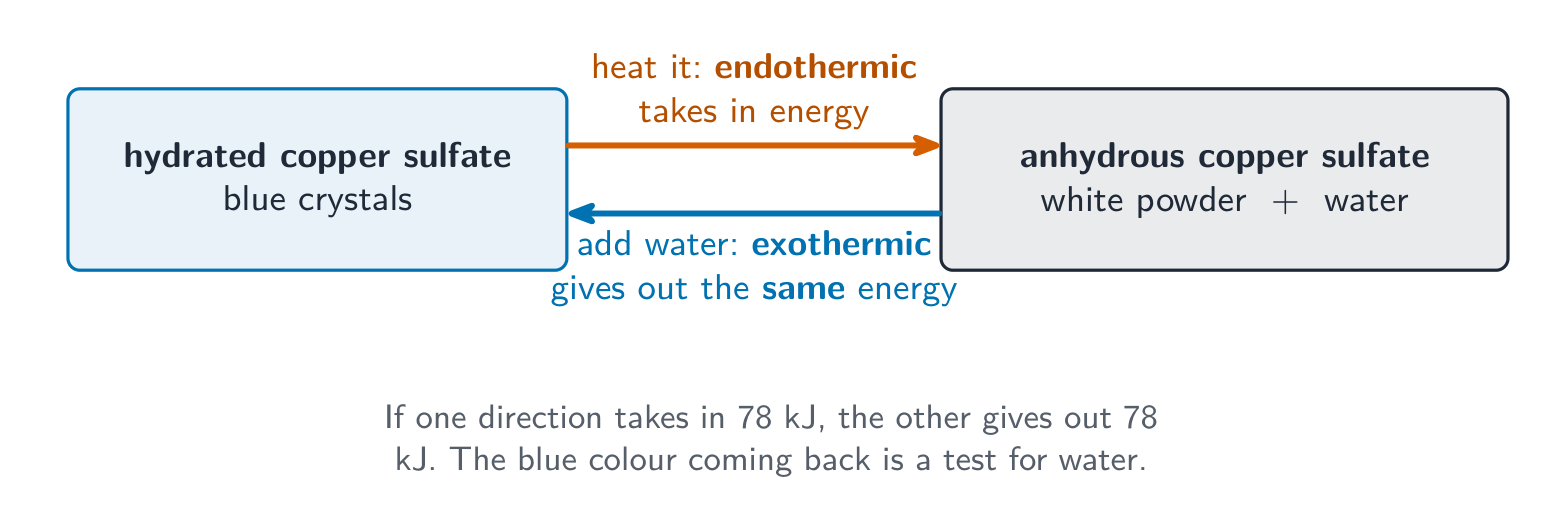
- Heat blue copper sulfate crystals and they turn white as water is driven off. Add a few drops of water to the white powder and it turns blue again — and gets hot.
- Labs use this colour change to test for water.
What does a white powder turning blue show?
Dificultad 1/5 · 100 monedas + un pequeño bono en el primer intento de hoy
This is a test for water.
The reaction
- $\text{CuSO}_4 \cdot 5\text{H}_2\text{O} \rightleftharpoons \text{CuSO}_4 + 5\text{H}_2\text{O}$.
- Hydrated copper sulfate 水合硫酸铜 (blue) contains water in its crystals. Anhydrous copper sulfate 无水硫酸铜 (white) has none.
Match each form to its colour.
Dificultad 2/5 · 140 monedas + un pequeño bono en el primer intento de hoy
Water makes it blue.
Energy in both directions
- If a reaction is endothermic in one direction, it is exothermic in the other.
- The same amount of energy is transferred each way.
Worked example: reading the energy diagram
On an energy diagram, the reactants are at 10 units and the products at 30 units.
- Forward $= 30 - 10 = +20$ units: endothermic (takes in 20).
- Reverse $= 10 - 30 = -20$ units: exothermic (gives out 20).
- Read the same diagram from right to left for the reverse reaction.
The reverse reaction transfers the same energy the other way
If the forward reaction takes in 20 units (10 → 30), the reverse gives out exactly 20. Read the same diagram from right to left.
A forward reaction takes in 45 kJ. How much energy is given out by the reverse reaction?
Dificultad 2/5 · 140 monedas + un pequeño bono en el primer intento de hoy
The same amount.
Reactants are at 50 units and products at 15 units. What is the energy change for the reverse reaction?
Dificultad 2/5 · 140 monedas + un pequeño bono en el primer intento de hoy
$50 - 15 = +35$ (endothermic reverse).
Copper sulfate in numbers
- Dehydrating blue copper sulfate takes in energy (endothermic).
- Adding water to the white powder releases exactly the same energy (exothermic) — you can feel the test tube warm up.
Adding water to anhydrous copper sulfate is
Dificultad 1/5 · 100 monedas + un pequeño bono en el primer intento de hoy
The tube warms up.
The reverse reaction does not give out "less" energy. If 78 kJ are taken in to remove the water, 78 kJ are given out when it is added back. Energy is conserved.
The reverse of an endothermic reaction gives out less energy than the forward reaction took in.
Dificultad 1/5 · 100 monedas + un pequeño bono en el primer intento de hoy
Exactly the same amount.
In a reversible reaction, if the forward direction is endothermic the reverse is exothermic, and the same amount of energy is transferred. Hydrated (blue) and anhydrous (white) copper sulfate show this, and the colour change tests for water.
Explain the energy changes when blue copper sulfate is heated and then water is added back to the white solid.
Reverse direction, reverse sign.