Atmosphere, resources and life-cycle decisions
Introducido| English | Significado |
|---|---|
| resources/rɪˈzɔːsɪz/ | Inputs or assets available for use in achieving a purpose. |
| photosynthesis/ˌfəʊtəʊˈsɪnθəsɪs/ | The process by which plants and other organisms use light energy to make organic substances from carbon dioxide and water. |
| greenhouse gases/ˈɡriːnhaʊs ˈɡæsɪz/ | Atmospheric gases that absorb and emit infrared radiation and contribute to the greenhouse effect. |
| potable water/ˈpəʊtəbl ˈwɔːtə/ | Water of suitable quality for drinking, with harmful contaminants sufficiently low; it need not be chemically pure. |
| life-cycle assessment/laɪf ˈsaɪkl əˈsesmənt/ | análisis del ciclo de vida |
The air we breathe was made by life
- Four billion years ago Earth's air was mostly carbon dioxide, like Venus today, with almost no oxygen. Today it is about four-fifths nitrogen and one-fifth oxygen.
- Chemistry explains how the atmosphere changed, why burning fuels now warms the planet, and how we can use Earth's resources 资源 without running out.
Today's atmosphere
- Dry air is about 78% nitrogen, 21% oxygen, and small amounts of other gases: argon (0.9%), carbon dioxide (0.04%) and water vapour.
- Early volcanoes released carbon dioxide and water vapour. The water condensed into oceans, where much $\text{CO}_2$ dissolved and later formed carbonate rocks such as limestone.
About what percentage of dry air is nitrogen?
Dificultad 2/5 · 140 monedas + un pequeño bono en el primer intento de hoy
About 78% nitrogen and 21% oxygen.
Where the oxygen came from
- Algae and then plants used photosynthesis 光合作用: $6\text{CO}_2+6\text{H}_2\text{O}\rightarrow\text{C}_6\text{H}_{12}\text{O}_6+6\text{O}_2$. Over billions of years this added oxygen and removed carbon dioxide.
- Carbon was also locked away in fossil fuels (coal, oil, gas) and in sedimentary rocks.
Which process added most of the oxygen to Earth's atmosphere?
Dificultad 1/5 · 100 monedas + un pequeño bono en el primer intento de hoy
Photosynthesis takes in carbon dioxide and gives out oxygen.
Greenhouse gases and climate
- Carbon dioxide, methane and water vapour are greenhouse gases 温室气体: they absorb infrared radiation given off by the warm Earth and keep the surface warmer.
- Burning fossil fuels adds $\text{CO}_2$; farming cattle and rice adds methane. Most climate scientists agree this is raising Earth's average temperature, with rising seas and more extreme weather.
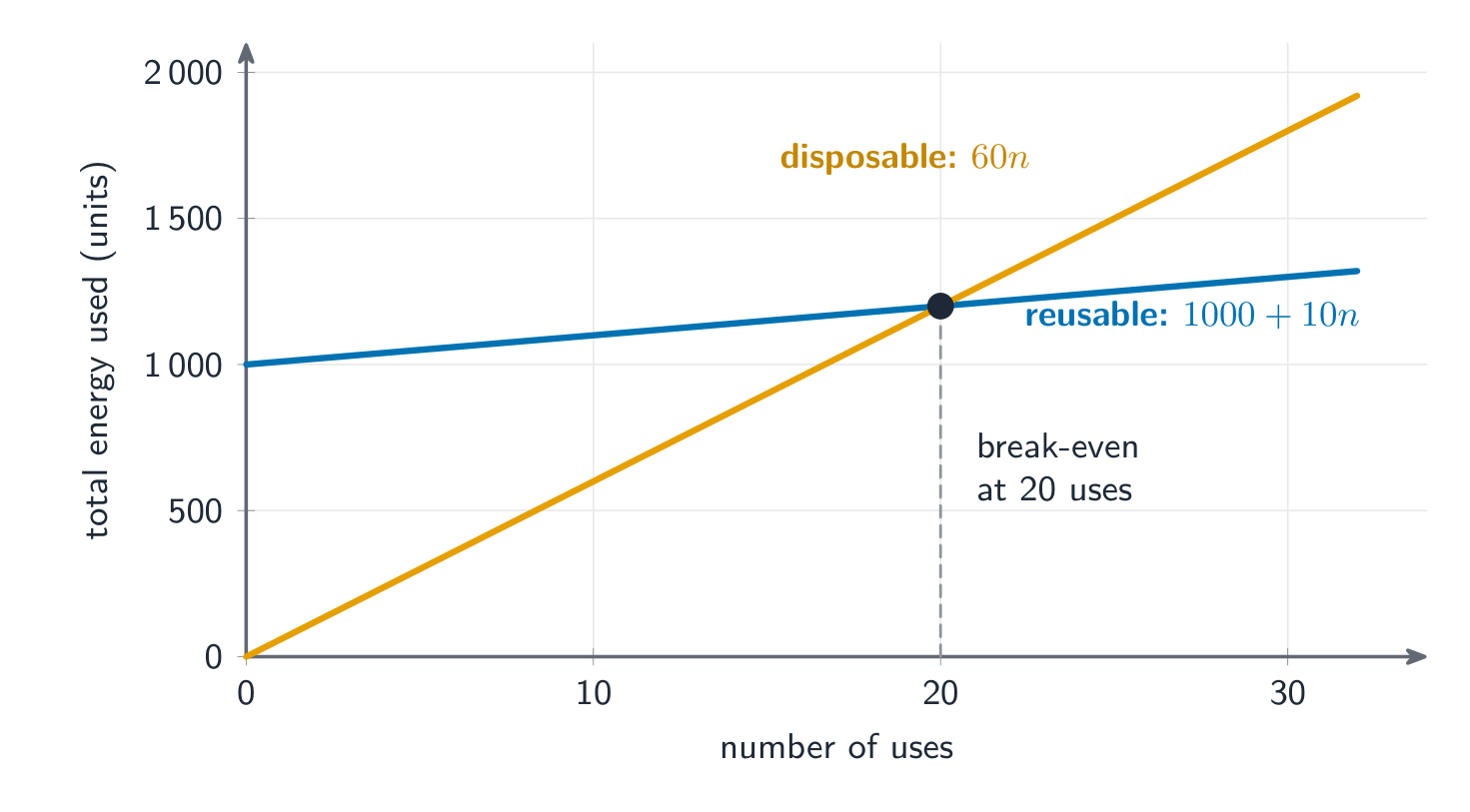
Equal service, different energy totals
1,000 + 10n and 60n are equal at 20 uses. Change the manufacture and per-use energy assumptions to see when reuse has lower energy for the same completed service.
Which are greenhouse gases? Select all that apply.
Dificultad 2/5 · 140 monedas + un pequeño bono en el primer intento de hoy
Nitrogen does not absorb infrared radiation.
Pollutants from burning fuels
- Incomplete combustion gives carbon monoxide (toxic) and soot (breathing problems, global dimming). Sulfur in fuels gives sulfur dioxide, and hot engines make nitrogen oxides: both cause acid rain.
- These are pollution problems. They are different from global warming, which is mainly caused by $\text{CO}_2$.
Match each pollutant to its main problem.
Dificultad 2/5 · 140 monedas + un pequeño bono en el primer intento de hoy
Each comes from burning fuels in a different way.
Water we can drink
- Potable water 饮用水 is safe to drink but not pure: it contains some dissolved salts. In the UK, fresh water is filtered and then sterilised with chlorine, ozone or ultraviolet light.
- Where fresh water is scarce, sea water is desalinated by distillation or reverse osmosis. Both use a lot of energy.
Potable water is pure water.
Dificultad 1/5 · 100 monedas + un pequeño bono en el primer intento de hoy
It is safe to drink but still contains dissolved substances.
Life-cycle assessment
- A life-cycle assessment 生命周期评价 (LCA) compares products over their whole life: raw materials, manufacture, use, and disposal. It counts energy, water, resources and waste at each stage.
- Compare products that do the same job, such as "carrying 1 litre of water 30 times", not just one bottle against another.
A reusable bottle needs 1000 energy units to make plus 10 per use (washing). A disposable bottle needs 60 units per use. After how many uses is the reusable bottle better?
- Total for reusable $=1000+10n$; total for disposables $=60n$.
- Equal when $1000+10n=60n$, so $50n=1000$ and $n=20$ uses.
- Used more than 20 times, the reusable bottle uses less energy.
A reusable cup needs 600 energy units to make and 5 per use. A disposable cup needs 35 per use. After how many uses do they break even?
Dificultad 2/5 · 140 monedas + un pequeño bono en el primer intento de hoy
$600+5n=35n$, so $30n=600$ y $n=20$.
An LCA is only as good as its data. Energy use and emissions can be measured, but some effects, such as how harmful a pollutant is, need value judgements. And "recyclable" does not mean "recycled": many recyclable items are never collected.
The early atmosphere was mostly $\text{CO}_2$; oceans, carbonate rocks, fossil fuels and photosynthesis removed it and added oxygen. Today's air is about 78% nitrogen and 21% oxygen. Greenhouse gases trap infrared radiation; extra $\text{CO}_2$ and methane are warming the climate. Potable water is filtered and sterilised. An LCA compares products over their whole life, doing the same job.
Why can an LCA give different answers for the same product?
Dificultad 1/5 · 100 monedas + un pequeño bono en el primer intento de hoy
How far things are transported, how often they are reused, and how harmful a pollutant is all change the result.