Atoms, elements and compounds: read the chemical symbols
Introducido| English | Significado |
|---|---|
| element/ˈelɪmənt/ | elemento |
| atom/ˈætəm/ | The smallest unit of an element that retains its chemical identity, consisting of a nucleus and electrons. |
| compound/ˈkɒmpaʊnd/ | compuesto |
| chemical reaction/ˈkemɪkl rɪˈækʃn/ | A process in which substances are transformed into new substances by rearranging atoms and electrons. |
118 building blocks
- Everything around you — water, air, your phone, your body — is made from just 118 known elements 元素.
- Only about 90 occur naturally. They combine in millions of ways, just as 26 letters make every English word.
- Chemists read and write these combinations with symbols and formulae.
Atoms, elements, compounds
- An atom is the smallest part of an element that can exist.
- An element contains only one type of atom. Oxygen gas, O₂, is still an element: both atoms are oxygen.
- A compound 化合物 contains two or more elements chemically combined in fixed proportions. Water, H₂O, always has two hydrogen atoms for every oxygen atom.
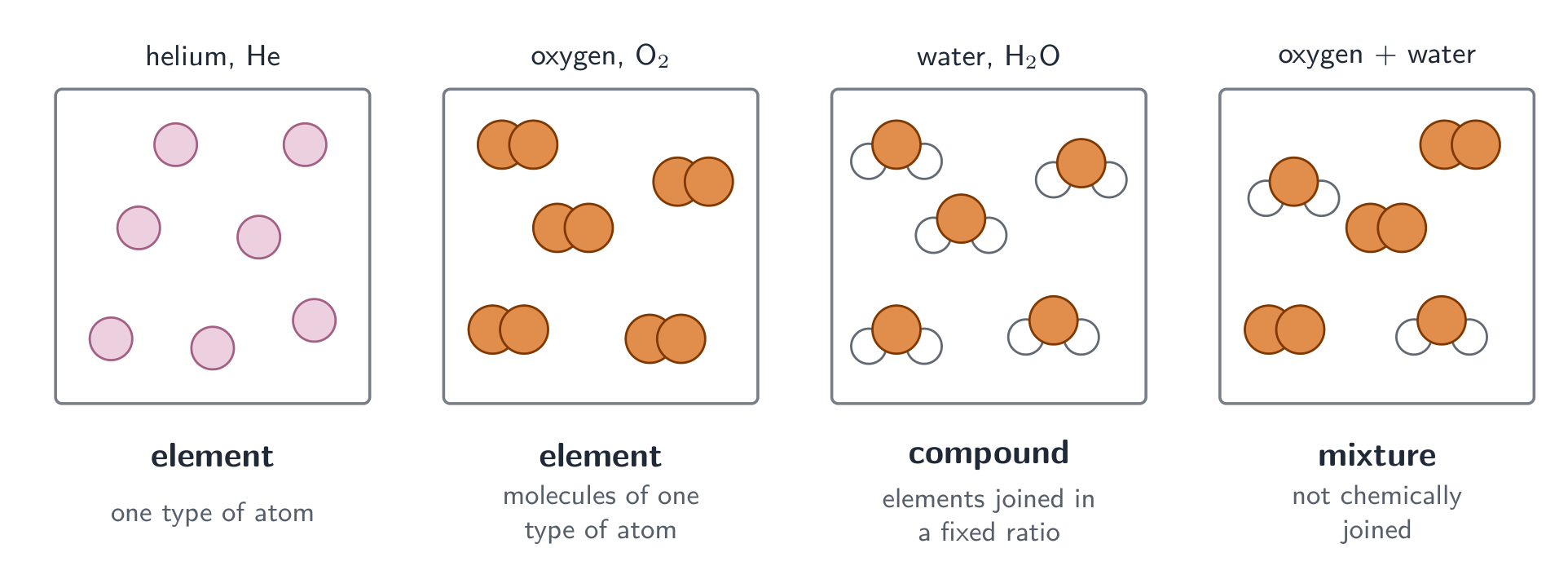
Element or compound?
Dificultad 2/5 · 140 monedas + un pequeño bono en el primer intento de hoy
A compound contains two or more different elements.
Reading symbols
- A symbol has one capital letter, sometimes followed by a small letter: Co is cobalt, but CO is carbon monoxide — a compound of carbon and oxygen.
- In a formula, a small number after a symbol counts the atoms just before it: CO₂ has 1 carbon and 2 oxygen atoms.
What is "Co"?
Dificultad 1/5 · 100 monedas + un pequeño bono en el primer intento de hoy
One capital and one small letter is one element symbol.
Worked example: counting atoms in a formula
How many atoms of each element are in 3Ca(OH)₂?
- One unit of Ca(OH)₂: 1 Ca; the bracket (OH) is taken twice, so 2 O and 2 H — 5 atoms.
- The 3 in front multiplies the whole formula: 3 Ca, 6 O, 6 H.
- Total $= 3 + 6 + 6 = 15$ atoms. The ratio Ca : O : H stays 1 : 2 : 2.
A coefficient multiplies the whole formula
One Ca(OH)₂ unit has 1 Ca, 2 O and 2 H, five atoms; three units have 3 Ca, 6 O and 6 H, fifteen atoms. The coefficient counts units, so the Ca : O : H ratio stays 1 : 2 : 2.
How many atoms in total are in 2Al₂(SO₄)₃?
Dificultad 2/5 · 140 monedas + un pequeño bono en el primer intento de hoy
One unit: 2 Al + 3 S + 12 O = 17 atoms; $2 \times 17 = 34$.
How many oxygen atoms are in 4H₂SO₄?
Dificultad 2/5 · 140 monedas + un pequeño bono en el primer intento de hoy
$4 \times 4 = 16$.
Making and breaking compounds
- A compound forms only in a chemical reaction: new substances form, often with a temperature change, light or a gas.
- To get the elements back you need another chemical reaction. Electricity splits water into hydrogen and oxygen; you cannot filter them apart.
How can water be separated into hydrogen and oxygen?
Dificultad 1/5 · 100 monedas + un pequeño bono en el primer intento de hoy
Separating a compound needs a chemical change.
Two atoms joined together are not always a compound. O₂, N₂ and Cl₂ contain two atoms, but both atoms are the same element, so they are elements. A compound needs at least two different elements.
O₂ is a compound because it contains two atoms.
Dificultad 1/5 · 100 monedas + un pequeño bono en el primer intento de hoy
Both atoms are oxygen, so it is an element.
Atoms are the smallest parts of elements; an element has one type of atom; a compound has different elements chemically joined in fixed proportions. In a formula, small numbers count atoms and the number in front multiplies the whole formula.
Explain the difference between a mixture of hydrogen and oxygen gases and the compound water.
Compare bonding, proportions and properties.