Total War
Introducido| English | Significado |
|---|---|
| total war/ˈtəʊtl wɔː/ | guerra total |
| Political propaganda/pəˈlɪtɪkl ˌprɒpəˈɡændə/ | Communication designed to shape beliefs or behaviour in support of a political cause, authority or programme. |
An Indian machine-gunner at Ypres, October 1914
- On 31 October 1914, near Ypres in Belgium, Khudadad Khan, a machine-gunner from the Punjab in British India, kept firing after the rest of his crew had been killed, holding back a German advance. He became the first Indian soldier to win the Victoria Cross, Britain's highest medal for bravery. About 1.3 million Indian soldiers served in World War I — far from home, in a war between European empires.
- World War I was a total war 总体战: governments used the whole society, and their empires, to fight.
About how many million Indian soldiers served in World War I?
Dificultad 2/5 · 140 monedas + un pequeño bono en el primer intento de hoy
Far from home.
A whole society at war
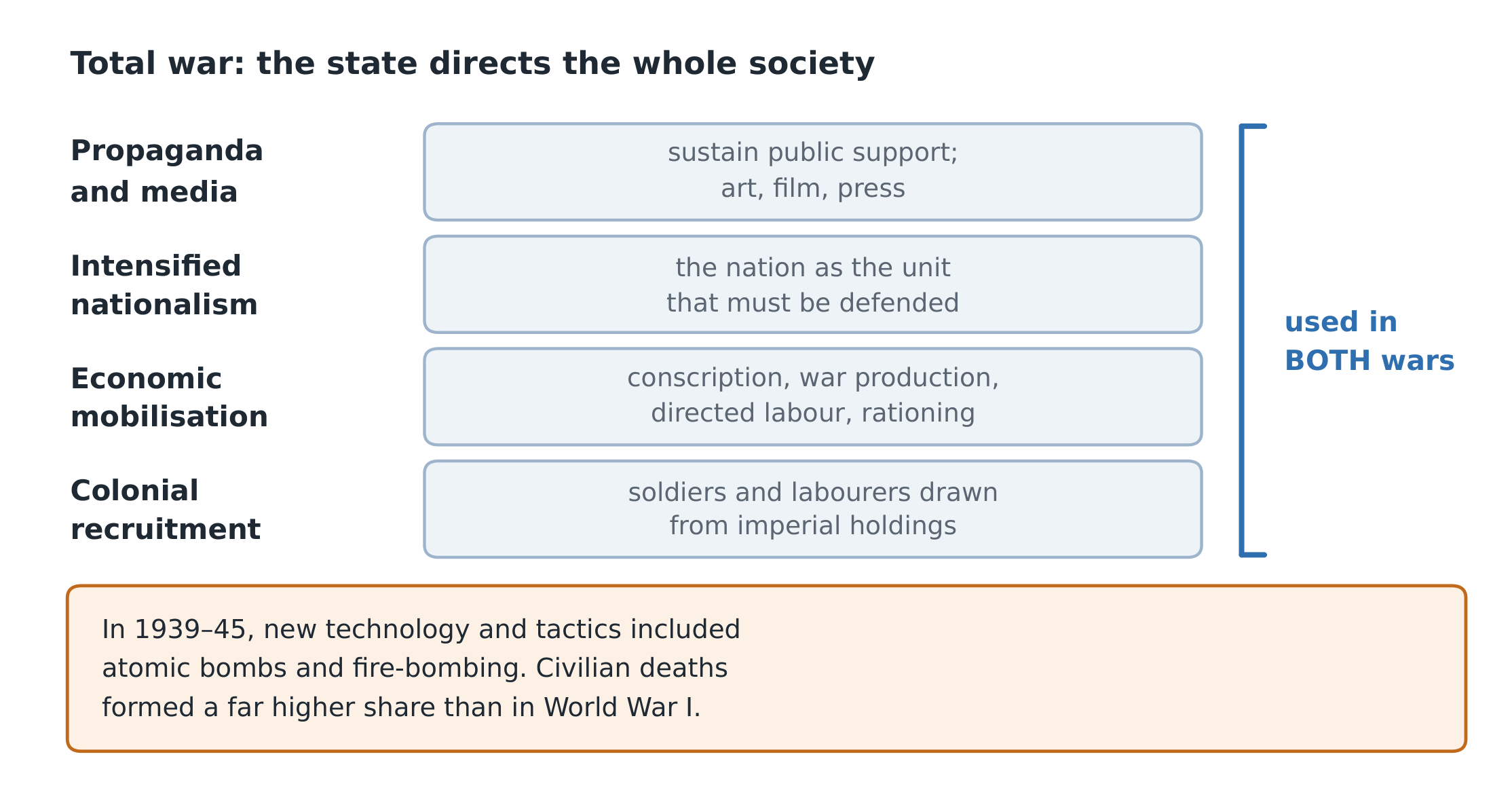
- Governments took control of factories, railways and food supplies; Britain introduced conscription in 1916.
- Women took factory jobs — about 1 million British women worked in munitions by 1918.
Tools of mobilisation
- Political propaganda 政治宣传: posters, films and newspapers encouraged men to enlist and civilians to save food.
- Governments also censored the press and rationed food.
Follow technology to total war
Technology, then stalemate, then national mobilisation — the 'because' at each step is what is marked.
Which were tools of mobilisation?
Dificultad 2/5 · 140 monedas + un pequeño bono en el primer intento de hoy
Total war tools.
Worked example: colonies were mobilised too
- Soldiers: about 1.3 million from India and about 200 000 from French West Africa, the tirailleurs sénégalais.
- Labour: about 140 000 Chinese workers dug trenches and unloaded ships in France for Britain and France.
- Effect: colonial peoples expected rights in return for their service; when these did not come, nationalist movements grew stronger after 1918.
Match each group to its contribution.
Dificultad 2/5 · 140 monedas + un pequeño bono en el primer intento de hoy
Colonies mobilised.
What was one effect of colonial service in the war?
Dificultad 1/5 · 100 monedas + un pequeño bono en el primer intento de hoy
Expectations not met.
Technology raised the casualties
- Machine guns, heavy artillery, poison gas and barbed wire made attacks deadly; on the first day of the Somme (1 July 1916), the British army suffered about 57 000 casualties.
- About 17 million soldiers and civilians died in the war.
On the first day of the Somme, the British army had about 57 000 casualties. About how many per hour, over 12 hours? (whole number)
Dificultad 2/5 · 140 monedas + un pequeño bono en el primer intento de hoy
57 000 ÷ 12.
How governments conducted war
- Total war meant the line between soldiers and civilians weakened: factories, food and morale were all targets.
- Germany's submarine attacks on shipping and Britain's naval blockade both aimed at civilian supplies.
World War I was not only a European war. Soldiers and workers from India, Africa, China and elsewhere fought and worked, and fighting reached Africa and the Middle East.
World War I involved only Europeans.
Dificultad 1/5 · 100 monedas + un pequeño bono en el primer intento de hoy
Colonial soldiers and workers took part.
In World War I, governments mobilised whole societies through conscription, factory control, propaganda and rationing, and drew on their empires for soldiers and labour. Machine guns, artillery and gas made it extremely deadly, and colonial service fed nationalism afterwards.
Explain how governments used their empires to fight World War I.
Process and effect.