Silver, Companies and the Atlantic System
Introducido| English | Significado |
|---|---|
| mercantilism/ˈmɜːkæntəlɪzəm/ | mercantilism |
| joint-stock companies/dʒɔɪnt stɒk ˈkʌmpəniz/ | joint-stock companies |
| Mercantilist/ˈmɜːkæntɪlɪst/ | Mercantilista |
A galleon to Manila, 1571
- In 1571 the Spanish founded Manila in the Philippines. Every year, a great ship called a galleon sailed from Acapulco in Mexico to Manila carrying American silver, and came back loaded with Chinese silk and porcelain.
- For the first time, goods and money moved regularly around the whole world. Silver mined in the Americas ended up in China.
What did the Manila galleon carry from Acapulco?
Dificultad 1/5 · 100 monedas + un pequeño bono en el primer intento de hoy
It came back with silk and porcelain.
Silver from the Americas
- In 1545 the Spanish found a mountain of silver at Potosí, in today's Bolivia; Mexico had rich mines too. Indigenous workers were forced to work there under the mita, a labour draft taken from the Inca.
- Spanish America produced most of the world's silver for the next two centuries.
The great silver mountain found by the Spanish in 1545 was at ____.
Dificultad 1/5 · 100 monedas + un pequeño bono en el primer intento de hoy
In today's Bolivia.
Why silver went to China
- China's Ming government began to collect taxes in silver in the later 1500s, so China needed huge amounts of it, and silver was worth more there than in Europe.
- Europeans had few goods the Chinese wanted, so they paid for silk, porcelain and tea with American silver.
China needed silver because its government collected taxes in silver.
Dificultad 1/5 · 100 monedas + un pequeño bono en el primer intento de hoy
Silver was worth more in China than in Europe.
Companies and mercantilism
- Rulers followed mercantilism 重商主义: export more than you import, collect gold and silver, and use colonies to supply raw materials.
- They gave trade monopolies to joint-stock companies 股份公司, such as the English East India Company (1600) and the Dutch VOC (1602). Many investors bought shares, so a lost ship did not ruin one merchant.
Why did joint-stock companies reduce risk?
Dificultad 1/5 · 100 monedas + un pequeño bono en el primer intento de hoy
Shares spread the risk.
Worked example: following one coin. A silver coin minted from Potosí silver could go to Seville to pay Spain's debts, then to Amsterdam, where the VOC used it to buy pepper in Asia; or it could cross the Pacific to Manila and buy Chinese silk, which was sold in Mexico or Europe. Either way, it ended in Asia. That circle linked four continents into one economy.
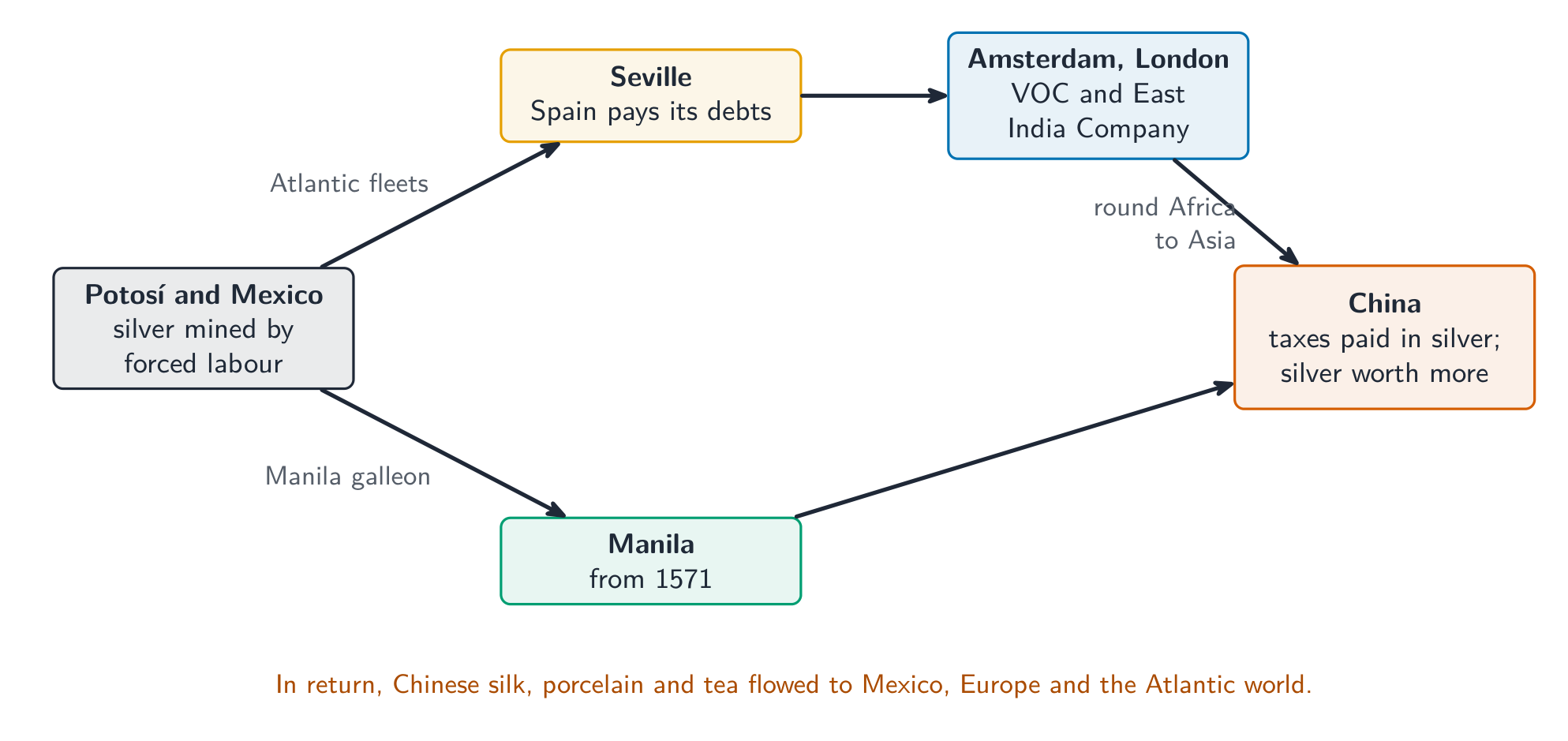
Most American silver ended up in Asia.
Dificultad 1/5 · 100 monedas + un pequeño bono en el primer intento de hoy
Through Europe or across the Pacific.
The Atlantic system moved people
- Sugar, tobacco and later cotton plantations in the Americas used enslaved Africans. About 12.5 million Africans were forced across the Atlantic between 1500 and 1866.
- African, American and European peoples and cultures mixed: in foods, music, languages and religions, such as Vodou in Haiti and Candomblé in Brazil.
Where in the circuit?
Sort each part of the global economy.
Which are examples of cultural mixing in the Atlantic world?
Dificultad 2/5 · 140 monedas + un pequeño bono en el primer intento de hoy
The Ming taxes were Chinese.
Older trade did not stop. Asian and African merchants kept trading in the Indian Ocean, often using European ships as well as their own. Europeans joined existing markets far more often than they controlled them.
Europeans controlled all Indian Ocean trade after 1500.
Dificultad 1/5 · 100 monedas + un pequeño bono en el primer intento de hoy
They mostly joined existing markets.
From the 1500s American silver, from Potosí and Mexico, flowed to Europe and across the Pacific through Manila, and most of it ended in China, which taxed in silver. Mercantilist rulers used joint-stock companies to share risk and win trade. The Atlantic system moved goods and about 12.5 million enslaved Africans, and mixed African, American and European cultures.
Explain how American silver created a global economy, 1550-1750.
Follow the silver.