States Paid for the Voyages
Introducido| English | Significado |
|---|---|
| trading-post empire/ˈtreɪdɪŋ pəʊst ˈempaɪə/ | An empire of forts and ports that controls key points of trade rather than large territories, like Portugal's in Asia. |
Arrival at Calicut, May 1498
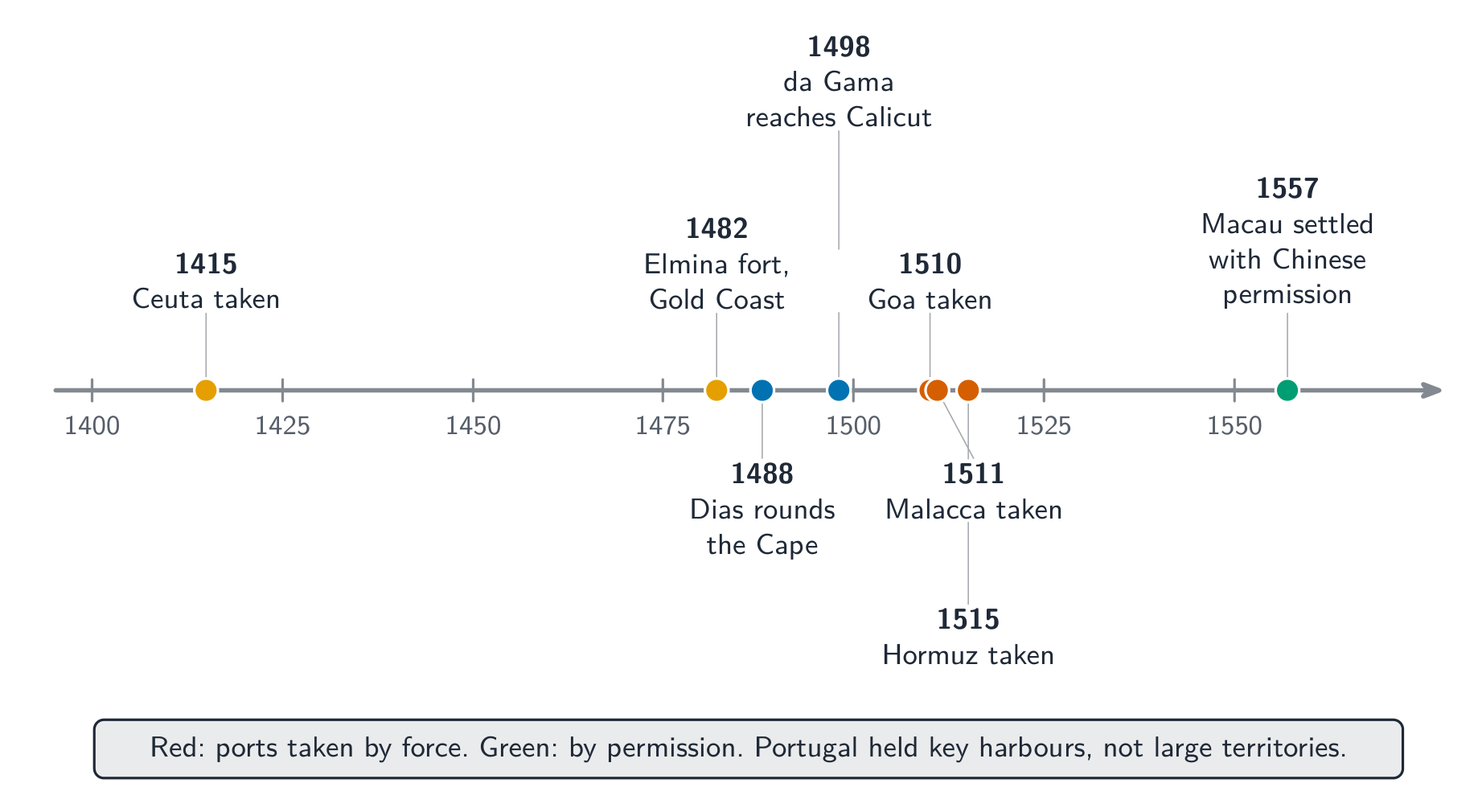
- On 20 May 1498, Vasco da Gama's ships reached Calicut on India's Malabar coast, after sailing around Africa from Lisbon. The voyage had been paid for by King Manuel I of Portugal, who wanted a sea route to the spice trade that avoided Venetian and Ottoman middlemen. Da Gama returned with pepper and cinnamon worth many times the cost of the trip — though he lost about half his men.
- From 1450, European states paid for voyages of exploration to find routes, trade and wealth.
Why did Portugal want a sea route to India?
Dificultad 1/5 · 100 monedas + un pequeño bono en el primer intento de hoy
Avoiding middlemen.
Exploration was a state project
- Kings and queens funded ships, crews and forts, expecting a share of the profits.
- They wanted gold, spices and routes that avoided rival powers.
Portugal: a trading-post empire
- Portugal built forts and harbours along the African coast, then at Goa (1510), Malacca (1511) and Macau (1557).
- This trading-post empire 贸易据点帝国 controlled key points of trade, not large territories.
Which sponsor, and what were they after?
Sort each voyage programme by its stated goal.
Put these Portuguese bases in order.
Dificultad 3/5 · 200 monedas + un pequeño bono en el primer intento de hoy
1498, 1510, 1511, 1557.
What was a trading-post empire?
Dificultad 1/5 · 100 monedas + un pequeño bono en el primer intento de hoy
Portugal's model.
Worked example: Spain crossed two oceans
- Atlantic: Ferdinand and Isabella paid for Columbus's voyage of 1492 to reach Asia by sailing west; he reached the Caribbean instead.
- Pacific: Magellan's expedition (1519–22) crossed the Pacific; only 18 of about 270 men returned.
- Result: from 1565, Spanish galleons sailed every year between Acapulco and Manila, carrying American silver to Asia.
Of about 270 men on Magellan's expedition, 18 returned. How many did not?
Dificultad 2/5 · 140 monedas + un pequeño bono en el primer intento de hoy
270 − 18.
Northern crossings
- England, France and the Netherlands sought a "northwest passage" to Asia through North America.
- John Cabot (1497) and Jacques Cartier (1534) explored the coasts of Canada.
Match each sponsor to its aim.
Dificultad 2/5 · 140 monedas + un pequeño bono en el primer intento de hoy
Different goals.
Economic effects
- New routes moved the centre of European trade from the Mediterranean to the Atlantic.
- Lisbon, Seville and later Amsterdam grew rich.
Explorers did not find what they were looking for. Columbus wanted Asia and found the Americas; the northwest passage was never found in that age. The effects were often unplanned.
Columbus found what he was looking for.
Dificultad 1/5 · 100 monedas + un pequeño bono en el primer intento de hoy
He wanted Asia.
From 1450, states paid for voyages: Portugal built a trading-post empire after da Gama reached India in 1498, Spain crossed the Atlantic and Pacific and linked Acapulco to Manila, and England, France and the Dutch searched for a northwest passage.
Compare the goals of Portuguese and Spanish exploration.
Comparison.