El Nuevo Trato
Introducido| English | Significado |
|---|---|
| relief/rɪˈliːf/ | Immediate help for people without income. |
| Social Security | The US government programme, begun in 1935, that pays pensions to older people and help to the unemployed and disabled. |
| deficit spending | A government spending more than it raises in taxes, borrowing to cover the gap. |
"The only thing we have to fear", 1933
- When Franklin D. Roosevelt took office in March 1933, about a quarter of American workers were unemployed and thousands of banks had failed. In his first speech he said "the only thing we have to fear is fear itself", then closed every bank for a "bank holiday". In his first hundred days, Congress passed fifteen major laws.
- The New Deal aimed at relief, recovery and reform.
Relief
- Relief 救济 meant immediate help for the unemployed and hungry.
- The Civilian Conservation Corps put young men to work planting trees and building parks; the Works Progress Administration (1935) employed about 8.5 million people over its life, building roads, schools and bridges.
Recovery and reform
- Recovery: the Agricultural Adjustment Act paid farmers to grow less to raise prices; the National Recovery Administration set codes for industry.
- Reform: the FDIC (1933) insured bank deposits; the SEC (1934) policed the stock market; the Wagner Act (1935) protected unions; the Social Security 社会保障 Act (1935) created old-age pensions and unemployment insurance.
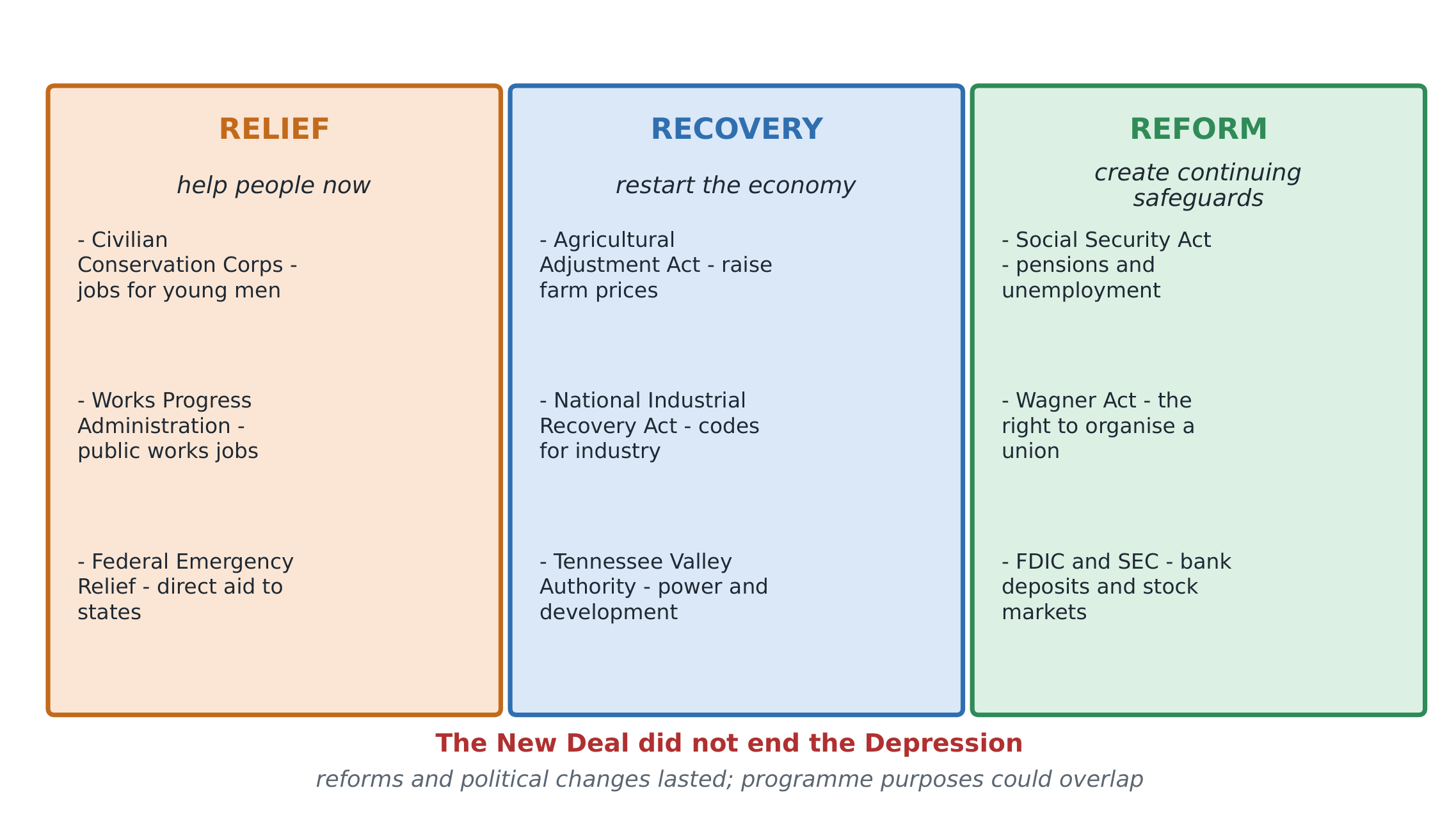
Match each programme to its main aim.
Dificultad 2/5 · 140 monedas + un pequeño bono en el primer intento de hoy
The three Rs.
What did the Social Security Act (1935) create?
Dificultad 1/5 · 100 monedas + un pequeño bono en el primer intento de hoy
A lasting safety net.
Worked example: did the New Deal work?
- Successes: bank runs stopped after the FDIC; millions got jobs and relief; unemployment fell from about 25% (1933) to about 14% (1937).
- Limits: a cut in spending caused a sharp recession in 1937–38; unemployment was still about 15% in 1940. Full recovery came only with war production.
- Lasting: Social Security, deposit insurance and union rights still exist. It eased the Depression and reformed the system more than it ended the Depression.
Sort the New Deal by what each measure was for
Relief, recovery and reform answer different questions, and only reform was meant to outlast the crisis.
Unemployment fell from about 25% in 1933 to about 14% in 1937. By how many percentage points did it fall?
Dificultad 2/5 · 140 monedas + un pequeño bono en el primer intento de hoy
25 − 14.
Pressure from both sides
- From the left, Huey Long's "Share Our Wealth" plan and Father Coughlin's radio talks demanded more redistribution.
- From the right, business groups attacked deficit spending 赤字开支 and government control. The Supreme Court struck down the NRA in 1935, and Roosevelt's 1937 plan to add justices failed.
Match each critic to their side.
Dificultad 2/5 · 140 monedas + un pequeño bono en el primer intento de hoy
Pressure from both sides.
People on the move
- Drought and dust storms on the Great Plains — the Dust Bowl — drove hundreds of thousands of families west to California.
- Many African Americans switched to the Democratic Party, though New Deal programmes often discriminated against them.
The Dust Bowl drove many Great Plains families west to California.
Dificultad 1/5 · 100 monedas + un pequeño bono en el primer intento de hoy
Drought and dust storms.
The New Deal did not end the Great Depression. Unemployment stayed high until the Second World War. Judge it on relief and lasting reform, not only on recovery.
The New Deal ended the Great Depression by 1937.
Dificultad 1/5 · 100 monedas + un pequeño bono en el primer intento de hoy
Unemployment stayed high until the war.
The New Deal combined relief (CCC, WPA), recovery (AAA, NRA) and reform (FDIC, SEC, Social Security, Wagner Act). Pushed by critics on the left and limited by the right and the courts, it eased the Depression and created lasting institutions, but war production completed the recovery.
Evaluate the success of the New Deal.
Argumentation.