After the Spanish-American War
Introducido| English | Significado |
|---|---|
| Platt Amendment | The 1901 measure that let the United States intervene in Cuba and keep a naval base at Guantánamo Bay. |
| Insular Cases | Supreme Court decisions of 1901 ruling that the Constitution did not fully apply in new overseas territories. |
| Open Door | The 1899-1900 U.S. policy asking all powers to allow equal trading rights in China. |
A declaration of independence in Kawit, June 1898
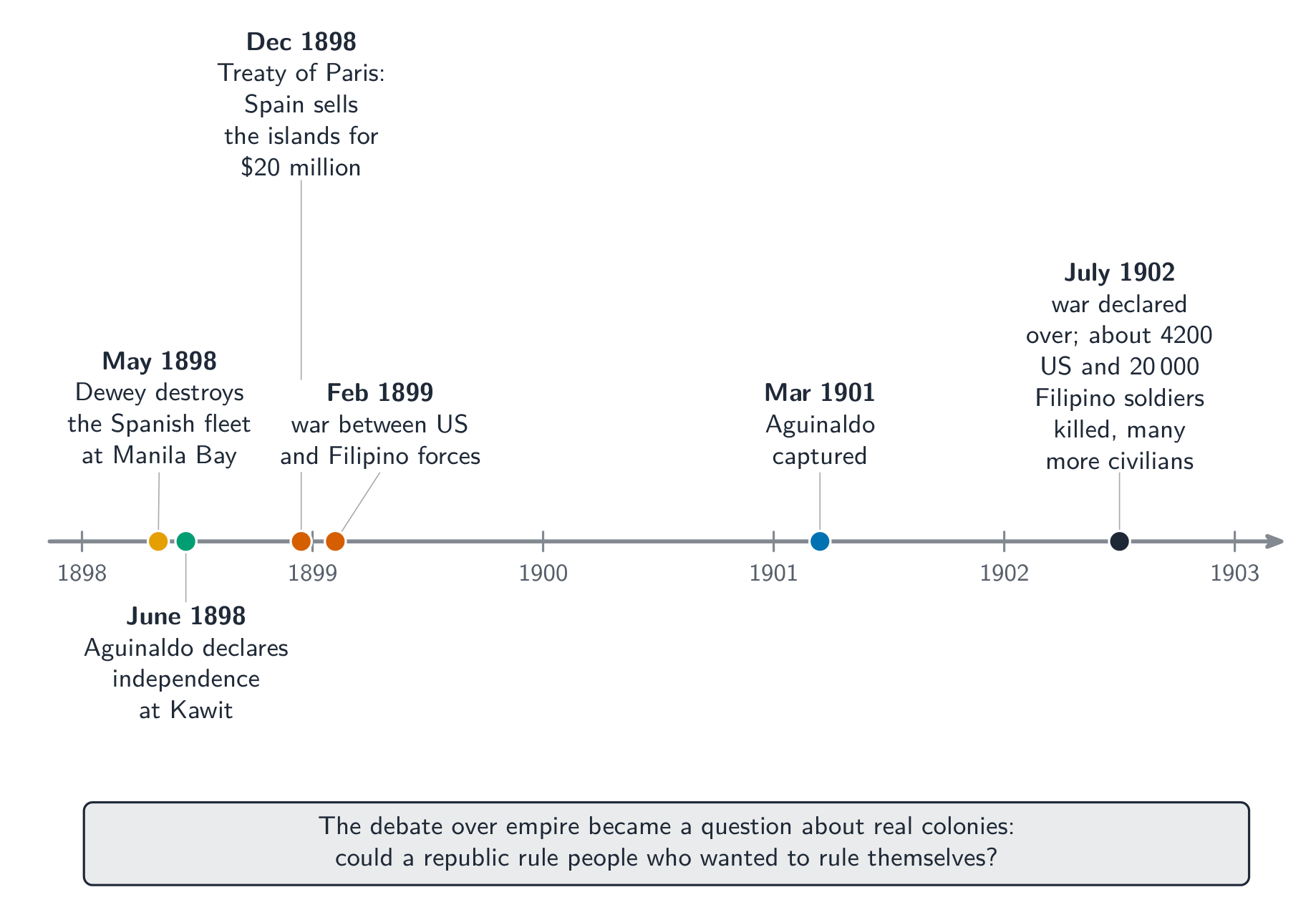
- On 12 June 1898, Emilio Aguinaldo declared the Philippines independent from Spain from the balcony of his house in Kawit. American ships had helped him return from exile, and many Filipinos believed the United States was their ally. But in December, Spain sold the islands to the United States for 20 million dollars. In February 1899, war broke out between American and Filipino forces.
- The Spanish-American War of 1898 made the United States a colonial power in the Caribbean and the Pacific.
Why did war break out between the US and Filipinos in 1899?
Dificultad 1/5 · 100 monedas + un pequeño bono en el primer intento de hoy
Aguinaldo's declaration, 1898.
For how many million dollars did Spain sell the Philippines to the US?
Dificultad 2/5 · 140 monedas + un pequeño bono en el primer intento de hoy
December 1898.
Three effects
- New colonies: the US took the Philippines, Puerto Rico and Guam, and annexed Hawaii in 1898.
- Cuba: it became nominally independent, but under US control; a new debate: Americans now argued about governing real colonies, not just whether to have them.
Which did the US take or annex in 1898?
Dificultad 2/5 · 140 monedas + un pequeño bono en el primer intento de hoy
Plus Guam.
The Philippine-American War
- The US fought Filipino independence forces from 1899 to 1902, and resistance continued for years after. About 4200 American soldiers died; about 20 000 Filipino soldiers and perhaps 200 000 civilians died from fighting, famine and disease.
- American troops burned villages and used torture, which anti-imperialists publicized.
Territory, Asian involvement, or the Philippine suppression?
Sort each effect of the war.
Worked example: islands as bases
- Cuba: the Platt Amendment 普拉特修正案 (1901) let the US intervene in Cuba and gave it a naval base at Guantánamo Bay.
- The Pacific: Hawaii's Pearl Harbor and the Philippines gave the US navy bases toward Asia.
- The canal: the Panama Canal, opened in 1914, linked the Atlantic and Pacific fleets.
The Panama Canal opened in 1914.
Dificultad 1/5 · 100 monedas + un pequeño bono en el primer intento de hoy
Linking two oceans.
A new kind of territory
- In the Insular Cases 海岛案 (1901), the Supreme Court ruled that the Constitution did not fully apply in the new territories — they were "unincorporated".
- Puerto Ricans became US citizens in 1917 but could not vote for president.
Match each term to its meaning.
Dificultad 2/5 · 140 monedas + un pequeño bono en el primer intento de hoy
The new empire.
Opening Asia
- The Open Door 门户开放 notes (1899–1900) asked the powers to give all nations equal trading rights in China.
- American power in the Pacific grew quickly.
The war with Spain was short, but the war in the Philippines was long and deadly. Do not stop the story in 1898.
American fighting in the Philippines ended in 1898.
Dificultad 1/5 · 100 monedas + un pequeño bono en el primer intento de hoy
It lasted from 1899 to at least 1902.
After 1898, the United States ruled the Philippines, Puerto Rico and Guam, annexed Hawaii and controlled Cuba through the Platt Amendment. It fought a long, deadly war against Filipino independence, gained naval bases toward Asia, and created a new kind of territory under the Insular Cases.
Explain the effects of the Spanish-American War on US foreign policy.
Effects.