Seeing Each Other
Introducido| English | Significado |
|---|---|
| sovereignty/ˈsɒvərɪnti/ | Supreme authority over a territory and its people. |
| King Philip's War | The war of 1675–76 between New England colonists and Native nations led by the Wampanoag leader Metacom. |
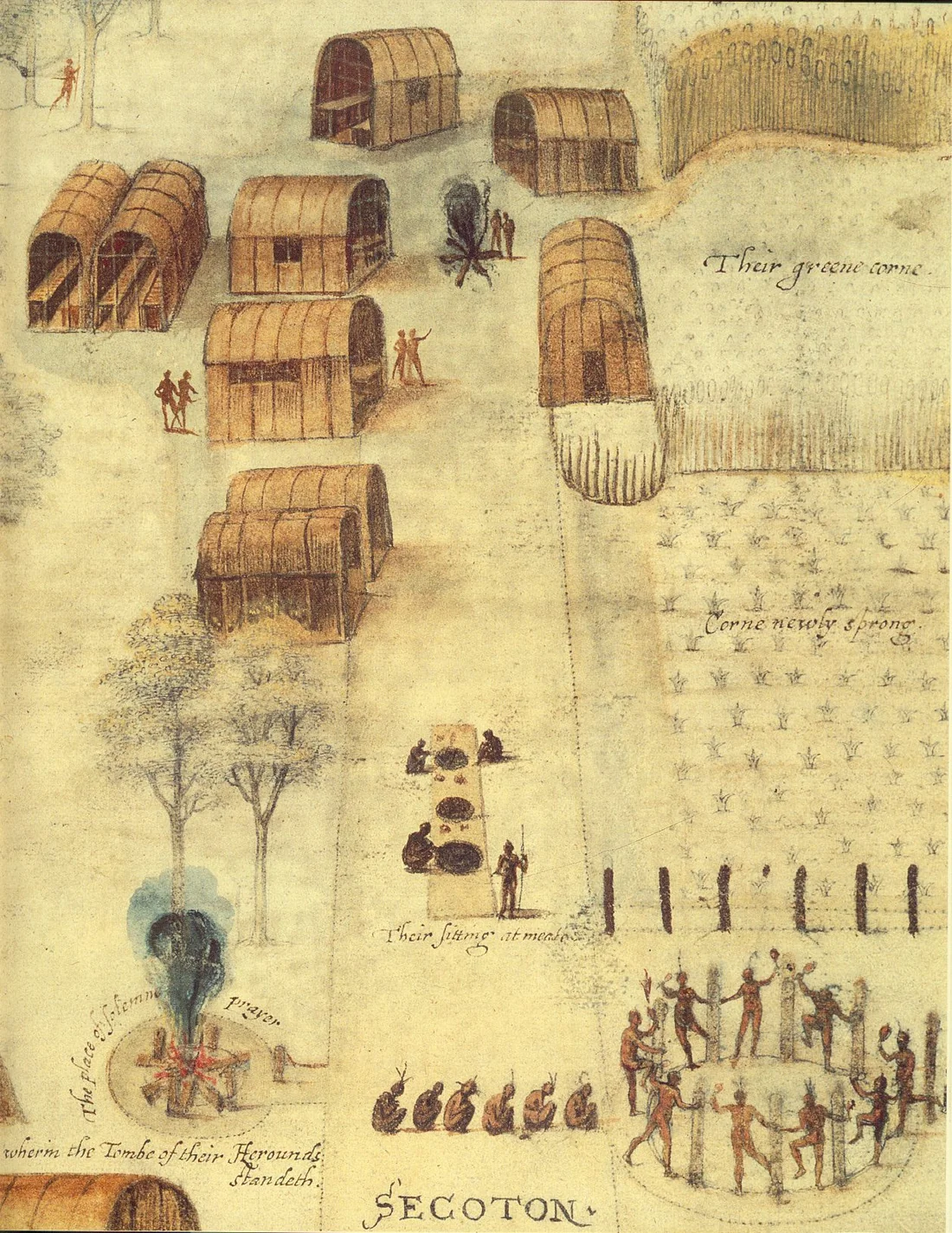
A painter at Roanoke, 1585
- In 1585, the English artist John White sailed to Roanoke Island, off today's North Carolina. He painted Algonquian towns, fields of maize, fishing and ceremonies with great care. In 1590, when he returned after a long delay, the colony he had led was gone. The only clue was the word "CROATOAN" carved on a post.
- When Europeans and Native Americans met, each saw the other through their own beliefs, and their views changed over time.
Different worldviews
- Land: most Europeans believed land could be owned privately and fenced; most Native peoples saw land as shared by the community for use, not for sale.
- Religion and work: Europeans saw Native religions as false; and because Native women did most farming, English men often called Native men lazy hunters.
How did most Native peoples see land?
Dificultad 1/5 · 100 monedas + un pequeño bono en el primer intento de hoy
Different worldviews.
Misunderstanding, then borrowing
- In 1621, Tisquantum (Squanto), who spoke English after being enslaved in Europe, taught the Plymouth colonists to plant maize with fish as fertilizer.
- Europeans adopted maize, tobacco and canoes; Native peoples adopted metal tools, guns and horses.
Divergence, native response, or the European debate?
Sort each element of mutual perception.
Match each item to who adopted it.
Dificultad 2/5 · 140 monedas + un pequeño bono en el primer intento de hoy
Borrowing both ways.
Worked example: two methods of defence
- Alliance: many nations allied with Europeans for trade goods and against their enemies, as the Wampanoag did with Plymouth in 1621.
- Armed resistance: the Powhatan Confederacy attacked Virginia's settlements in 1622, killing about 350 colonists; in 1680 the Pueblo Revolt drove the Spanish out of New Mexico for twelve years.
- The choice: nations chose the method that protected their land and sovereignty 主权 best at the time.
Match each event to its method.
Dificultad 2/5 · 140 monedas + un pequeño bono en el primer intento de hoy
Two methods.
For how many years did the Pueblo Revolt keep the Spanish out of New Mexico?
Dificultad 2/5 · 140 monedas + un pequeño bono en el primer intento de hoy
1680–92.
A debate inside Europe
- At Valladolid in Spain (1550–51), Bartolomé de las Casas argued that Native Americans were fully human and should be converted peacefully.
- Juan Ginés de Sepúlveda argued that they were "natural slaves" who could be conquered.
What did Las Casas argue at Valladolid?
Dificultad 1/5 · 100 monedas + un pequeño bono en el primer intento de hoy
Sepúlveda argued the opposite.
Views hardened
- As colonists wanted more land, many came to see Native peoples as obstacles. Wars such as King Philip's War 菲利普王战争 (1675–76) left deep hatred on both sides.
- Ideas of race began to justify conquest and slavery.
Native peoples were not passive. They chose to trade, ally, adapt or fight, depending on their interests. Describe their choices, not only European actions.
Native peoples were passive victims who made no choices.
Dificultad 1/5 · 100 monedas + un pequeño bono en el primer intento de hoy
They chose alliance, adaptation or war.
Europeans and Native Americans had different views of land, religion and work. They misunderstood each other but also borrowed crops, tools and animals. Native nations defended themselves by alliance and war, Europeans debated how to treat them, and views hardened as colonists took more land.
Explain how relations between Europeans and Native Americans changed over time.
Change over time.