Parametric Circles and Lines · Círculos y rectas paramétricas
| English | Español |
|---|---|
| parameter/pəˈræmɪtə/ | parámetro |
| parametric equations/ˌpærəˈmetrɪk ɪˈkweɪʒnz/ | ecuaciones paramétricas |
| unit circle/ˈjuːnɪt ˈsɜːkl/ | círculo unitario |
Drawing circles the easy way
- A circle is impossible to write as a single $y = f(x)$ — it fails the vertical-line test.
- But with a parameter, it becomes beautifully simple: an angle sweeping around.
- Lines, too, get a clean parametric form built from a starting point and a direction.
- These two shapes are the workhorses of parametric geometry.
Dibujar círculos de forma sencilla
- Es imposible escribir un círculo como una única función $y = f(x)$; no supera la prueba de la línea vertical.
- Pero con un parámetro, se vuelve bellamente simple: un ángulo barrido alrededor del centro.
- Las rectas también obtienen una forma paramétrica limpia construida a partir de un punto inicial y una dirección.
- Estas dos figuras son las herramientas fundamentales de la geometría paramétrica.
A line, parametrically
- Start at a point $(x_0, y_0)$ and move a fixed step each unit of $t$.
- The parametric equations 参数方程 are $x = x_0 + at$ and $y = y_0 + bt$.
- Here $(a, b)$ is the direction, and $t$ is the parameter 参数 that carries you along.
- As $t$ runs over all reals, the point traces the full straight line.
Una recta, en forma paramétrica
- Comienza en un punto $(x_0, y_0)$ y muévete un paso fijo cada unidad de $t$.
- Las ecuaciones paramétricas son $x = x_0 + at$ e $y = y_0 + bt$.
- Aquí $(a, b)$ es la dirección, y $t$ es el parámetro que te transporta a lo largo de la curva.
- A medida que $t$ recorre todos los números reales, el punto traza la recta completa.
A line through a point in a fixed direction can be written parametrically as… · Una recta que pasa por un punto en una dirección fija puede escribirse paramétricamente como…
Starting at $(x_0, y_0)$ and moving by $(a, b)$ each unit of $t$ traces a straight line. · Partiendo de $(x_0, y_0)$ y moviéndose por $(a, b)$ cada unidad de $t$, se traza una línea recta.
A circle, parametrically
- A point on the unit circle 单位圆 at angle $t$ is $(\cos t, \sin t)$.
- Scale by the radius $r$: $x = r\cos t$ and $y = r\sin t$ trace a circle of radius $r$.
- As $t$ sweeps from $0$ to $2\pi$, the point travels once around, counter-clockwise.
- Shift by $(h, k)$ to centre the circle anywhere.
Un círculo, en forma paramétrica
- Un punto en la circunferencia unitaria en el ángulo $t$ es $(\cos t, \sin t)$.
- Al escalar por el radio $r$: $x = r\cos t$ e $y = r\sin t$ trazan un círculo de radio $r$.
- A medida que $t$ barre desde $0$ hasta $2\pi$, el punto da una vuelta completa en sentido antihorario.
- Desplázalo por $(h, k)$ para centrar el círculo en cualquier lugar.
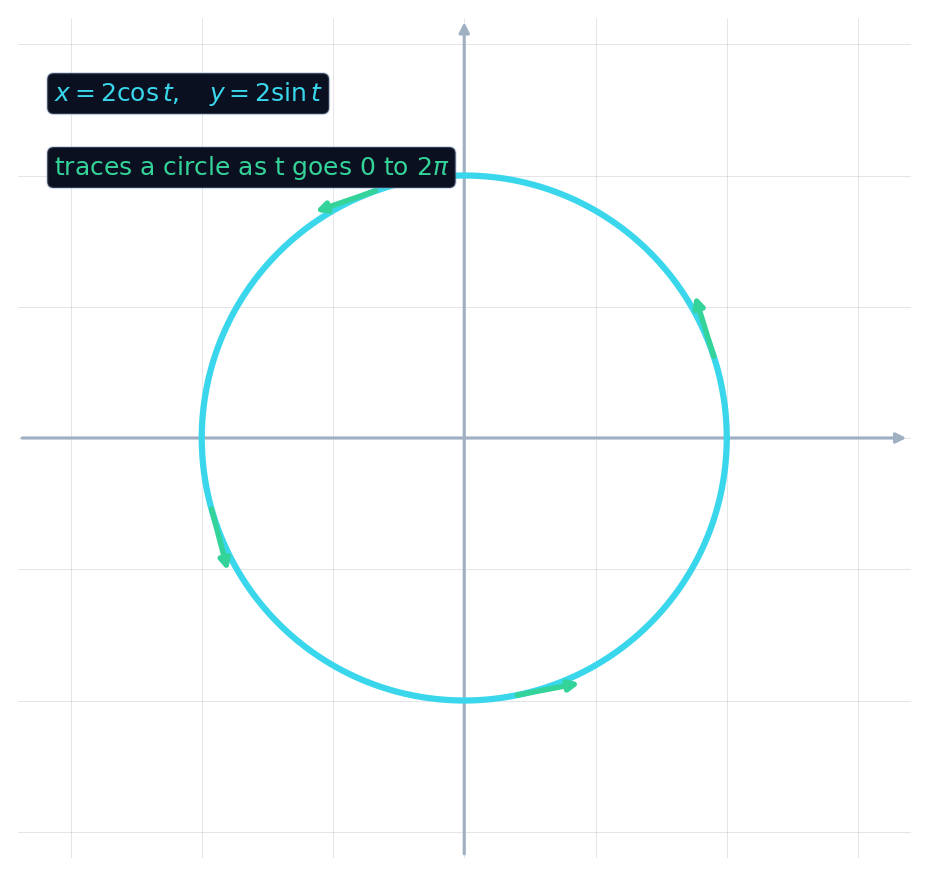
Sweep the angle to trace a circle · Barrido del ángulo para trazar un círculo
As the parameter (an angle) sweeps from 0 to 2 pi, the point (cos t, sin t) travels once around the circle. · A medida que el parámetro (un ángulo) se barre de 0 a 2π, el punto (cos t, sin t) recorre una vez la circunferencia.
Which parametric equations trace a circle of radius $r$ centred at the origin? · ¿Qué ecuaciones paramétricas trazan un círculo de radio $r$ centrado en el origen?
From the unit circle scaled by $r$: $x = r\cos t$ and · y $y = r\sin t$ trace the circle as $t$ goes $0$ to · hasta $2\pi$. · Desde el círculo unitario escalado por $r$: $x = r\cos t$ e $y = r\sin t$ trazan el círculo cuando $t$ va de $0$ a $2\pi$.
The parametrization $x = \cos t,\ y = \sin t$ comes directly from the ____. · La parametrización $x = \cos t,\ y = \sin t$ proviene directamente de la ____.
A point on the unit circle at angle $t$ is $(\cos t, \sin t)$ — the natural parametrization of a circle. · Un punto en el círculo unitario en el ángulo $t$ es $(\cos t, \sin t)$ — la parametrización natural de un círculo.
Select all · todos true statements. · Seleccione todas las afirmaciones verdaderas.
A circle can be parametrized (that is the whole point). The other three are correct. · Un círculo puede ser parametrizado (ese es todo el punto). Las otras tres son correctas.
Direction and speed
- The parametrization sets not just the shape but the way it is drawn.
- $x = \cos t, y = \sin t$ goes counter-clockwise; $x = \cos t, y = -\sin t$ goes clockwise.
- Replacing $t$ with $2t$ traces the same circle twice as fast.
- So the same circle has many parametrizations, each with its own motion.
Dirección y velocidad
- La parametrización define no solo la forma, sino la manera en que se dibuja.
- $x = \cos t, y = \sin t$ va en sentido antihorario; $x = \cos t, y = -\sin t$ va en sentido horario.
- Reemplazar $t$ por $2t$ traza el mismo círculo dos veces más rápido.
- Por tanto, el mismo círculo tiene muchas parametrizaciones, cada una con su propio movimiento.
Restricting $t$ to · hasta $0 \le t \le \pi$ in · hacia adentro $x = \cos t,\ y = \sin t$ traces only the top half of the circle. · Restringir $t$ a $0 \le t \le \pi$ en $x = \cos t,\ y = \sin t$ traza solo la mitad superior del círculo.
From $t = 0$ to · hasta $\pi$, $y = \sin t \ge 0$, so only the upper semicircle is drawn. · De $t = 0$ a $\pi$, $y = \sin t \ge 0$, por lo que solo se dibuja el semicírculo superior.
Drawing only part
- Restricting the parameter interval draws just an arc.
- $0 \le t \le \pi$ in $(\cos t, \sin t)$ gives only the top half of the circle.
- For a line, restricting $t$ gives a segment or a ray.
- Choose the interval to draw exactly the piece you want.
Dibujar solo una parte
- Restringir el intervalo del parámetro dibuja solo un arco.
- $0 \le t \le \pi$ en $(\cos t, \sin t)$ da solo la mitad superior del círculo.
- Para una recta, restringir $t$ da un segmento o una semirrecta.
- Elige el intervalo para dibujar exactamente la pieza que deseas.
The parametric form of a circle is not unique. $(\cos t, \sin t)$ and $(\sin t, \cos t)$ both trace the unit circle, but start at different points and go in different directions. Always check the starting point and direction, not just the shape.
La forma paramétrica de un círculo no es única. $(\cos t, \sin t)$ y $(\sin t, \cos t)$ trazan ambos la circunferencia unitaria, pero comienzan en puntos diferentes y van en direcciones distintas. Siempre verifica el punto de inicio y la dirección, no solo la forma.
Parametrize the circle of radius $3$ centred at $(1, -2)$.
- Start from the unit-circle form and scale by $3$: $3\cos t$, $3\sin t$.
- Shift the centre to $(1, -2)$: $x = 1 + 3\cos t$, $y = -2 + 3\sin t$.
- As $t$ goes $0$ to $2\pi$, this traces the full circle once.
Parametriza el círculo de radio $3$ centrado en $(1, -2)$.
- Comienza con la forma de la circunferencia unitaria y escala por $3$: $3\cos t$, $3\sin t$.
- Desplaza el centro a $(1, -2)$: $x = 1 + 3\cos t$, $y = -2 + 3\sin t$.
- A medida que $t$ va de $0$ a $2\pi$, esto traza el círculo completo una vez.
A line is $x = x_0 + at,\ y = y_0 + bt$ (a point plus a direction). A circle of radius $r$ is $x = r\cos t,\ y = r\sin t$, straight from the unit circle. These parametric equations let the parameter $t$ set the shape, direction, and speed — restrict $t$ to draw only an arc or segment.
Una recta es $x = x_0 + at,\ y = y_0 + bt$ (un punto más una dirección). Un círculo de radio $r$ es $x = r\cos t,\ y = r\sin t$, directamente de la circunferencia unitaria. Estas ecuaciones paramétricas permiten que el parámetro $t$ defina la forma, la dirección y la velocidad; restringe $t$ para dibujar solo un arco o segmento.