Angular Momentum and Angular Impulse
Introducido| English | Significado |
|---|---|
| angular momentum/ˈæŋɡjʊlə məʊˈmentəm/ | momento angular |
| angular impulse/ˈæŋɡjʊlə ˈɪmpʌls/ | impulso angular |
The spin that won't quit
- A spinning top stays upright and keeps turning.
- A figure skater glides through a spin for many seconds.
- Something about the motion resists being stopped.
- Spinning objects carry a stubborn "quantity of turning."
Angular momentum
- Angular momentum 角动量 measures how much turning an object carries:
- About the spin axis, this component is rotational inertia times signed angular velocity; angular momentum as a whole is a vector.
- It is the rotational twin of linear momentum $p = mv$.
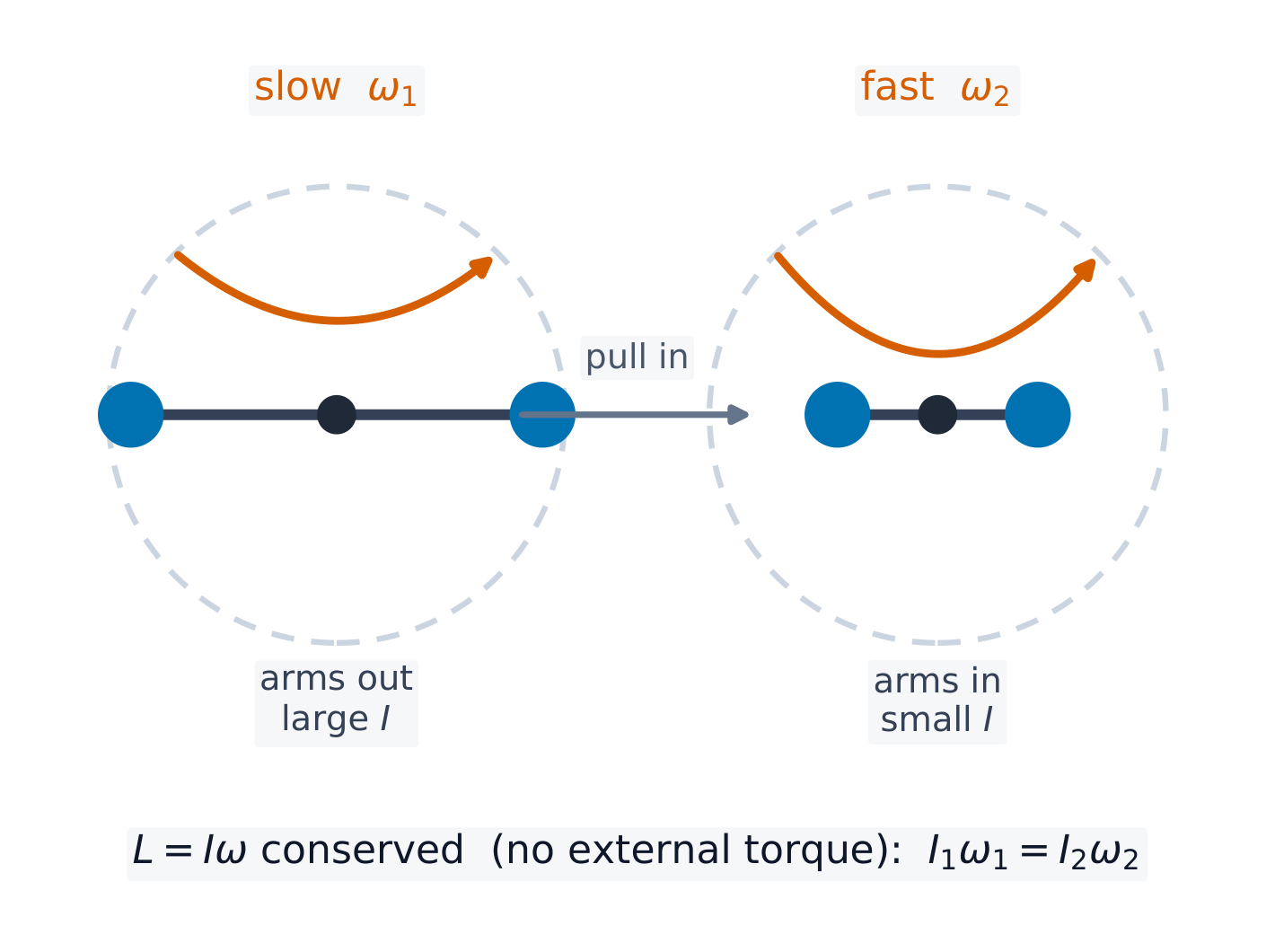
A spinning skater pulls in her arms: I falls, so ω rises and L = Iω stays constant
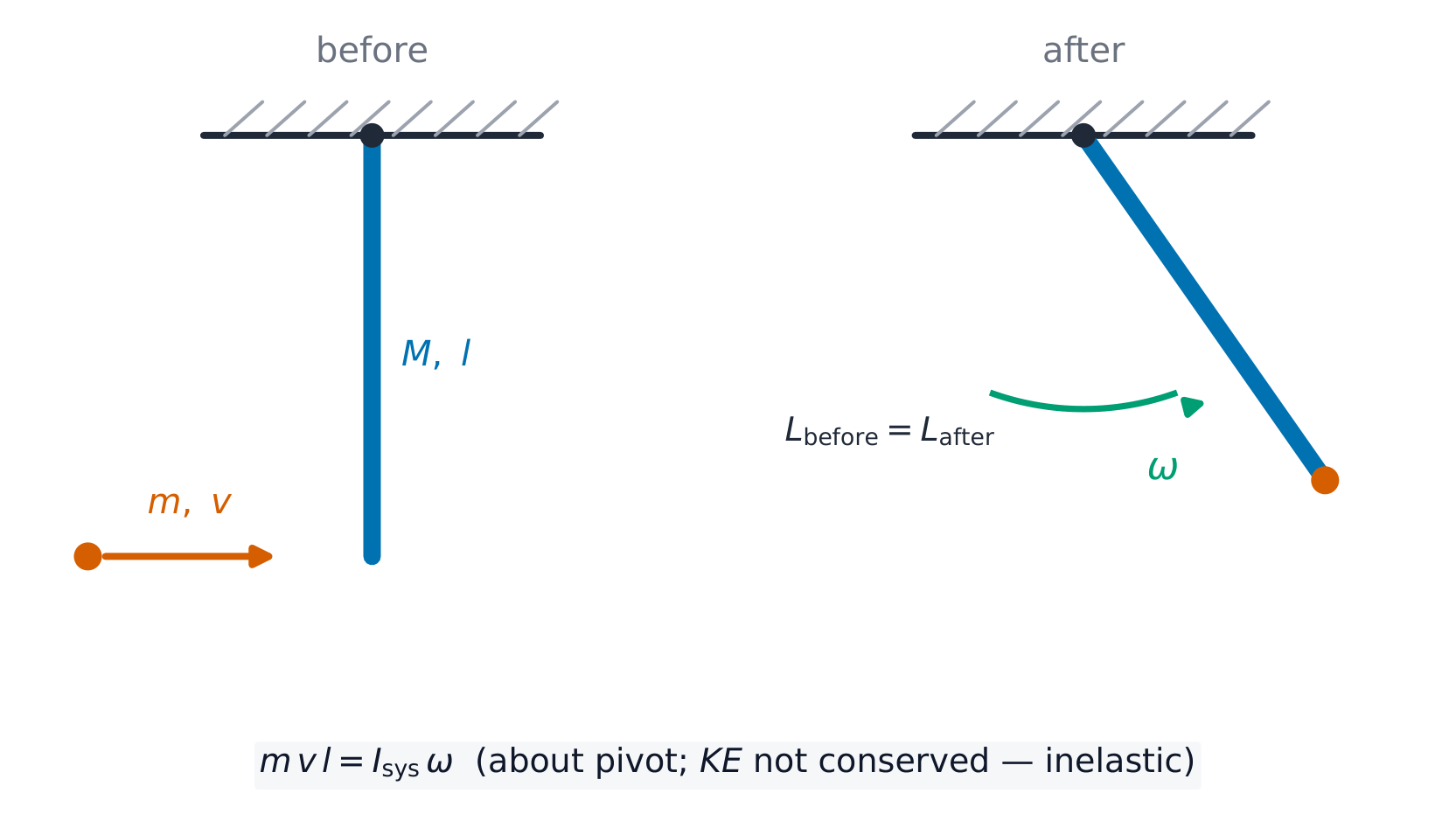
A bullet sticking in a pivoted rod: angular momentum about the pivot is conserved
A flywheel with $I = 5\ \text{kg}\cdot\text{m}^2$ spins at $\omega = 4\ \text{rad/s}$. Its angular momentum (in kg·m²/s)?
Dificultad 2/5 · 140 monedas + un pequeño bono en el primer intento de hoy
$L = I\omega = 5 \times 4 = 20\ \text{kg}\cdot\text{m}^2/\text{s}$.
Angular momentum $L = I\omega$ is the rotational twin of which linear quantity?
Dificultad 1/5 · 100 monedas + un pequeño bono en el primer intento de hoy
$I$ mirrors $m$ y $\omega$ mirrors $v$, so $L = I\omega$ mirrors $p = mv$.
A mass moving in a circle
- A point mass $m$ moving tangentially at speed $v$ in a circle of radius $r$ has angular-momentum magnitude about the center:
- Farther out or faster means more angular momentum.
- This is why pulling in your arms changes a skater's spin.
A $2\ \text{kg}$ ball moves at $3\ \dfrac{\text{m}}{\text{s}}$ in a circle of radius $4\ \text{m}$. Find its angular momentum magnitude about the axis through the circle center perpendicular to its plane (in kg·m²/s).
Dificultad 2/5 · 140 monedas + un pequeño bono en el primer intento de hoy
$L = mvr = 2 \times 3 \times 4 = 24\ \text{kg}\cdot\text{m}^2/\text{s}$.
Angular impulse changes L
- A constant net torque about a fixed axis acting for a time delivers angular impulse 角冲量; if torque varies, integrate it over time:
- It is the rotational twin of $F\,\Delta t = \Delta p$.
- Equivalently $\tau = \dfrac{dL}{dt}$: torque is the rate of change of angular momentum.
Angular momentum
Angular momentum is rotational inertia times angular speed.
A constant net torque of $3\ \text{N}\cdot\text{m}$ acts about a fixed axis for $5\ \text{s}$. Find the change in angular momentum about that axis (in kg·m²/s).
Dificultad 2/5 · 140 monedas + un pequeño bono en el primer intento de hoy
$\Delta L = \tau\,\Delta t = 3 \times 5 = 15\ \text{kg}\cdot\text{m}^2/\text{s}$.
Torque equals the rate of change of angular momentum, $\tau = dL/dt$.
Dificultad 1/5 · 100 monedas + un pequeño bono en el primer intento de hoy
This is Newton's second law for rotation in momentum form.
A wheel with $I = 3\ \text{kg}\cdot\text{m}^2$ spins at $\omega = 2\ \text{rad/s}$.
- Angular momentum: $L = I\omega = 3 \times 2 = 6\ \text{kg}\cdot\text{m}^2/\text{s}$.
- A steady torque $\tau = 4\ \text{N}\cdot\text{m}$ for $3\ \text{s}$ adds $\Delta L = 12$, so $L$ rises to $18$.
To state an object's angular momentum meaningfully, you must also give the...
Dificultad 1/5 · 100 monedas + un pequeño bono en el primer intento de hoy
Angular momentum is defined relative to an axis; different axes give different $L$.
Angular momentum depends on the axis you measure it about — always state the axis. And $L = mvr$ uses the perpendicular distance from the axis to the line of motion; if the velocity is not perpendicular to $r$, keep only the perpendicular component ($L = mv_\perp r$).
Angular momentum $L = I\omega$ (or $L = mvr$ for a point mass) is the rotational twin of $p = mv$. A torque acting over time is an angular impulse that changes it: $\tau\,\Delta t = \Delta L$, or $\tau = dL/dt$. Always name the axis, and use the perpendicular distance.
Write from the data: find the angular momentum
- A flywheel with rotational inertia 6 spins at 3 rad/s.
- Find its angular momentum.
A flywheel has rotational inertia 6 kg m squared and spins at 3 rad/s. What is its angular momentum about the spin axis?
6 times 3 is 18.
A flywheel has rotational inertia 6 kg m squared about its spin axis and spins at 3 rad/s. What is its angular momentum magnitude about that axis, in kg m squared per second?
Dificultad 1/5 · 100 monedas + un pequeño bono en el primer intento de hoy
Inertia times angular speed is 6 times 3. Other options — 20 (the lesson flywheel); 6 (the inertia used as the momentum).