Electric Potential
Introducido| English | Significado |
|---|---|
| volt/vəʊlt/ | voltio |
| electric potential/ɪˈlektrɪk pəˈtenʃl/ | potencial eléctrico |
| equipotential/ˌiːkwɪpəˈtenʃl/ | equipotencial |
| gradient/ˈɡreɪdɪənt/ | gradiente |
The "height" of the electric landscape
- Imagine the field as a hilly landscape and charge as a ball.
- Potential tells you the "height" at each point — energy per unit charge.
- A $+$ charge rolls downhill (to low potential); a $-$ charge rolls uphill.
- Because it is energy per charge, it is a scalar — no arrows to juggle.
Volts: energy per charge
- The electric potential 电势 $V$ is the potential energy per unit charge: $V = \dfrac{U}{q}$.
- Its unit is the volt 伏特 (1 V $= 1$ J/C).
- For a point charge: $V = \dfrac{kQ}{r}$ — positive near $+$, negative near $-$.
- The energy of a charge placed there is simply $U = qV$.
Potencial eléctrico $V$ is:
Dificultad 1/5 · 100 monedas + un pequeño bono en el primer intento de hoy
$V = U/q$ — potential energy per unit charge, in volts.
Scalars add the easy way
- Potential is a scalar, so many charges just add their $V$ values.
- $V = \sum \dfrac{kQ_i}{r_i}$ — no components, no angles.
- This is why potential is often easier to compute than the field.
- Find $V$ everywhere first, then get the field from it.
Potentials from several charges must be added as vectors, using their directions.
Dificultad 1/5 · 100 monedas + un pequeño bono en el primer intento de hoy
False. Potential is a scalar: $V = \sum kQ_i/r_i$, so you add the values with their signs. It is the electric field that must be added as vectors.
Two charges give $+50\ \text{V}$ y $-20\ \text{V}$ at a point. Find the total $V$ (in V).
Dificultad 2/5 · 140 monedas + un pequeño bono en el primer intento de hoy
Scalars add: $50 + (-20) = 30\ \text{V}$.
Equipotentials map the field
- An equipotential 等势面 is a line (or surface) of constant $V$.
- The electric field does no work moving a charge along an equipotential.
- Equipotentials are always perpendicular to field lines.
- For a point charge they are spheres (circles in a cross-section); for a uniform field, parallel planes.
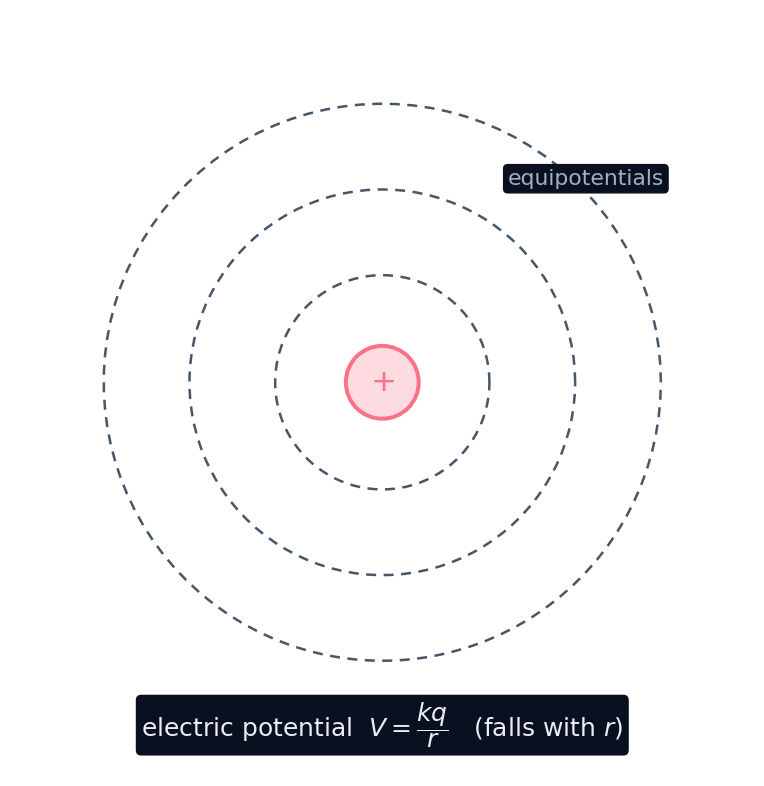
Field and equipotentials
See how the field lines from a charge cross its circular equipotentials at right angles.
Equipotential surfaces are always ____ to the electric field lines.
Dificultad 1/5 · 100 monedas + un pequeño bono en el primer intento de hoy
Field lines cross equipotentials at right angles.
Field is the slope of potential
- The field points downhill, from high $V$ to low $V$.
- In one dimension its signed component is $E_x = -\dfrac{dV}{dx}$; in three dimensions, $\vec E = -\nabla V$ (a gradient 梯度).
- Closely packed equipotentials at equal potential intervals mean a steep slope — a strong field.
- So $E$ (a vector) and $V$ (a scalar) carry the same information.
Where equipotential surfaces at equal voltage intervals are packed closely together, the field is:
Dificultad 1/5 · 100 monedas + un pequeño bono en el primer intento de hoy
A steep potential slope ($E = -dV/dx$) means a strong field.
Select todos true statements about $V$ y $E$.
Dificultad 2/5 · 140 monedas + un pequeño bono en el primer intento de hoy
$V$ scalar, $E$ vector, $E = -dV/dx$. But $V=0$ does NOT force $E=0$.
Two charges give $V = +30\ \text{V}$ and $V = -12\ \text{V}$ at a point. What is the total potential?
- Potential is a scalar, so just add: $V = 30 + (-12)$.
- $V = +18\ \text{V}$ — no vectors needed.
Worked examples: a continuous charge, then energy
1. Potential on the axis of a ring (charge $Q$, radius $R$), at distance $x$ from its centre.
- Every bit of charge $dq$ is the same distance $\sqrt{x^2+R^2}$ away, and potential is a scalar, so just add: $V=\dfrac{kQ}{\sqrt{x^2+R^2}}$.
- Then the field from the slope: $E_x=-\dfrac{dV}{dx}=\dfrac{kQx}{(x^2+R^2)^{3/2}}$. This is zero at the centre, as symmetry says.
2. Potential difference to speed. A proton ($m=1.67\times10^{-27}$ kg, $q=1.6\times10^{-19}$ C) starts at rest and accelerates through $1000$ V.
- Energy conservation: $q\Delta V=\tfrac12mv^2$, so $v=\sqrt{\dfrac{2q\Delta V}{m}}=4.4\times10^5$ m/s.
Along the x-axis, V(x) = 4x² − 6x volts (x in metres). Find E_x at x = 2.0 m.
Dificultad 2/5 · 140 monedas + un pequeño bono en el primer intento de hoy
E_x = −dV/dx = −(8x − 6) = −(16 − 6) = −10 V/m: the field points in the −x direction.
An electron (m = 9.11 × 10⁻³¹ kg, q = 1.6 × 10⁻¹⁹ C) starts at rest and moves through a potential difference of 50 V. Find its speed in units of 10⁶ m/s.
Dificultad 2/5 · 140 monedas + un pequeño bono en el primer intento de hoy
v = √(2qΔV/m) = √(2 × 1.6 × 10⁻¹⁹ × 50 / 9.11 × 10⁻³¹) = 4.19 × 10⁶ m/s.
$V$ is a scalar; $E$ is a vector. They are not the same: at the midpoint between two equal opposite charges, $V = 0$ but $E$ is not zero. Never assume "$V=0$ means $E=0$".
Electric potential is energy per charge, $V = U/q$ (volts), a scalar you can add: $V = \sum kQ_i/r_i$. Equipotentials are constant-$V$ surfaces, perpendicular to the field, and the signed field component is $E_x = -dV/dx$ in one dimension.
Write from the data: find the potential
- One charge contributes +40 volts at a point. Another contributes -8 volts there.
- Find the total potential. Say why the fields are not added in the same way.
At one point two charges contribute +40 volts and -8 volts. What is the total potential, and why is the field addition different?
40 plus -8 is 32. Scalars add directly. Fields need components.
Two source charges contribute +40 volts and -8 volts at the same point. What is the total potential?
Dificultad 1/5 · 100 monedas + un pequeño bono en el primer intento de hoy
40 plus -8 is 32 volts.