Types of Radioactive Decay
Introducido| English | Significado |
|---|---|
| alpha/ˈælfə/ | alfa |
| beta/ˈbiːtə/ | beta |
| gamma/ˈɡæmə/ | gamma |
| half-life/hɑːf laɪf/ | vida media |
Some atoms are unstable — and throw out particles to fix it
- A few kinds of atom have nuclei that are simply too unstable to last.
- To settle down, they decay, hurling out a particle or a burst of energy at random.
- The three flavours are alpha, beta and gamma radiation.
- Knowing which is which tells you how dangerous and how penetrating the radiation is.
Alpha, beta, gamma
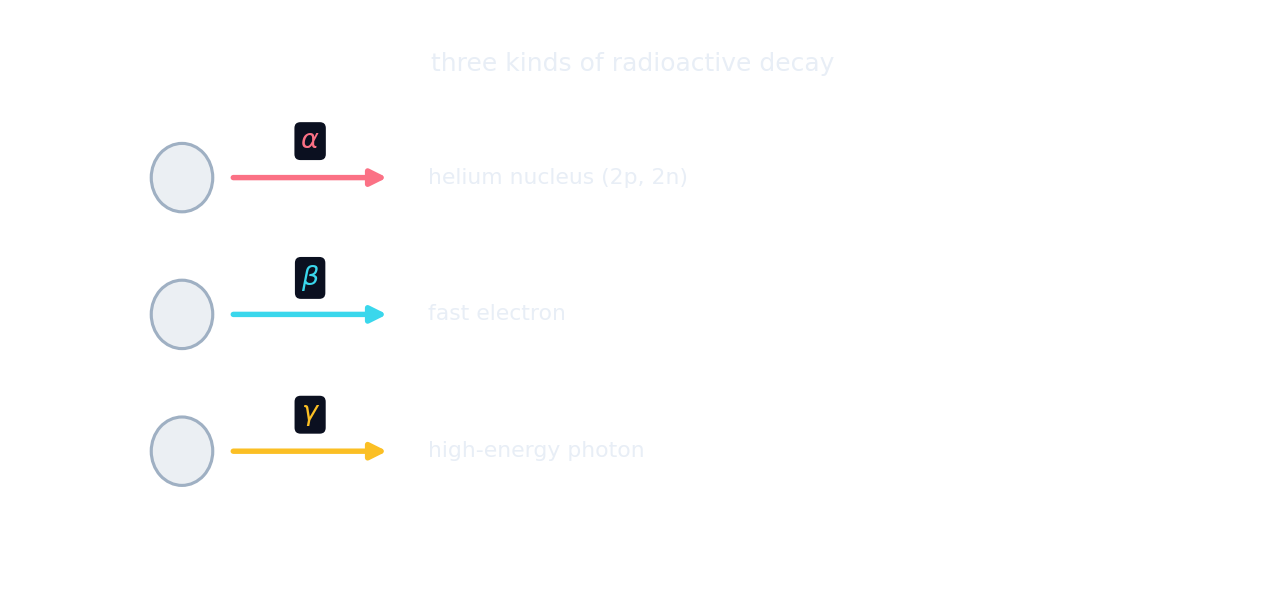
- Alpha 阿尔法 ($\alpha$) — a heavy helium nucleus (2 protons, 2 neutrons); slow and highly ionising.
- Beta 贝塔: in beta-minus decay, a neutron becomes a proton, emitting an electron and an antineutrino; beta-plus decay emits a positron and neutrino as a proton becomes a neutron.
- Gamma 伽马 ($\gamma$) — a burst of high-energy photon, no mass or charge, from a nucleus settling down.
- Each is emitted by an unstable nucleus trying to reach a stable state.
Balance a decay
Choose alpha, beta or gamma and see how the nucleus changes and the equation balances.
An alpha particle is:
Dificultad 1/5 · 100 monedas + un pequeño bono en el primer intento de hoy
An alpha particle is a helium nucleus — 2 protons and 2 neutrons.
In beta-minus decay, the charged particle emitted by the nucleus is a fast ____.
Dificultad 1/5 · 100 monedas + un pequeño bono en el primer intento de hoy
In beta-minus decay a neutron becomes a proton, an electron and an antineutrino. Beta-plus decay instead emits a positron and a neutrino.
Penetration and danger
- Alpha is stopped by paper or skin — but dangerous if swallowed (it ionises heavily).
- Beta passes through paper but is stopped by a few millimetres of aluminium.
- Gamma is the most penetrating, needing thick lead or concrete to reduce it.
- Alpha deposits energy densely along a short track; total harm also depends on energy, absorbed dose and where the radioactive material is.
Which radiation is the most penetrating?
Dificultad 1/5 · 100 monedas + un pequeño bono en el primer intento de hoy
Gamma is generally the most penetrating of these three types. Thick lead or concrete attenuates it; shielding does not guarantee complete removal.
Select todos true statements about radioactive decay.
Dificultad 2/5 · 140 monedas + un pequeño bono en el primer intento de hoy
Alpha particles are helium nuclei and can be stopped by paper or intact skin. Gamma is generally the most penetrating of these three, but it can still deposit energy; total harm depends on dose and circumstances.
Half-life
- Radioactive decay is random, but on average a sample halves its activity in a fixed half-life 半衰期.
- After one half-life, half the unstable nuclei have decayed; after two, a quarter remain.
- Half-lives range from fractions of a second to billions of years.
- Carbon-dating and nuclear-waste storage both hinge on the half-life.
A sample starts with 80 unstable nuclei of half-life 2 years. What is the expected number of undecayed parent nuclei after 4 years?
Dificultad 2/5 · 140 monedas + un pequeño bono en el primer intento de hoy
$4$ years = two half-lives: $80 \to 40 \to 20$.
Radioactive decay is random, but a sample halves its activity each half-life on average.
Dificultad 1/5 · 100 monedas + un pequeño bono en el primer intento de hoy
Individual decays are random; the half-life is the average time to halve.
Penetration and ionisation are different properties. Alpha produces dense ionisation over a short range and can be especially hazardous internally; gamma can also deposit damaging energy. Do not rank total risk from penetration alone: dose, energy and location matter.
A radioactive sample has a half-life of $2$ years and starts with $80$ unstable nuclei. What is the expected number remaining after $4$ years?
- $4$ years is two half-lives.
- Expected counts: after one half-life, $80/2 = 40$; after two, $40/2 = 20$ nuclei remain. A small sample can fluctuate around these means.
Unstable nuclei decay by emitting alpha (helium nucleus), beta (fast electron) or gamma (photon) radiation. Gamma is the most penetrating; alpha the most ionising (dangerous inside). Decay is random, but a sample halves its activity each half-life — the basis of carbon dating.
Write from the data given
- A sample starts with 200 unstable nuclei and has a half-life of 4 hours.
- Find the expected number of undecayed parent nuclei after 12 hours; individual decays are random.
A sample starts with 200 unstable nuclei of half-life 4 hours. What is the expected number of undecayed parent nuclei after 12 hours?
Three halvings take 200 to 25.
A sample starts with 200 unstable nuclei of half-life 4 hours. What is the expected number of undecayed parent nuclei after 12 hours?
Dificultad 1/5 · 100 monedas + un pequeño bono en el primer intento de hoy
12/4 = 3 half-lives, so the expected surviving count is 200 × (1/2)^3 = 200/8 = 25. 20 belongs to the earlier example; 100 is the expected count after one half-life.