Blackbody Radiation · Radiación de Cuerpo Negro
| English | Español |
|---|---|
| blackbody radiation/ˈblækbɒdi ˌreɪdɪˈeɪʃn/ | radiación de cuerpo negro |
Heat metal and it glows red, then orange, then white
- A cool poker is dark; heat it and it glows a dull red, then orange, then dazzling white.
- Every warm object glows — the colour tells you its temperature.
- This glow is blackbody radiation 黑体辐射, given off by all hot bodies.
- Explaining its shape needed a brand-new idea — the birth of quantum theory.
Calienta metal y brilla rojo, luego naranja, luego blanco
- Una parrilla fría es oscura; al calentarla, brilla con un rojo apagado, luego naranja, y finalmente un blanco deslumbrante.
- Todo objeto cálido brilla — el color te indica su temperatura.
- Este brillo es la radiación de cuerpo negro, emitida por todos los cuerpos calientes.
- Explicar su forma requirió una idea completamente nueva: el nacimiento de la teoría cuántica.
The radiation curve
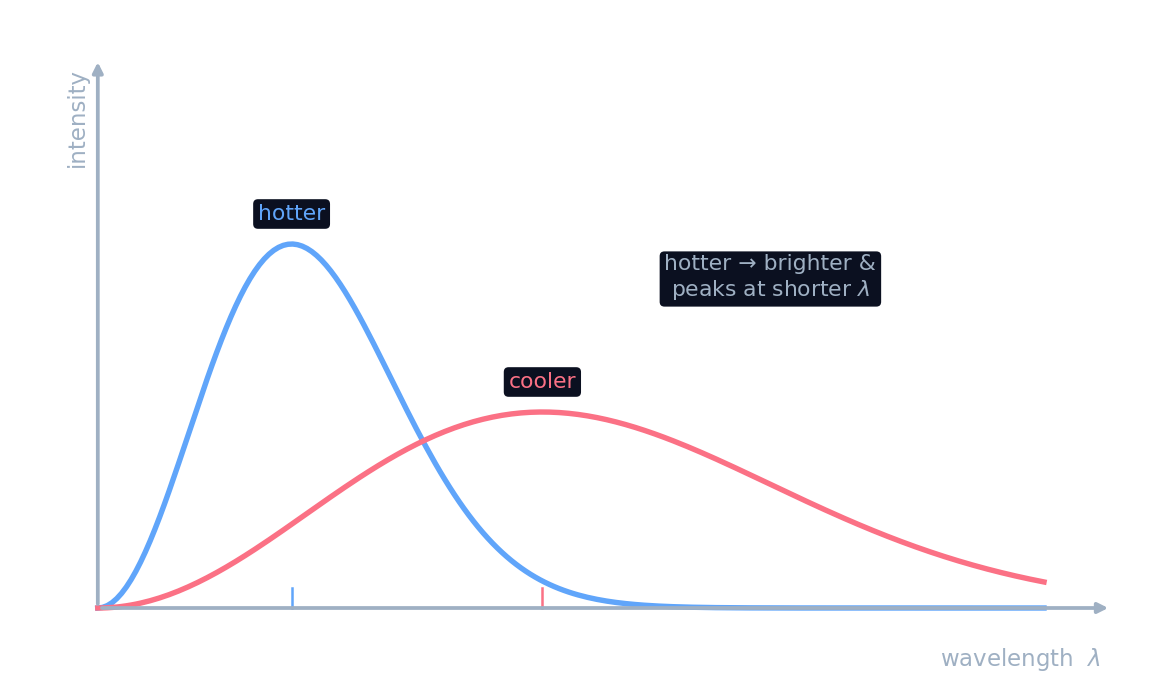
- A hot body emits a smooth spread of wavelengths, with a clear peak.
- Plot intensity against wavelength and you get a curve that rises to a peak, then falls.
- A hotter body glows brighter (a taller curve) at every wavelength.
- Its peak also shifts to a shorter wavelength — from red toward blue.
La curva de radiación
- Un cuerpo caliente emite una distribución suave de longitudes de onda, con un pico claro.
- Al graficar la intensidad frente a la longitud de onda, obtienes una curva que sube hasta un pico y luego desciende.
- Un cuerpo más caliente brilla más fuerte (una curva más alta) en todas las longitudes de onda.
- Su pico también se desplaza hacia una longitud de onda más corta — desde el rojo hacia el azul.
As a blackbody gets hotter, its peak wavelength: · A medida que un cuerpo negro se calienta, su longitud de onda pico:
A hotter body peaks at a shorter wavelength — the glow shifts toward blue. · Un cuerpo más caliente tiene su pico en una longitud de onda más corta: el resplandor se desplaza hacia el azul.
A hotter blackbody emits more intensity at every wavelength than a cooler one. · Un cuerpo negro más caliente emite mayor intensidad en todas las longitudes de onda que uno más frío.
The hotter curve is taller at all wavelengths. · La curva del cuerpo más caliente es más alta en todas las longitudes de onda.
Colour tells temperature
- Because the peak shifts with temperature, the colour of the glow reveals how hot something is.
- A red star is cooler; a blue-white star is hotter (the opposite of the "hot = red" everyday feel).
- Astronomers judge a star's temperature from the colour of its light.
- Even your own body glows — in the infrared, which thermal cameras see.
El color indica la temperatura
- Dado que el pico se desplaza con la temperatura, el color del brillo revela qué tan caliente está algo.
- Una estrella roja es más fría; una estrella blanco-azulada es más caliente (lo opuesto a la sensación cotidiana de que "caliente = rojo").
- Los astrónomos determinan la temperatura de una estrella a partir del color de su luz.
- Incluso tu propio cuerpo brilla — en el infrarrojo, que ven las cámaras térmicas.
A red star and a blue-white star: which is hotter? · Una estrella roja y una estrella blanco-azulada: ¿cuál es más caliente?
Blue-white light peaks at a shorter wavelength, so that star is hotter. · La luz blanco-azulada tiene su pico en una longitud de onda más corta, por lo que esa estrella es más caliente.
The colour of a glowing object can be used to estimate its temperature. · El color de un objeto incandescente puede usarse para estimar su temperatura.
The peak wavelength (colour) shifts with temperature, so colour reveals it. · La longitud de onda pico (color) cambia con la temperatura, por lo que el color la revela.
Select all · todos true statements about blackbody radiation. · Selecciona todas las afirmaciones verdaderas sobre la radiación de cuerpo negro.
Hotter = brighter, peak bluer, colour = temperature. Classical physics failed; Planck's quanta were needed. · Más caliente = más brillante, pico más azul, color = temperatura. La física clásica falló; se necesitaron los cuantos de Planck.
Why it launched quantum theory
- Classical physics predicted a hot body should blast out infinite ultraviolet energy — clearly wrong.
- Max Planck fixed it by assuming energy comes in quanta (packets), $E = hf$.
- That single quantum assumption gave the correct curve — and started quantum physics.
- Blackbody radiation is where the quantum world first announced itself.
Por qué lanzó la teoría cuántica
- La física clásica predecía que un cuerpo caliente debería emitir energía ultravioleta infinita — claramente incorrecto.
- Max Planck lo solucionó asumiendo que la energía viene en cuantos (paquetes), $E = hf$.
- Esa única suposición cuántica dio la curva correcta — e inició la física cuántica.
- La radiación de cuerpo negro es donde el mundo cuántico anunció su existencia por primera vez.
Hotter or cooler blackbody? · ¿Cuerpo negro más caliente o más frío?
A blackbody's spectrum shifts with temperature. Sort each fact. · El espectro de un cuerpo negro cambia con la temperatura. Clasifica cada afirmación.
Planck explained the blackbody curve by assuming energy comes in packets called ____. · Planck explicó la curva del cuerpo negro asumiendo que la energía viene en paquetes llamados ____.
Energy quanta ($E = hf$) gave the correct curve and started quantum theory. · Los cuantos de energía ($E = hf$) produjeron la curva correcta e iniciaron la teoría cuántica.
For a hotter body, the peak shifts to a shorter wavelength (toward blue), not a longer one. This is the reverse of everyday intuition where "hot = red". A blue-white star is much hotter than a red one.
Para un cuerpo más caliente, el pico se desplaza hacia una longitud de onda más corta (hacia el azul), no hacia una más larga. Esto es lo opuesto a la intuición cotidiana donde "caliente = rojo". Una estrella blanco-azulada es mucho más caliente que una roja.
Two stars glow, one red and one blue-white. Which is hotter?
- The blue-white star is hotter — its blackbody peak is at a shorter wavelength.
- The red star is cooler, with its peak toward longer wavelengths.
Dos estrellas brillan, una roja y otra blanco-azulada. ¿Cuál es más caliente?
- La estrella blanco-azulada es más caliente — su pico de cuerpo negro está en una longitud de onda más corta.
- La estrella roja es más fría, con su pico hacia longitudes de onda más largas.
Blackbody radiation is the glow of every hot object. A hotter body is brighter and its peak shifts to a shorter wavelength (bluer) — so colour reveals temperature. Explaining the curve required Planck's idea that energy comes in quanta ($E = hf$), launching quantum theory.
La radiación de cuerpo negro es el brillo de todo objeto caliente. Un cuerpo más caliente es más brillante y su pico se desplaza hacia una longitud de onda más corta (más azul), por lo que el color revela la temperatura. Explicar la curva requirió la idea de Planck de que la energía viene en cuantos ($E = hf$), lanzando la teoría cuántica.