Boundary Behavior of Waves and Polarization
Introducido| English | Significado |
|---|---|
| polariser/ˈpəʊlɑːraɪzə/ | Polarizador |
Why polarised sunglasses kill the glare off water
- Slip on polarised sunglasses and the harsh glare off a lake or road just melts away.
- They work by blocking light that vibrates in one particular direction.
- That trick only works on transverse waves — and it reveals what happens when waves meet a boundary.
- Boundaries reflect, transmit and filter waves in useful ways.
What happens at a boundary
- At many boundaries, part of a wave is reflected and part is transmitted; full reflection or negligible reflection can also occur.
- If speed changes at oblique incidence, a transmitted wave refracts; at normal incidence its direction stays the same.
- A displacement pulse on a string inverts at a fixed end and stays upright at a free end; reflection phase depends on the boundary, not density alone.
- How much reflects vs transmits depends on how different the two media are.
When a wave meets a boundary between two media, it generally:
Dificultad 1/5 · 100 monedas + un pequeño bono en el primer intento de hoy
Part of the wave reflects and part transmits (refracting) at a boundary.
Polarisation
- A transverse wave vibrates in a plane; unpolarised light has electric-field orientations spread across the plane perpendicular to travel.
- A polariser 偏振片 lets through only the vibrations in one direction — polarised light.
- Cross two polarisers at right angles and no light gets through.
- Reflected glare is partly polarised, which is why polarised lenses can block it.
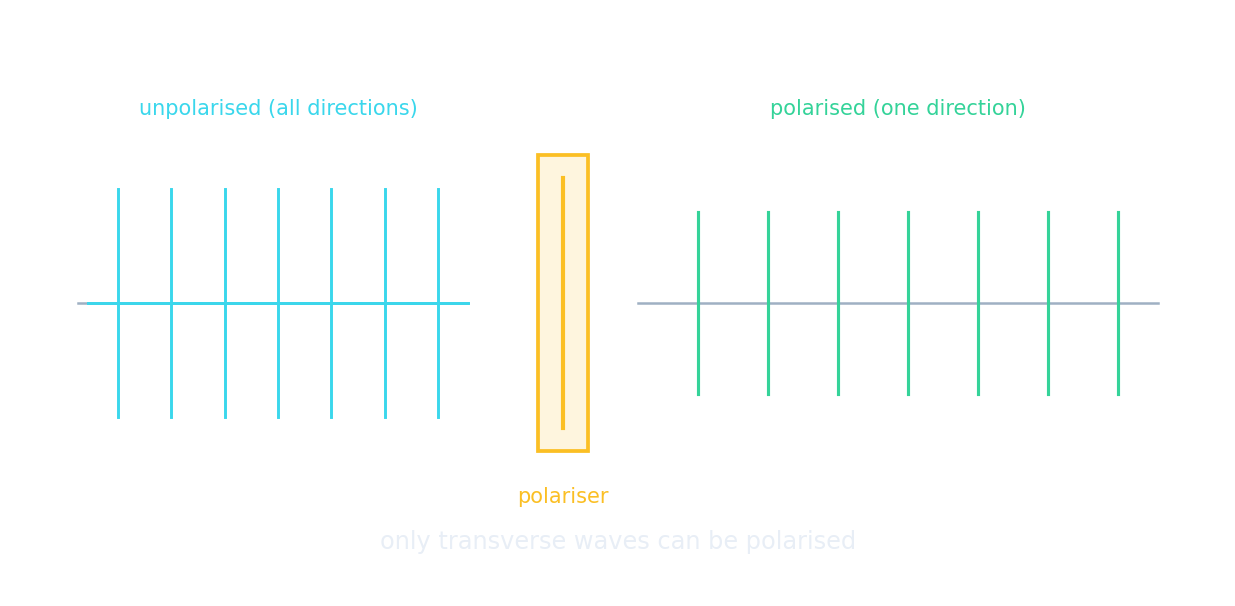
A transverse wave to polarise
See a transverse wave vibrating in a plane — the kind a polariser can filter.
Two polarisers are crossed at right angles. How much light passes through both?
Dificultad 1/5 · 100 monedas + un pequeño bono en el primer intento de hoy
The second polariser blocks the direction the first passed, so almost no light gets through.
Select todos true statements about polarisation and boundaries.
Dificultad 2/5 · 140 monedas + un pequeño bono en el primer intento de hoy
Polarisers filter one direction (transverse only), and boundaries split waves. Sound (longitudinal) cannot be polarised.
Only transverse waves polarise
- Because sound in air is longitudinal (it vibrates along its travel), it cannot be polarised.
- The fact that light can be polarised is direct proof that light is a transverse wave.
- Polarisation is used in sunglasses, LCD screens and stress-testing materials.
- It is one of the clearest ways to tell a transverse wave from a longitudinal one.
Which type of wave can be polarised?
Dificultad 1/5 · 100 monedas + un pequeño bono en el primer intento de hoy
Only transverse waves vibrate in a plane, so only they can be polarised.
Sound cannot be polarised because it is a longitudinal wave.
Dificultad 1/5 · 100 monedas + un pequeño bono en el primer intento de hoy
Sound vibrates along its travel direction, so there is no cross-direction to filter.
The fact that light can be polarised proves light is a ____ wave.
Dificultad 1/5 · 100 monedas + un pequeño bono en el primer intento de hoy
Only transverse waves can be polarised, so light must be transverse.
Only transverse waves can be polarised — sound in air cannot, because its vibration is along the direction of travel, not across it. If a wave can be polarised, that alone proves it is transverse.
Unpolarised light passes through one vertical polariser, then a second polariser turned to horizontal. How much light emerges?
- The first makes the light vertically polarised.
- The second (horizontal) blocks vertical vibrations, so almost no light gets through.
At many boundaries, a wave partly reflects and partly transmits; refraction changes direction at oblique incidence when wave speed changes. A polariser passes only one vibration direction, giving polarised light — possible only for transverse waves. That light polarises (and sound does not) proves light is transverse.
Write from the data: find the transmitted intensity
- Two ideal polarisers are crossed at 90 degrees.
- Say what intensity gets through the second one, and why a sound wave is different.
Light passes through an ideal polariser, then through a second ideal polariser whose axis is at 90 degrees to the first. What fraction of the light intensity gets through the second polariser, and can a sound wave be polarised in the same way?
Crossed ideal polarisers block the remaining transverse light.
Light passes through an ideal polariser and then a second ideal polariser with its axis at 90 degrees to the first. What intensity emerges from the second?
Dificultad 1/5 · 100 monedas + un pequeño bono en el primer intento de hoy
After the first polariser, the electric field is perpendicular to the second transmission axis, so zero intensity emerges. Half the intensity incident on the second would pass at 45 degrees; it is not half the original unpolarised intensity.