Reflection · Reflexión
| English | Español |
|---|---|
| law of reflection/lɔː ɒv rɪˈflekʃn/ | ley de reflexión |
| normal/ˈnɔːml/ | normal |
Light bounces off a mirror at a precise angle
- Shine a torch at a mirror and the beam bounces off — but not just anywhere.
- It leaves at exactly the same angle it arrived, mirror-flipped.
- This is the law of reflection 反射定律, obeyed by every mirror and shiny surface.
- Get this one rule and mirror images make perfect sense.
La luz rebota en un espejo con un ángulo preciso
- Si apuntas una linterna a un espejo, el haz rebotará — pero no hacia cualquier lugar.
- Sale con exactamente el mismo ángulo con el que llegó, invertido por el espejo.
- Esta es la ley de reflexión 反射定律, cumplida por cada espejo y superficie brillante.
- Si entiendes esta única regla, las imágenes reflejadas tendrán todo el sentido.
The law of reflection
- Angles are measured from the normal 法线 — the line perpendicular to the surface.
- The angle of incidence equals the angle of reflection: $\theta_i = \theta_r$.
- The incoming ray, the reflected ray and the normal all lie in one plane.
- This holds no matter what the angle — steep or shallow.
La ley de reflexión
- Los ángulos se miden desde la normal 法线 — la línea perpendicular a la superficie.
- El ángulo de incidencia es igual al ángulo de reflexión: $\theta_i = \theta_r$.
- El rayo incidente, el rayo reflejado y la normal están todos en un mismo plano.
- Esto se cumple sin importar cuál sea el ángulo — ya sea pronunciado o bajo.
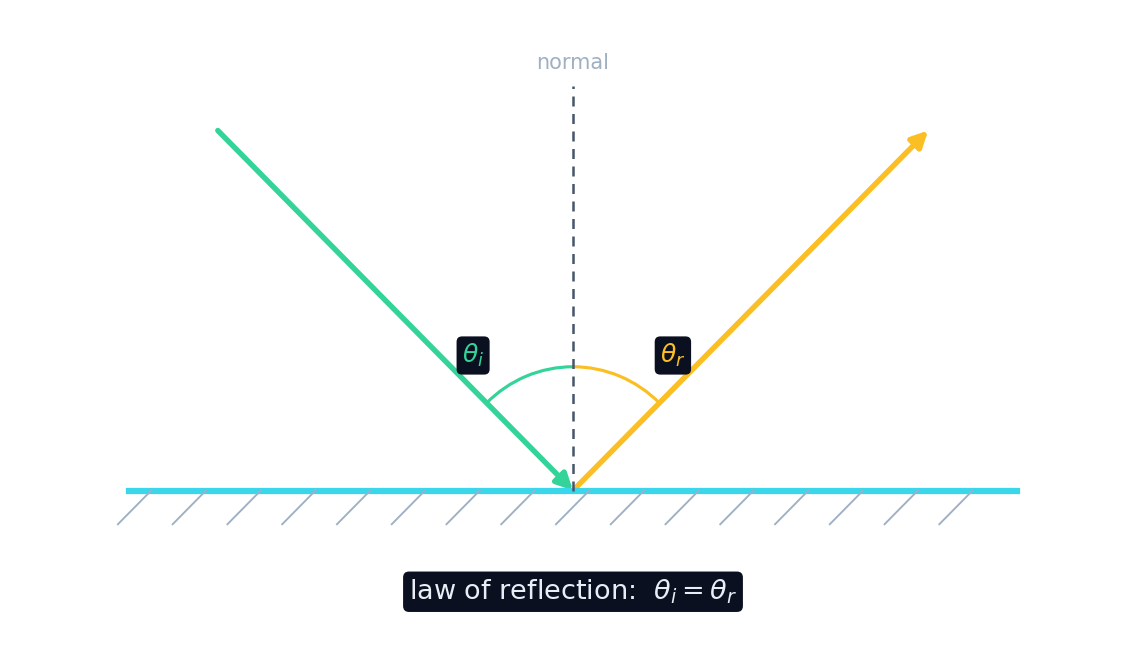
A ray strikes a mirror at $30^\circ$ to the normal. At what angle to the normal does it reflect, in degrees? · Un rayo incide sobre un espejo a $30^\circ$ respecto a la normal. ¿A qué ángulo respecto a la normal se refleja, en grados?
$\theta_r = \theta_i = 30^\circ$ by the law of reflection. · $\theta_r = \theta_i = 30^\circ$ según la ley de reflexión.
The law of reflection states that: · La ley de reflexión establece que:
$\theta_i = \theta_r$, both measured from the normal. · $\theta_i = \theta_r$, ambos medidos desde la normal.
Smooth vs rough surfaces
- A smooth surface (a mirror) reflects a beam neatly — specular reflection.
- A rough surface scatters light every which way — diffuse reflection.
- Both obey $\theta_i = \theta_r$ at each tiny point; the roughness just points the normals every way.
- Diffuse reflection is why you can see this page from any angle.
Superficies lisas vs. rugosas
- Una superficie lisa (un espejo) refleja un haz de manera ordenada — reflexión especular.
- Una superficie rugosa dispersa la luz en todas direcciones — reflexión difusa.
- Ambas obedecen $\theta_i = \theta_r$ en cada punto microscópico; la rugosidad simplemente orienta las normales en todas direcciones.
- La reflexión difusa es la razón por la que puedes ver esta página desde cualquier ángulo.
Why can you read this page from many angles? · ¿Por qué puedes leer esta página desde muchos ángulos diferentes?
The rough paper scatters light diffusely, so it reaches your eyes from any angle. · El papel rugoso dispersa la luz de forma difusa, por lo que llega a tus ojos desde cualquier ángulo.
Select all · todos true statements about reflection. · Selecciona todas las afirmaciones verdaderas sobre la reflexión.
Reflection obeys $\theta_i = \theta_r$ from the normal, smooth = specular. Rough surfaces still obey it at each point. · La reflexión obedece $\theta_i = \theta_r$ desde la normal; superficie lisa = especular. Las superficies rugosas aún así la obedecen en cada punto.
Always measure from the normal
- The single most common slip is measuring the angle from the surface instead of the normal.
- The normal is the perpendicular line; angles in optics are always taken from it.
- A ray hitting a mirror "flat" ($\theta_i \approx 90^\circ$ from the normal) grazes off almost flat.
- A ray straight down the normal ($\theta_i = 0$) reflects straight back.
Siempre mide desde la normal
- El error más común es medir el ángulo respecto a la superficie en lugar de respecto a la normal.
- La normal es la línea perpendicular; los ángulos en óptica se siempre toman desde ella.
- Un rayo que golpea un espejo "de lado" ($\theta_i \approx 90^\circ$ respecto a la normal) raspa casi paralelo a la superficie.
- Un rayo que entra recto por la normal ($\theta_i = 0$) se refleja directamente hacia atrás.
The law of reflection · La ley de reflexión
For a mirror, the angle of reflection always equals the angle of incidence - a straight line through the origin. · Para un espejo, el ángulo de reflexión siempre es igual al ángulo de incidencia: una línea recta que pasa por el origen.
In optics, angles are always measured from the ____ (the perpendicular line). · En óptica, los ángulos siempre se miden desde la ____ (la línea perpendicular).
The normal is perpendicular to the surface; all optics angles use it. · La normal es perpendicular a la superficie; todos los ángulos ópticos la utilizan.
A ray at $30^\circ$ to the mirror surface is at $60^\circ$ to the normal. · Un rayo a $30^\circ$ respecto a la superficie del espejo está a $60^\circ$ respecto a la normal.
Surface and normal are perpendicular, so the two angles add to $90^\circ$. · La superficie y la normal son perpendiculares, por lo que los dos ángulos suman $90^\circ$.
Always measure the angles from the normal (the perpendicular), not from the mirror surface. A ray at $30^\circ$ to the surface is at $60^\circ$ to the normal — and $60^\circ$ is what goes into $\theta_i = \theta_r$.
Mide siempre los ángulos desde la normal (la perpendicular), no desde la superficie del espejo. Un rayo a $30^\circ$ respecto a la superficie está a $60^\circ$ respecto a la normal — y es ese $60^\circ$ lo que va en $\theta_i = \theta_r$.
A ray strikes a mirror at $30^\circ$ to the normal. At what angle does it reflect?
- By the law of reflection, $\theta_r = \theta_i = 30^\circ$ to the normal.
The total angle between the incoming and outgoing rays is $60^\circ$.
Un rayo incide sobre un espejo a $30^\circ$ respecto a la normal. ¿A qué ángulo se refleja?
- Por la ley de reflexión, $\theta_r = \theta_i = 30^\circ$ respecto a la normal.
El ángulo total entre los rayos entrante y saliente es de $60^\circ$.
The law of reflection: the angle of incidence equals the angle of reflection ($\theta_i = \theta_r$), both measured from the normal. Smooth surfaces give clear specular reflection; rough ones give scattered diffuse reflection. Always measure from the normal.
La ley de reflexión: el ángulo de incidencia es igual al ángulo de reflexión ($\theta_i = \theta_r$), ambos medidos desde la normal. Las superficies lisas producen una reflexión especular nítida; las rugosas generan una reflexión difusa dispersa. Siempre mide desde la normal.