Rotational Kinetic Energy · Energía Cinética Rotacional
| English | Español |
|---|---|
| rotational kinetic energy/rəʊˈteɪʃənl kɪˈnetɪk ˈenədʒi/ | energía cinética rotacional |
A spinning flywheel stores usable energy
- A heavy flywheel, spun up fast, can power a machine for minutes after the motor stops.
- It isn't going anywhere — yet it clearly holds energy in its spin.
- A rotating body has rotational kinetic energy 转动动能, just as a moving one has translational.
- Swap mass for rotational inertia and speed for angular speed, and the formula follows.
Un volante en rotación almacena energía utilizable
- Un volante pesado, acelerado a alta velocidad, puede accionar una máquina durante varios minutos después de que el motor se detenga.
- No está en movimiento lineal — pero claramente posee energía en su rotación.
- Un cuerpo en rotación tiene energía cinética rotacional 转动动能, al igual que un cuerpo en traslación tiene energía cinética traslacional.
- Al sustituir la masa por inercia rotacional y la velocidad por velocidad angular, se obtiene la fórmula correspondiente.
The rotational kinetic energy formula
- A spinning body stores $E_k = \tfrac12 I \omega^2$.
- It is the exact twin of $\tfrac12 m v^2$, with $I$ for mass and $\omega$ for speed.
- Like all energy it is a scalar, measured in joules.
- Faster spin or larger rotational inertia both store more energy.
La fórmula de la energía cinética rotacional
- Un cuerpo en rotación almacena $E_k = \tfrac12 I \omega^2$.
- Es el equivalente exacto de $\tfrac12 m v^2$, donde $I$ reemplaza a la masa y $\omega$ a la velocidad.
- Como toda energía, es una magnitud escalar, medida en joules.
- Una mayor velocidad de rotación o una mayor inercia rotacional permiten almacenar más energía.
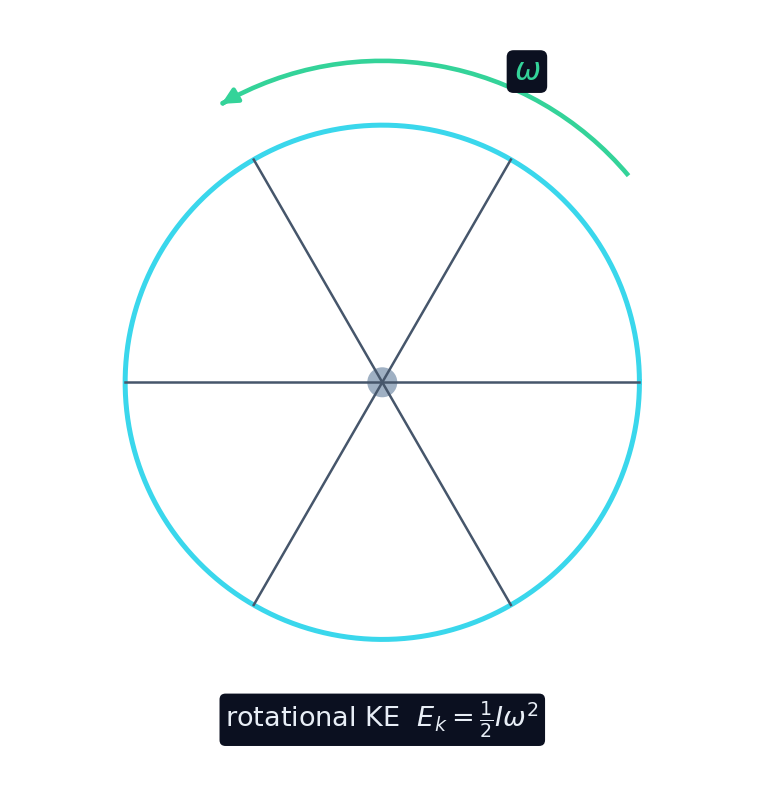
Spin stores energy · El giro almacena energía
Change how fast the angle sweeps to feel how spin rate feeds the rotational kinetic energy. · Cambia la velocidad de barrido del ángulo para sentir cómo la tasa de giro alimenta la energía cinética rotacional.
A wheel with $I = 4\ \text{kg}\cdot\text{m}^2$ spins at $\omega = 3\ \tfrac{\text{rad}}{\text{s}}$. What is its rotational kinetic energy, in joules? · Una rueda con $I = 4\ \text{kg}\cdot\text{m}^2$ gira a $\omega = 3\ \tfrac{\text{rad}}{\text{s}}$. ¿Cuál es su energía cinética rotacional, en julios?
$E_k = \tfrac12 I\omega^2 = \tfrac12 (4)(9) = 18\ \text{J}$.
Which is the formula for rotational kinetic energy? · ¿Cuál es la fórmula para la energía cinética rotacional?
It is · Es $\tfrac12 I\omega^2$ — the rotational twin of $\tfrac12 mv^2$. · Es $\tfrac12 I\omega^2$ — el equivalente rotacional de $\tfrac12 mv^2$.
Rotational kinetic energy is measured in ____. · La energía cinética rotacional se mide en ____.
It is an energy, so it is measured in joules. · Es una forma de energía, por lo que se mide en julios.
It depends on ω squared
- Because of the $\omega^2$, doubling the spin rate stores four times the energy.
- This is why flywheels are spun as fast as their strength allows.
- Rotational inertia matters too, in direct proportion — double $I$, double the energy.
- Mass placed far from the axis (large $I$) makes a very effective energy store.
Depende de ω al cuadrado
- Debido al término $\omega^2$, duplicar la velocidad de rotación almacena cuatro veces la energía.
- Por esta razón, los volantes giran tan rápido como lo permite su resistencia estructural.
- La inercia rotacional también es relevante, en proporción directa: si se duplica $I$, se duplica la energía almacenada.
- Colocar la masa lejos del eje (lo que produce una gran $I$) genera un almacenamiento de energía muy eficiente.
If a flywheel doubles its angular speed, its rotational kinetic energy becomes: · Si un volante duplica su velocidad angular, su energía cinética rotacional se vuelve:
$E_k \propto \omega^2$, so doubling $\omega$ gives four times the energy. · $E_k \propto \omega^2$, por lo que al duplicar $\omega$ se obtiene cuatro veces la energía.
Select all · todos ways to increase a flywheel's stored rotational kinetic energy. · Selecciona todas las formas de aumentar la energía cinética rotacional almacenada en un volante.
Higher $\omega$ or larger $I$ (mass at the rim) raises $\tfrac12 I\omega^2$. Colour has no effect. · Un mayor $\omega$ o un mayor $I$ (masa en el borde) aumenta $\tfrac12 I\omega^2$. El color no tiene efecto.
Flywheels as batteries
- Some buses and race cars store braking energy in a spinning flywheel, then reuse it.
- The energy goes in as $\tfrac12 I\omega^2$ and comes back out to drive the wheels.
- No chemicals, no wear — just a very fast, well-balanced disk.
- It is a neat mechanical "battery" built on this one formula.
Volantes como baterías
- Algunos autobuses y autos de carreras almacenan la energía de frenado en un volante giratorio para reutilizarla posteriormente.
- La energía entra en forma de $\tfrac12 I\omega^2$ y sale nuevamente para impulsar las ruedas.
- Sin productos químicos ni desgaste mecánico; solo un disco muy ligero, bien equilibrado y de alta velocidad.
- Constituye una "batería" mecánica elegante basada en esta única fórmula.
A spinning flywheel can be used to store energy and release it later. · Un volante giratorio puede usarse para almacenar energía y liberarla posteriormente.
The energy $\tfrac12 I\omega^2$ is stored in the spin and can drive a machine afterward. · La energía $\tfrac12 I\omega^2$ se almacena en el giro y puede accionar una máquina posteriormente.
Use rotational inertia $I$ and angular speed $\omega$ in $\tfrac12 I\omega^2$, never plain mass and linear speed. A rolling object has both kinds of kinetic energy at once (lesson 6.5) — don't forget the spinning part.
Utilice siempre la inercia rotacional $I$ y la velocidad angular $\omega$ en $\tfrac12 I\omega^2$, nunca la masa simple y la velocidad lineal. Un objeto que rueda posee ambos tipos de energía cinética simultáneamente (lección 6.5) — no olvide la componente de rotación.
A wheel of rotational inertia $I = 4\ \text{kg}\cdot\text{m}^2$ spins at $\omega = 3\ \tfrac{\text{rad}}{\text{s}}$.
- $E_k = \tfrac12 I\omega^2 = \tfrac12 (4)(3^2) = \tfrac12 (4)(9) = 18\ \text{J}$.
Double the spin to $6\ \tfrac{\text{rad}}{\text{s}}$ and $E_k = \tfrac12(4)(36) = 72\ \text{J}$ — four times as much.
Una rueda con inercia rotacional $I = 4\ \text{kg}\cdot\text{m}^2$ gira a $\omega = 3\ \tfrac{\text{rad}}{\text{s}}$.
- $E_k = \tfrac12 I\omega^2 = \tfrac12 (4)(3^2) = \tfrac12 (4)(9) = 18\ \text{J}$.
Al duplicar la velocidad de rotación a $6\ \tfrac{\text{rad}}{\text{s}}$, la energía resulta ser $E_k = \tfrac12(4)(36) = 72\ \text{J}$ — exactamente cuatro veces más.
Rotational kinetic energy is $E_k = \tfrac12 I\omega^2$, the spin twin of $\tfrac12 mv^2$. It grows with the square of angular speed, so doubling $\omega$ stores four times the energy. Flywheels use it as a mechanical energy store.
La energía cinética rotacional viene dada por $E_k = \tfrac12 I\omega^2$, siendo el equivalente rotacional de $\tfrac12 mv^2$. Crecce con el cuadrado de la velocidad angular, por lo que al duplicar $\omega$ se almacena cuatro veces la energía. Los volantes utilizan este principio como sistema de almacenamiento de energía mecánica.