Exchange Rates
Introducido| English | Significado |
|---|---|
| currency/ˈkʌrənsi/ | Moneda |
| exchange rate/eksˈtʃeɪndʒ reɪt/ | Tipo de cambio |
| Appreciation/əˌpriːʃɪˈeɪʃn/ | Apreciación |
| Depreciation/dɪˌpriːʃɪˈeɪʃn/ | Depreciación |
| floating exchange rate/ˈfləʊtɪŋ eksˈtʃeɪndʒ reɪt/ | Tipo de cambio flotante |
The price of one currency in another
- An exchange rate 汇率 is the price of one currency 货币 in terms of another.
- For example: how many yuan it takes to buy one US dollar.
- Because it is a price, it can rise or fall like any other.
- Two words describe those moves — and they are easy to mix up.
An exchange rate is:
Dificultad 1/5 · 100 monedas + un pequeño bono en el primer intento de hoy
It says how much of one currency buys another.
When a currency becomes more valuable and buys more foreign currency, it has ______.
Dificultad 1/5 · 100 monedas + un pequeño bono en el primer intento de hoy
More foreign currency per unit = appreciation.
One currency can appreciate against another while the other also appreciates against it.
Dificultad 1/5 · 100 monedas + un pequeño bono en el primer intento de hoy
False. An exchange rate is one price seen from two sides: if one currency appreciates, the other necessarily depreciates against it.
Appreciation and depreciation
- Appreciation 升值 means a currency becomes more valuable — it buys more foreign currency.
- Depreciation 贬值 means a currency becomes less valuable — it buys less.
- The catch: one currency's appreciation is always the other's depreciation.
- If the dollar rises against the yuan, the yuan falls against the dollar.
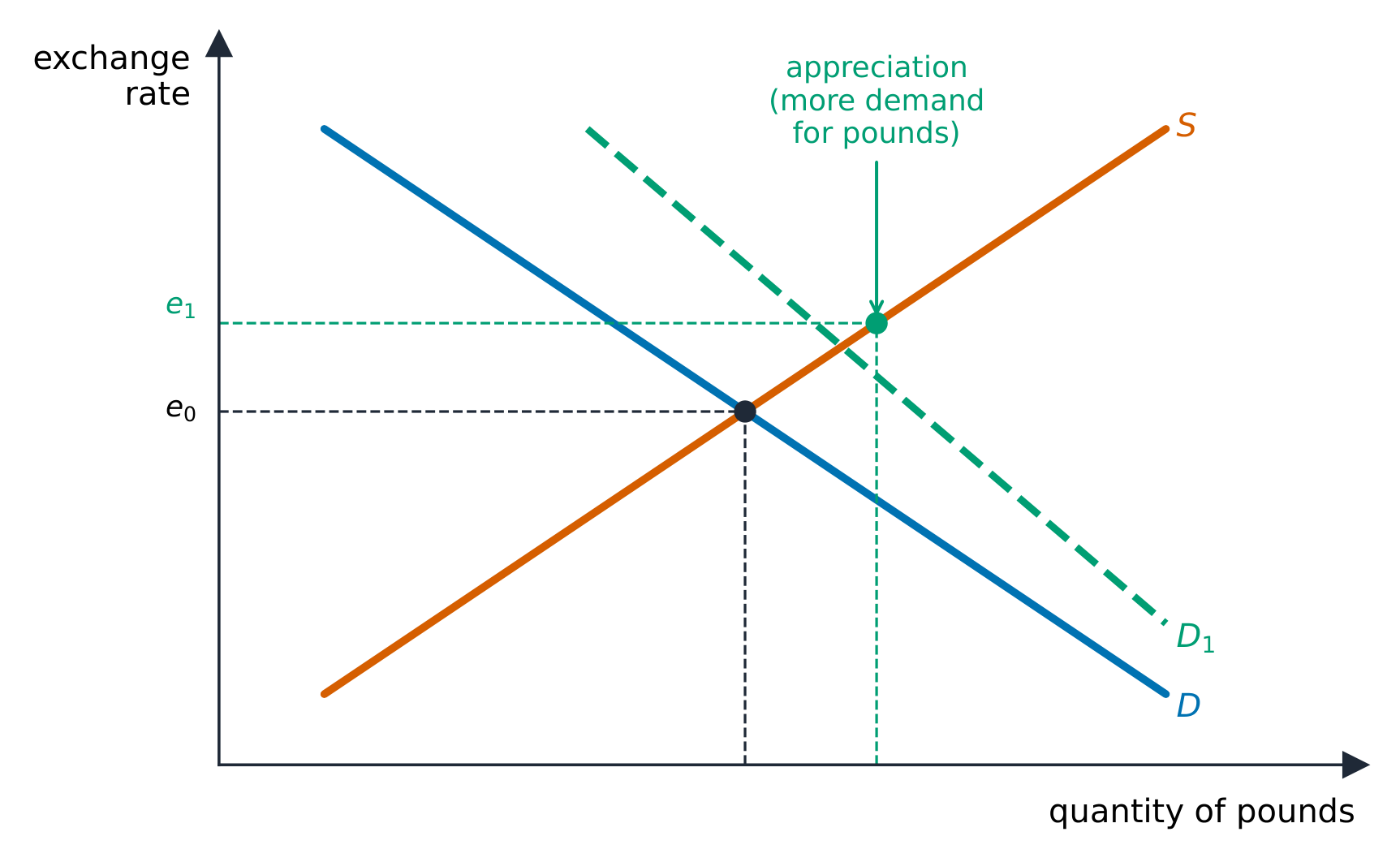
A floating exchange rate 浮动汇率 set by the demand for and supply of a currency
Appreciation or depreciation?
A currency appreciates when it buys more foreign currency, and depreciates when it buys less. One currency's appreciation is the other's depreciation.
If $1 goes from buying 7 yuan to buying 8 yuan, then:
Dificultad 1/5 · 100 monedas + un pequeño bono en el primer intento de hoy
Each dollar buys more yuan, so the dollar rose; one currency's gain is the other's loss.
If $1 falls from 7 yuan to 6 yuan, the dollar has:
Dificultad 1/5 · 100 monedas + un pequeño bono en el primer intento de hoy
Each dollar now buys fewer yuan, so it lost value.
Reading a rate change
- Worked idea. Suppose $1 buys 7 yuan. If$1 now buys 8 yuan, the dollar has appreciated (each dollar buys more yuan) — and the yuan has depreciated.
- If instead $1 falls to 6 yuan, the dollar has depreciated.
- Trick to remember: if your currency buys more foreign money, it appreciated.
- Always name which currency moved — "the dollar appreciated against the yuan."
A floating exchange rate is set by:
Dificultad 1/5 · 100 monedas + un pequeño bono en el primer intento de hoy
Floating means the market sets it freely, not the government.
Floating rates
- Most major currencies use a floating exchange rate.
- It is set freely by the supply of and demand for the currency in world markets.
- No government fixes it — it moves minute by minute as trading happens.
- The next lesson models exactly how that supply and demand set the rate.
Worked example: one move, two currencies
Last year 1 euro bought $\$1.20$; now 1 euro buys $\$1.05$. Which currency appreciated? What happens to a €100 French wine in US shops?
- Each euro now buys fewer dollars, so the euro depreciated against the dollar, and the dollar appreciated against the euro ($\$1$ buys 0.95 euro instead of 0.83).
- The wine cost $100 \times 1.20 = 120$ dollars; now it costs $100 \times 1.05 = 105$ dollars. French goods become cheaper for Americans, so US imports from France tend to rise.
The rate moves from 110 yen per dollar to 130 yen per dollar. Which is true?
Dificultad 1/5 · 100 monedas + un pequeño bono en el primer intento de hoy
Each dollar buys more yen.
A floating exchange rate is set by supply and demand in the foreign exchange market.
Dificultad 1/5 · 100 monedas + un pequeño bono en el primer intento de hoy
No government fixes it.
An exchange rate is the price of one currency in another. Appreciation = more valuable (buys more); depreciation = less valuable. One currency's appreciation is the other's depreciation ($1 = 7 \to 8$ yuan means the dollar appreciated, the yuan depreciated). Most rates float, set by supply and demand.
Write from a fall to 4 pesos
- One dollar used to buy 5 pesos. It now buys 4 pesos.
- Say what happened to the dollar.
One dollar used to buy 5 pesos and now buys 4 pesos. Has the dollar appreciated or depreciated?
Fewer pesos per dollar means the dollar lost value.
What happened to the dollar?
Dificultad 1/5 · 100 monedas + un pequeño bono en el primer intento de hoy
A dollar buys fewer pesos, 4 instead of 5, so it is weaker.