Nominal v. Real Interest Rates
Introducido| English | Significado |
|---|---|
| real interest rate/rɪəl ˈɪntrest reɪt/ | tasa de interés real |
| Fisher equation/ˈfɪʃə ɪˈkweɪʒn/ | ecuación de Fisher |
| nominal interest rate/ˈnɒmɪnl ˈɪntrest reɪt/ | tasa de interés nominal |
| expected inflation/ekˈspektɪd ɪnˈfleɪʃn/ | inflación esperada |
| borrowers/ˈbɒrəʊəz/ | deudores |
| lenders/ˈlendəz/ | prestatarios |
| variable rate | variable rate |
| fixed income | fixed income |
The interest rate that really matters
- The rate you see quoted is in current dollars — but inflation eats those dollars.
- So the number on the loan is not the whole story.
- What matters is how much buying power a lender truly earns.
- That is the difference between the nominal and the real interest rate.
The Fisher equation
- The nominal interest rate 名义利率 is the percentage a lender charges in current dollars.
- The real interest rate 实际利率 strips inflation out.
- The Fisher equation 费雪方程: $\text{real rate} \approx \text{nominal rate} - \text{expected inflation}$.
- Expected inflation 预期通货膨胀 is how much prices are expected to rise.
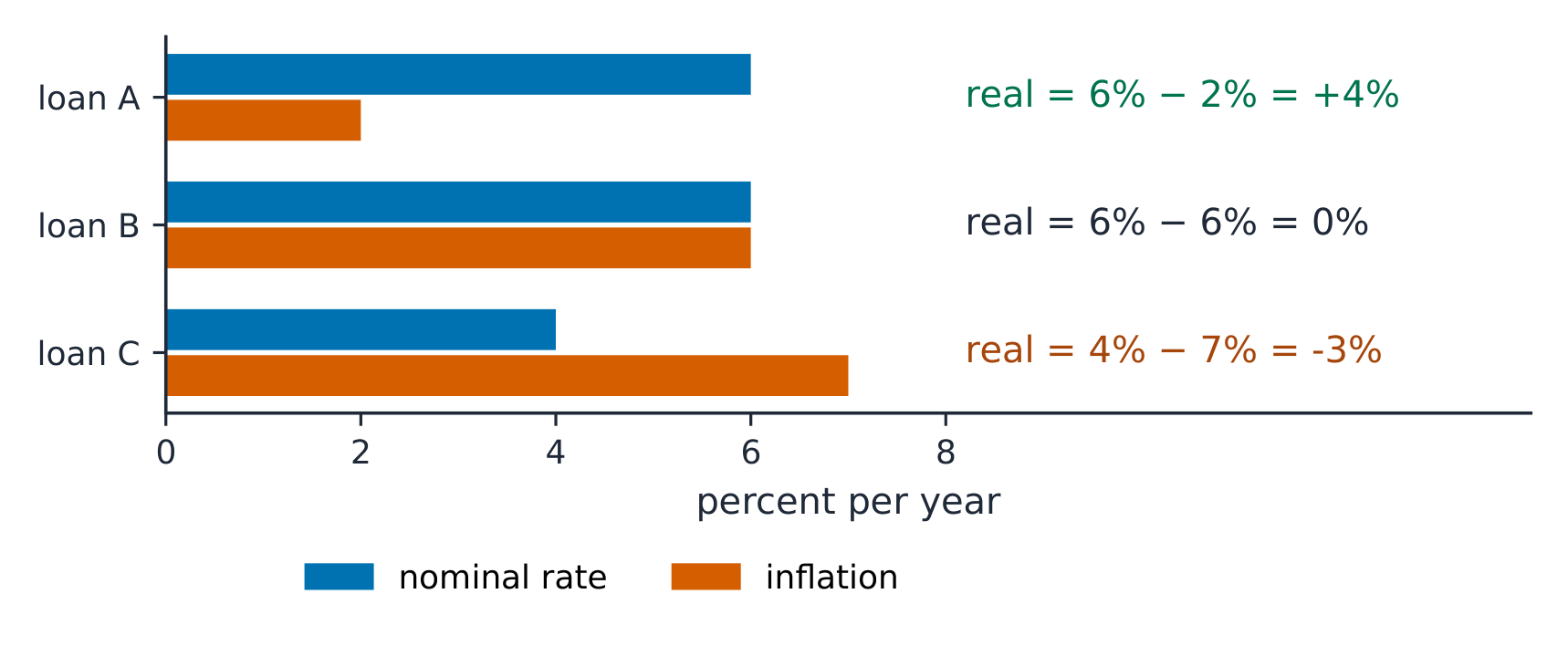
Real interest rate = nominal interest rate − inflation rate
Higher inflation than expected — who wins?
The real rate is the nominal rate minus inflation. If inflation is higher than expected, borrowers win and lenders lose.
The Fisher equation says the real interest rate approximately equals:
Dificultad 1/5 · 100 monedas + un pequeño bono en el primer intento de hoy
Real ≈ nominal − expected inflation — inflation is subtracted out.
The interest rate quoted in current dollars, before removing inflation, is the ______ rate.
Dificultad 1/5 · 100 monedas + un pequeño bono en el primer intento de hoy
The nominal rate includes inflation; the real rate takes it out.
To know how much buying power a lender truly earns, you use the:
Dificultad 1/5 · 100 monedas + un pequeño bono en el primer intento de hoy
The real rate strips out inflation, showing the true gain in purchasing power.
Who wins from surprise inflation
- The gap between expected and actual inflation decides who gains.
- If inflation is higher than expected, borrowers 借款人 win — they repay in cheaper dollars — and lenders 放款人 lose.
- If inflation is lower than expected, lenders win and borrowers lose.
A loan has a nominal rate of 6% and inflation turns out to be 5%. What is the real interest rate, in percent?
Dificultad 2/5 · 140 monedas + un pequeño bono en el primer intento de hoy
Real rate = 6 − 5 = 1%.
If inflation turns out higher than expected:
Dificultad 1/5 · 100 monedas + un pequeño bono en el primer intento de hoy
Borrowers repay with cheaper dollars, so lenders receive less buying power.
If inflation is lower than expected, borrowers gain and lenders lose.
Dificultad 1/5 · 100 monedas + un pequeño bono en el primer intento de hoy
False. The dollars repaid buy more than the lender planned, so lenders gain and borrowers lose when inflation is lower than expected.
A worked case
- Worked idea. A bank lends at a nominal rate of 6% and expects 2% inflation, so it plans on a real return of $6 - 2 = 4\%$.
- If inflation instead jumps to 5%, the real rate it actually earns is only $6 - 5 = 1\%$.
- The borrower repaid with cheaper dollars, so the borrower gained and the bank lost.
- This is exactly why unexpected inflation redistributes wealth.
Worked example: setting a loan rate
A lender wants a real return of 3% and expects inflation of 4%. (a) What nominal rate should it charge? (b) Inflation turns out to be 2%. Who gains?
- (a) Nominal ≈ real + expected inflation = 3 + 4 = 7%.
- (b) Actual real rate = 7 − 2 = 5%, above the planned 3%. Inflation was lower than expected, so the lender gains and the borrower loses: the dollars repaid buy more than expected.
The nominal rate is 9% and expected inflation is 6%. What is the expected real interest rate, in %?
Dificultad 2/5 · 140 monedas + un pequeño bono en el primer intento de hoy
9 − 6 = 3%.
If inflation is higher than expected, borrowers with fixed-rate loans gain.
Dificultad 1/5 · 100 monedas + un pequeño bono en el primer intento de hoy
They repay in dollars that buy less than expected.
Fixed rates, variable rates and savers
- Surprise inflation only redistributes when the nominal rate is fixed. With a variable (adjustable) rate loan, the rate rises with inflation, so the lender is protected.
- Savers with money in fixed-rate accounts and people on fixed incomes (a pension that does not rise with prices) lose from unexpected inflation, just like lenders. If inflation is higher than the nominal rate, the real rate is negative: 2% interest with 5% inflation is a real rate of −3%, so savings lose buying power every year.
A savings account pays 1.5% nominal interest. Inflation is 4%. What is the real interest rate, in percent?
Dificultad 2/5 · 140 monedas + un pequeño bono en el primer intento de hoy
1.5 − 4 = −2.5%. The savings lose buying power each year.
Inflation turns out much higher than expected. Who is most likely to be hurt?
Dificultad 1/5 · 100 monedas + un pequeño bono en el primer intento de hoy
A fixed income buys less when prices rise faster than expected. Fixed-rate borrowers gain; a variable-rate lender is protected.
Worked FRQ answer
Question: Ana takes a one-year loan from a bank at a fixed nominal interest rate of 8%. Both expect inflation of 3%. (a) What real interest rate do they expect? (b) Actual inflation turns out to be 6%. Calculate the actual real interest rate. (c) Who is better off than expected, Ana or the bank? Explain. (d) How could the bank have protected itself?
(a) 8 − 3 = 5%.
(b) 8 − 6 = 2%.
(c) Ana. Inflation was higher than expected, so the dollars she repays buy less than both expected; her real cost of borrowing fell from 5% to 2%.
(d) By lending at a variable rate that rises with inflation, or by building a higher expected inflation into the nominal rate.
- Why it scores: (a) and (b) use expected and actual inflation in the right places; (c) names the winner and explains it with the value of money repaid; (d) gives a specific mechanism, not "charge more".
FRQ practice. A lender wants a real return of 2% and expects inflation of 3%. (a) What nominal rate should it charge? (b) Actual inflation is 1%. Calculate the actual real rate. (c) Does the borrower or the lender gain from the surprise? Explain.
Set the rate with expected inflation; judge the outcome with actual inflation.
Common errors. Using actual inflation to find the rate a lender sets (the rate is set with expected inflation). Saying all inflation hurts lenders: only unexpected inflation does, because expected inflation is already in the nominal rate. Adding instead of subtracting: real = nominal − inflation.
The nominal interest rate is quoted in current dollars; the real interest rate removes inflation, via the Fisher equation ($\text{real} \approx \text{nominal} - \text{expected inflation}$). Higher-than-expected inflation helps borrowers and hurts lenders; lower-than-expected does the reverse.
Write from the data: find the real rate
- The nominal interest rate is 9 percent. Inflation is 4 percent.
- Find the real rate.
A loan has a nominal interest rate of 9 percent and inflation is 4 percent. What is the real interest rate, in percent?
9 minus 4 is 5.
What is the real interest rate?
Dificultad 1/5 · 100 monedas + un pequeño bono en el primer intento de hoy
9 percent minus inflation of 4 percent is a real rate of 5 percent.