Confidence and Its Loss
Introducido| English | Significado |
|---|---|
| positivism/ˈpɒzɪtɪvɪzəm/ | The belief, associated with Auguste Comte, that real knowledge comes only from observation and the scientific method. |
| relativity | Einstein's theories (1905, 1915) showing that measurements of time and space depend on the observer's motion. |
| modernism/ˈmɒdənɪzəm/ | Art and literature that broke with traditional forms around 1900. |
A riot at the ballet, 1913
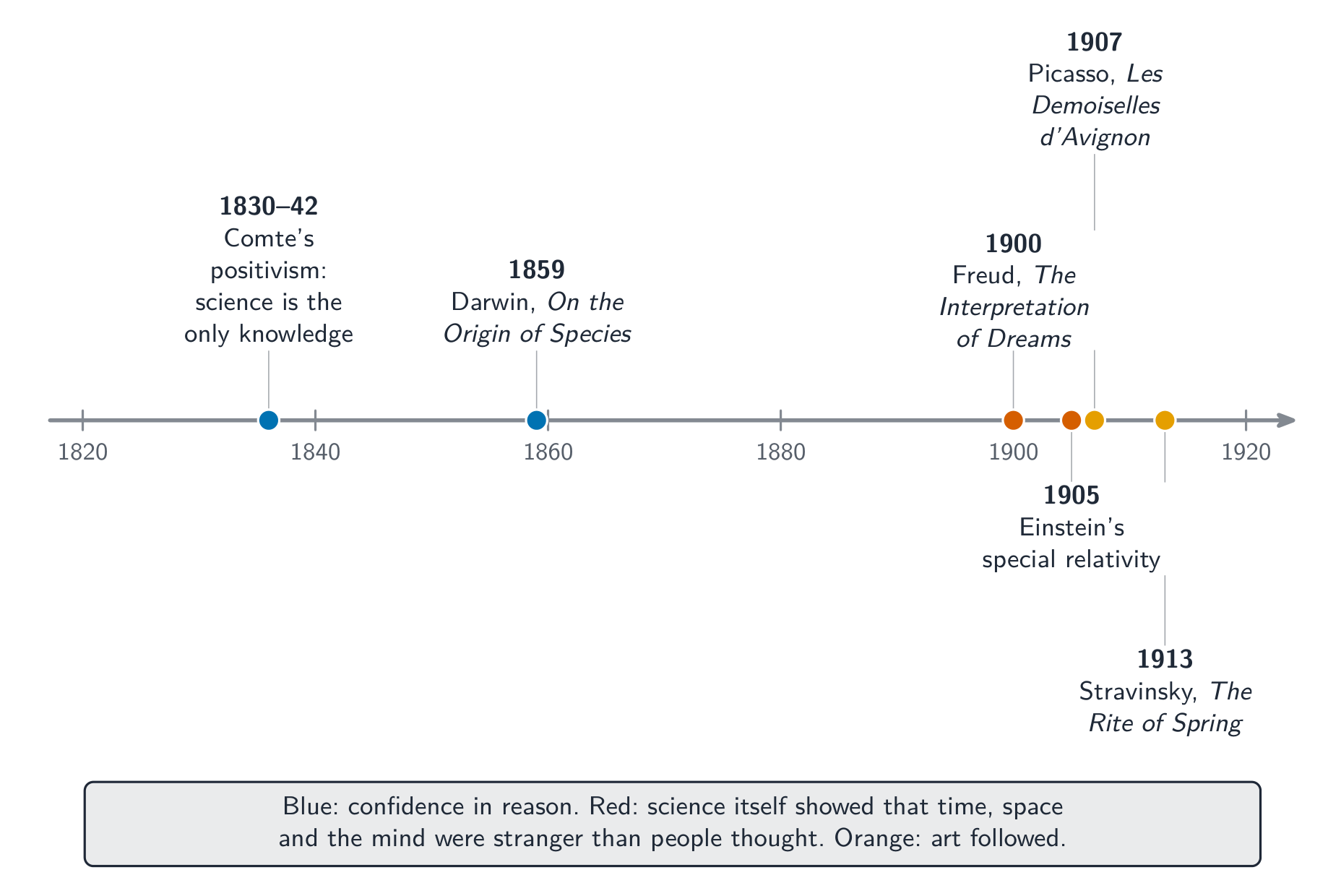
- On 29 May 1913, the first performance of Igor Stravinsky's ballet The Rite of Spring in Paris caused an uproar. Its harsh rhythms and clashing chords so shocked the audience that people shouted, whistled and fought; the dancers could barely hear the orchestra. Older ideas of order and beauty were breaking down.
- In the nineteenth century Europeans trusted science and reason; by 1914 that confidence was shaken.
Positivism
- Positivism 实证主义, developed by Auguste Comte in the 1830s–40s, held that only scientific observation gives true knowledge, and that science could also be used to understand society.
- Real advances supported this confidence: Pasteur's germ theory (1860s), vaccines, electricity and railways.
What did positivism claim?
Dificultad 1/5 · 100 monedas + un pequeño bono en el primer intento de hoy
Comte's view.
Darwin
- Charles Darwin's On the Origin of Species (1859) explained life's variety by natural selection.
- It supported faith in science, but also challenged the Bible's account of creation and the special place of humans.
Darwin's theory of natural selection challenged the Bible's account of creation.
Dificultad 1/5 · 100 monedas + un pequeño bono en el primer intento de hoy
On the Origin of Species, 1859.
Worked example: how confidence broke
- Philosophy: Friedrich Nietzsche declared "God is dead" (1882) and attacked the idea of fixed moral truths.
- Psychology: Sigmund Freud's The Interpretation of Dreams (1900) argued that unconscious desires, not reason, drive much human behaviour.
- Physics: Max Planck's quantum theory (1900) and Albert Einstein's theory of relativity 相对论 (1905) showed that Newton's laws were not the whole truth. Science itself undermined the certainty that positivists had placed in it.
Positivism, the loss of confidence, or the result?
Sort each element of the intellectual shift.
Match each thinker to the idea.
Dificultad 2/5 · 140 monedas + un pequeño bono en el primer intento de hoy
Sources of doubt.
Put these in order.
Dificultad 3/5 · 200 monedas + un pequeño bono en el primer intento de hoy
1859, 1882, 1900, 1905.
Modernism in the arts
- Modernism 现代主义 rejected traditional forms: Picasso's Les Demoiselles d'Avignon (1907) broke the human figure into angular shapes, leading to Cubism.
- Writers and composers experimented with new structures, as Stravinsky did.
Which work is an example of modernism in art?
Dificultad 1/5 · 100 monedas + un pequeño bono en el primer intento de hoy
It broke the human figure into angular shapes.
Progress and anxiety together
- Most Europeans still believed in progress in 1914; railways, medicine and electric light were real improvements.
- But among thinkers and artists, a sense that reality was uncertain and humans irrational was spreading.
Science did not simply defeat religion. Darwin, Einstein and Freud undermined many certainties, including those of positivist science itself. The result was relativism and uncertainty, not a simple triumph of reason.
By 1914 science had replaced all uncertainty with fixed truths.
Dificultad 1/5 · 100 monedas + un pequeño bono en el primer intento de hoy
New science increased uncertainty.
Positivism, Darwin and scientific advances gave nineteenth-century Europe confidence in science and progress. Nietzsche, Freud, Planck and Einstein then questioned fixed truths, rational human nature and Newtonian physics, and modernist art broke with traditional forms.
Explain how new ideas between 1880 and 1914 challenged confidence in reason and progress.
Change.