Movements for Reform
Introducido| English | Significado |
|---|---|
| Chartists | Members of the British working-class movement of 1838–48 that demanded the People's Charter, including votes for all men. |
| reform movement | An organized campaign by many people to change laws or society. |
A petition 10 km long, 1842
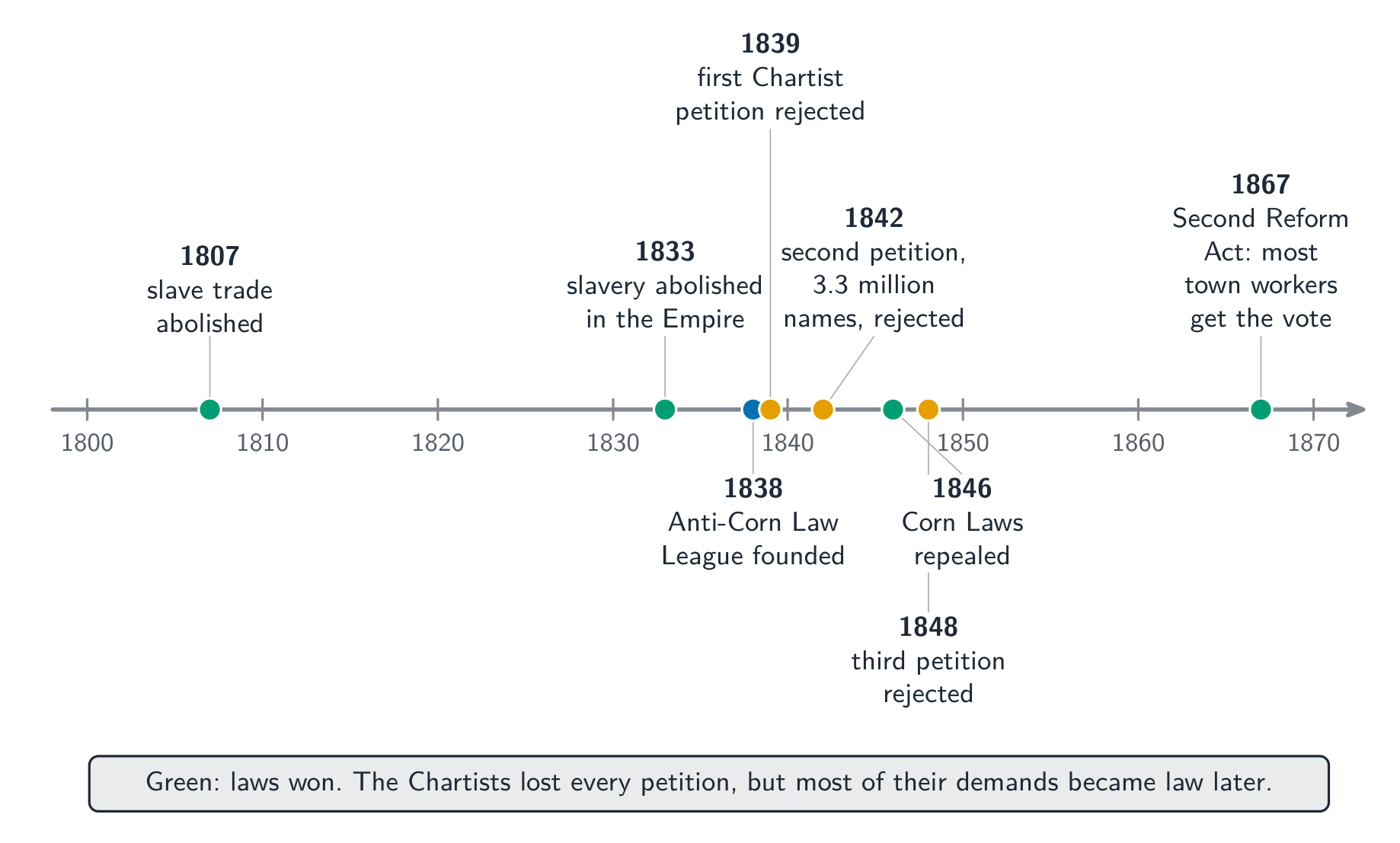
- In May 1842, the Chartists carried a petition to Parliament with about 3.3 million signatures — out of a British population of about 27 million. It was so large that it had to be broken into pieces to fit through the door. It demanded the vote for all men and five other reforms. Parliament rejected it by 287 votes to 49.
- Nineteenth-century reform movements organized ordinary people to pressure governments.
About how many million signatures did the 1842 Chartist petition have?
Dificultad 2/5 · 140 monedas + un pequeño bono en el primer intento de hoy
Out of about 27 million people.
What a movement adds
- An idea becomes a reform movement 改革运动 when people organize: meetings, newspapers, petitions, membership dues and leaders.
- The Chartists 宪章派 (1838–48) demanded the People's Charter: votes for all men, secret ballots, payment for MPs and other changes.
How did reform movements organize?
Dificultad 2/5 · 140 monedas + un pequeño bono en el primer intento de hoy
Pressure from below.
Movements change laws
- The Anti-Corn Law League (1838–46) campaigned against taxes on imported grain, which kept bread prices high. Parliament repealed the Corn Laws in 1846.
- Campaigners against slavery, many inspired by evangelical Christianity, won its abolition in the British Empire in 1833.
The idea, the organisation, or the response?
Sort each stage of reform.
Match each movement to its result.
Dificultad 2/5 · 140 monedas + un pequeño bono en el primer intento de hoy
Movements changed laws.
Worked example: ideas behind movements
- Liberal economics (Adam Smith): the Anti-Corn Law League argued that free trade would lower food prices.
- Religion: the abolition movement and the temperance movement against alcohol drew on Christian conscience.
- Socialism and labour: workers formed trade unions; in Germany, the Social Democratic Party (1875) grew into the largest party by 1912.
Which idea most influenced the Anti-Corn Law League?
Dificultad 1/5 · 100 monedas + un pequeño bono en el primer intento de hoy
Cheaper food through free trade.
Women's movements
- Women campaigned for education, property rights and the vote. Britain's Married Women's Property Act (1882) let wives own property.
- In 1906 Finland became the first European country to give women the vote.
Finland was the first European country to give women the vote.
Dificultad 1/5 · 100 monedas + un pequeño bono en el primer intento de hoy
In 1906.
The problems they addressed
- Industrial cities, low wages, child labour, poor housing and the lack of political rights for most people.
- Many reforms succeeded only after decades: all six Chartist demands except annual parliaments eventually became law.
A rejected movement could still succeed later. The Chartists failed in 1848, but most of their demands became law by 1918. Judge movements over the long term.
Because the Chartists were rejected in 1848, none of their demands ever became law.
Dificultad 1/5 · 100 monedas + un pequeño bono en el primer intento de hoy
Most became law later.
Reform movements turned ideas into organized pressure through petitions, meetings and newspapers. The Chartists, the Anti-Corn Law League, abolitionists, trade unions and women's movements pushed governments to change laws, often after long campaigns.
Explain how reform movements influenced governments in nineteenth-century Britain.
Influence.