What the Revolution Set Off
Introducido| English | Significado |
|---|---|
| Haitian Revolution | The 1791–1804 revolt of enslaved people in the French colony of Saint-Domingue, which created independent Haiti. |
| conservatism/kənˈsɜːvətɪzəm/ | The ideology defending tradition, monarchy, church and gradual change. |
Saint-Domingue, August 1791
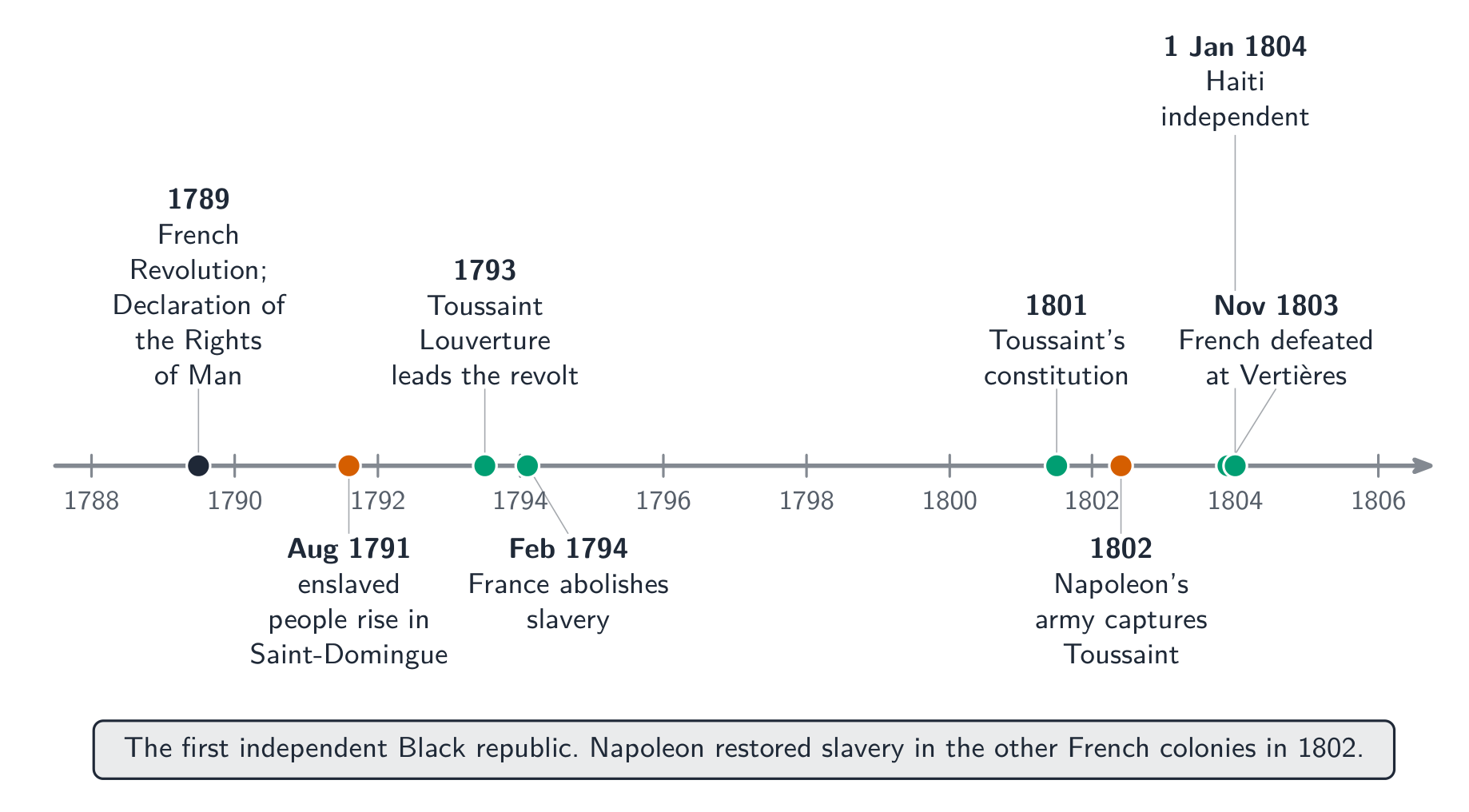
- In August 1791, enslaved people on the sugar plantations of Saint-Domingue, France's richest colony, rose in revolt. The colony held about 500 000 enslaved people and only about 40 000 white colonists. Led from 1793 by Toussaint Louverture, a formerly enslaved man, they fought French, Spanish and British armies. In 1804 the colony became independent as Haiti.
- The ideals of the French Revolution spread far beyond France.
Saint-Domingue had about 500 000 enslaved people and 40 000 white colonists. How many enslaved people were there for each white colonist? (Round to a whole number.)
Dificultad 2/5 · 140 monedas + un pequeño bono en el primer intento de hoy
500 000 ÷ 40 000 = 12.5, rounded to 13.
Ideals on the move
- The Declaration of the Rights of Man (1789) said "men are born and remain free and equal in rights". Enslaved people, free people of colour and women asked: did this include us?
- In 1794 the French government abolished slavery in its colonies; Napoleon tried to restore it in 1802.
France abolished slavery in its colonies in 1794.
Dificultad 1/5 · 100 monedas + un pequeño bono en el primer intento de hoy
Napoleon tried to restore it in 1802.
The Haitian Revolution
- The Haitian Revolution 海地革命 was the only successful large slave revolt in history and created the first independent Black republic.
- French troops sent by Napoleon in 1802 captured Toussaint, but disease and Haitian resistance destroyed the army.
Who led the Haitian Revolution from 1793?
Dificultad 1/5 · 100 monedas + un pequeño bono en el primer intento de hoy
A formerly enslaved man.
Worked example: two reactions in Britain
- Edmund Burke: in Reflections on the Revolution in France (1790), he warned that tearing down old institutions would lead to violence and tyranny — the founding text of conservatism 保守主义.
- Mary Wollstonecraft: in A Vindication of the Rights of Woman (1792), she argued that the Revolution's principles should extend to women's education and rights.
- Comparison: the same events led one writer to defend tradition and another to demand wider equality.
Follow the Revolution's effects outward
The ideals ran further than their authors intended, and the contradiction beside them is examinable too.
Match each writer to the argument.
Dificultad 2/5 · 140 monedas + un pequeño bono en el primer intento de hoy
Different reactions.
Women claim rights
- Olympe de Gouges wrote the Declaration of the Rights of Woman (1791). She was executed in 1793, and in the same year women's political clubs were banned.
- The Revolution opened the question of women's rights but closed it again for decades.
Across the world
- In Latin America, leaders such as Simón Bolívar drew on revolutionary ideals in wars of independence from Spain after 1810.
- In Europe, rulers condemned the Revolution after the execution of Louis XVI (1793) and the Terror, and many joined wars against France.
Put these in order.
Dificultad 3/5 · 200 monedas + un pequeño bono en el primer intento de hoy
1789, 1791, 1794, 1804.
The French Revolution "inspired", it did not "cause", these movements. Enslaved Haitians, Latin American creoles and European radicals had their own grievances. They used revolutionary language for their own purposes.
The French Revolution alone caused the Haitian Revolution.
Dificultad 1/5 · 100 monedas + un pequeño bono en el primer intento de hoy
It inspired people with their own grievances.
The French Revolution's ideals of liberty and equality inspired the Haitian Revolution, women's claims to rights and later Latin American independence. In Europe, they also provoked a conservative reaction, voiced by Burke, and condemnation by monarchs.
Explain how the ideals of the French Revolution influenced movements outside France.
Causation.