A Divided Christendom
Introducido| English | Significado |
|---|---|
| indulgences | indulgences |
| Calvinists | Calvinists |
| Catholic Reformation/ˈkæθlɪk rɪfɔːˈmeɪʃn/ | The Catholic Church's own renewal and response to Protestant criticism. |
| Peace of Augsburg | The 1555 settlement letting each German prince choose Lutheranism or Catholicism for his territory. |
"Here I stand", Worms 1521
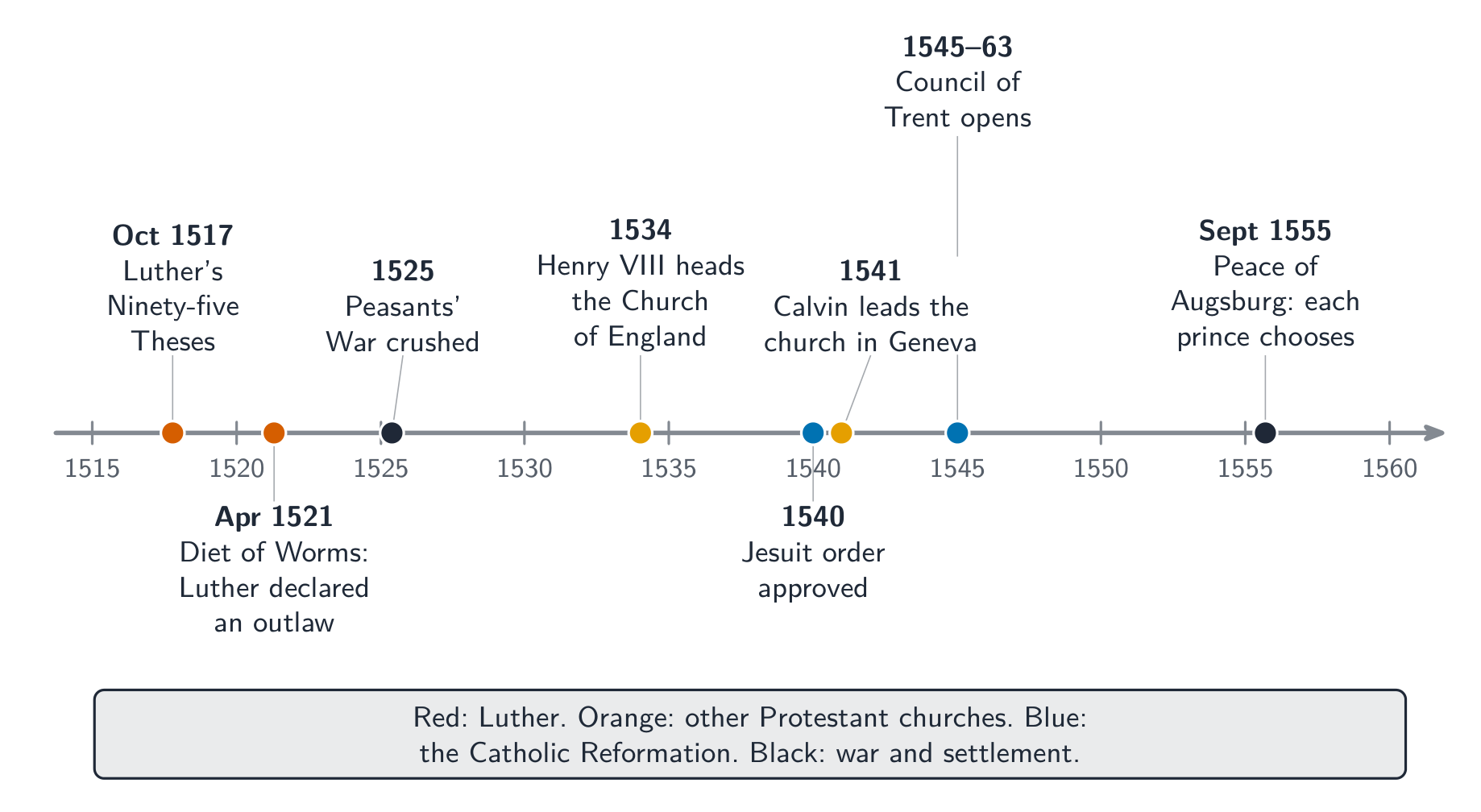
- In April 1521, the monk Martin Luther stood before the young Emperor Charles V at the city of Worms. He was ordered to take back his writings against the pope. He refused unless he was proved wrong from the Bible. The emperor declared him an outlaw.
- Luther was not burned, as the Czech reformer Jan Hus had been in 1415. His prince, Frederick of Saxony, hid him in Wartburg castle, where he translated the New Testament into German.
What happened to Luther after the meeting at Worms in 1521?
Dificultad 1/5 · 100 monedas + un pequeño bono en el primer intento de hoy
Frederick of Saxony hid him at Wartburg castle.
One Church before 1517
- Before 1517, almost all western Europeans belonged to one Church led by the pope in Rome. It ran courts, collected taxes, owned perhaps a fifth of the land in some regions and controlled education.
- Many people complained about it: priests who could not read Latin, bishops who held several offices, and the sale of indulgences 赎罪券 — documents said to reduce punishment for sins after death.
Documents sold by the Church and said to reduce punishment for sins were called ____.
Dificultad 1/5 · 100 monedas + un pequeño bono en el primer intento de hoy
Their sale started Luther's protest.
Luther's challenge
- In October 1517, Luther wrote his Ninety-five Theses against the sale of indulgences. He taught that people are saved by faith alone, not by good works or payments, and that the Bible alone is the authority for Christians.
- Printers copied his theses and pamphlets across Germany within weeks. By 1521 he had rejected the pope's authority completely.
Luther taught that people are saved by faith alone.
Dificultad 1/5 · 100 monedas + un pequeño bono en el primer intento de hoy
Not by good works or payments.
Why this challenge survived
- Printing carried Luther's ideas faster than the Church could answer them.
- Princes had their own reasons to support him: closing monasteries gave them land, and money no longer went to Rome. The emperor needed the princes' help against the Ottomans and France, so he could not crush Luther at once.
Why did some princes support Luther?
Dificultad 2/5 · 140 monedas + un pequeño bono en el primer intento de hoy
The emperor opposed Luther.
Worked example: why did Frederick protect Luther? Frederick of Saxony stayed Catholic all his life, so belief alone does not explain it. Luther taught at Frederick's own new university at Wittenberg, and Frederick disliked the emperor's power and the money sent to Rome. A strong answer gives both: some princes believed Luther, and many gained from him.
Frederick of Saxony became a Lutheran before he protected Luther.
Dificultad 1/5 · 100 monedas + un pequeño bono en el primer intento de hoy
He stayed Catholic; his reasons were also political.
Many churches, not two
- Within a generation there were several Protestant churches: Lutherans in northern Germany and Scandinavia, Calvinists 加尔文宗 in Geneva, France, Scotland and the Netherlands, and the Church of England after Henry VIII broke with Rome in 1534.
- The Catholic Church answered with its own Catholic Reformation 天主教改革: the Jesuits (1540) built schools and sent missionaries, and the Council of Trent (1545–63) fixed Catholic teaching and trained better priests.
Why did the Reformation survive?
Sort each reason the challenge succeeded.
Match each church to a place where it was strong.
Dificultad 2/5 · 140 monedas + un pequeño bono en el primer intento de hoy
Protestants did not form one church.
Religion and politics were the same question. The Peace of Augsburg 奥格斯堡和约 (1555) let each German prince choose Lutheranism or Catholicism for his lands. Calvinists were left out, and subjects had to follow their ruler or move. Religious unity was now decided by rulers, and the next century brought wars over it.
What did the Peace of Augsburg (1555) allow?
Dificultad 1/5 · 100 monedas + un pequeño bono en el primer intento de hoy
Calvinists were left out.
Before 1517 western Europe had one Church. Luther's attack on indulgences (1517), spread by printing and protected by princes who gained land and power, split it. By 1555 there were Lutheran, Calvinist, Anglican and reformed Catholic churches, and the Peace of Augsburg made religion a matter for each ruler, which led to more conflict.
Why was Luther's challenge to the Church more successful than earlier ones?
Combine belief, technology and power.