Impacto del Diseño de Programas
Introducido| English | Significado |
|---|---|
| modular/ˈmɒdjʊlə/ | modular |
Two neat designs can report different averages
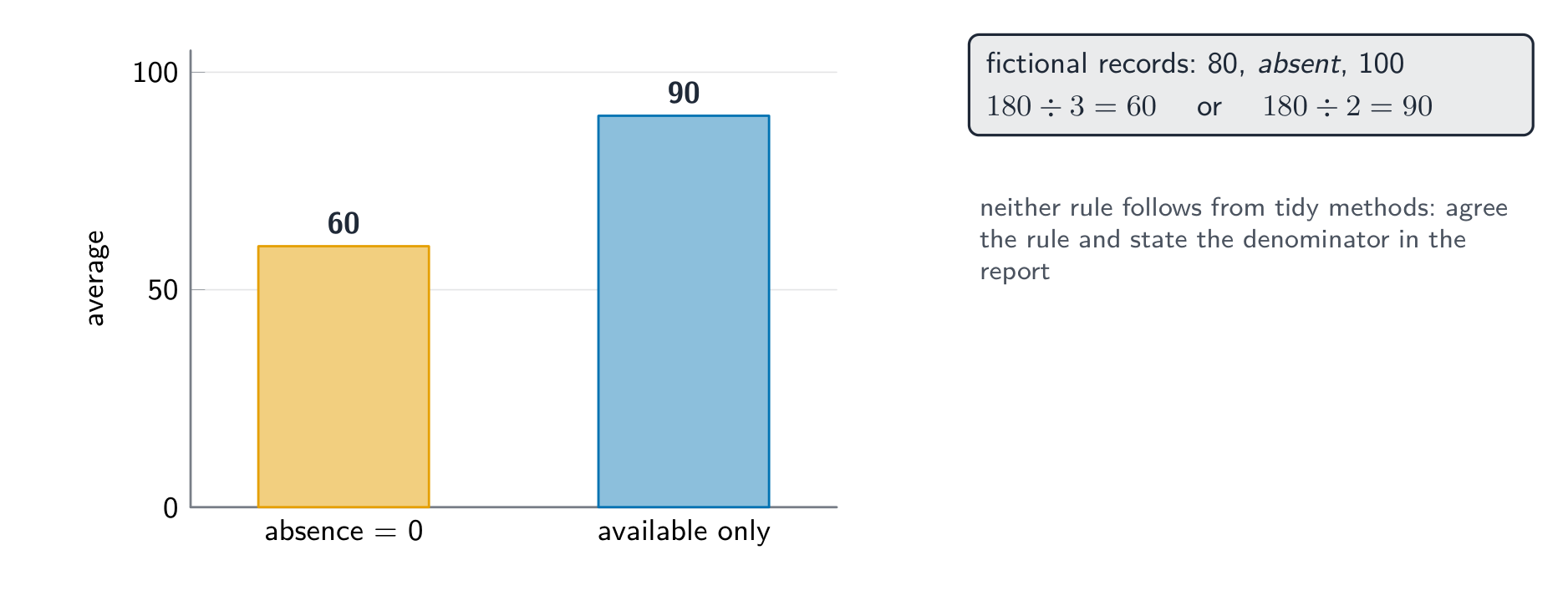
- A fictional record contains scores 80, absent and 100. Treating absence as zero gives
(80 + 0 + 100) / 3 = 60; omitting the absent result gives(80 + 100) / 2 = 90. - Separate methods can calculate either result correctly. Organization does not choose the reporting policy: establish what absence means, who decides, and which denominator the report must show before using the result.
Las puntuaciones son 80, ausentes y 100. Según la política de puntuaciones disponibles, ¿cuál es el promedio?
Dificultad 2/5 · 140 monedas + un pequeño bono en el primer intento de hoy
La suma de las puntuaciones presentes es 180 y el número presente es 2, por lo tanto 180/2 = 90.
Turn a requirement into a contract
- Specify whether absence means an unattempted assessed task, a task not assigned, or data not yet entered. These cases need not share a rule; the fictional example demonstrates consequences and does not prescribe a school grading policy.
- State the accepted input, the treatment of missing values and the result. If the rule is “average available scores”, an all-missing record has no average; report that case explicitly instead of inventing zero or dividing by zero.
Separate responsibilities for checking
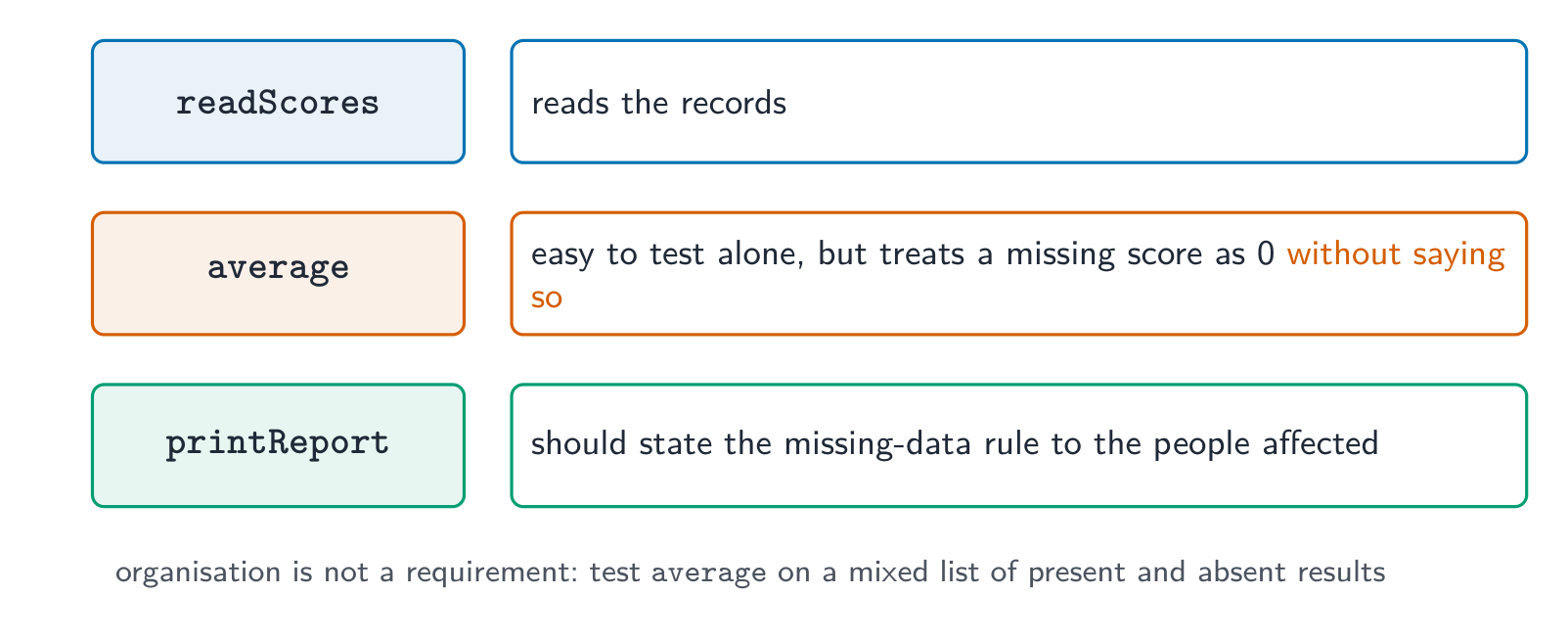
- A modular 模块化 design separates
readScores,averageAvailableandprintReport. The average method can be checked with known values without reading a file or capturing formatted output. - Separation helps when interfaces remain clear. A change to the meaning of absence can still require changes in calculation, reporting and checks; small methods and good names alone do not prevent those dependencies.
Check ordinary and boundary cases
- For the available-score policy, check [80, absent, 100] gives 90, a single 80 gives 80, and [absent, absent] produces the agreed “no result” outcome. Do not merely check that the program runs.
- The calculation below uses
nullfor missing values. It returns a double average and rejects the all-missing case. It assumes a non-null array of ordinary scores; input validation and reporting are separate responsibilities.
public class AverageAvailable {
    public static double averageAvailable(Integer[] scores) {
        double total = 0;
        int present = 0;
        for (Integer score : scores) {
            if (score != null) {
                total += score;
                present++;
            }
        }
        if (present == 0) {
            throw new IllegalArgumentException("No available scores");
        }
        return total / present;
    }
}
Un diseño modular (piezas independientes y bien nombradas) es principalmente más fácil de...
Dificultad 1/5 · 100 monedas + un pequeño bono en el primer intento de hoy
La modularidad hace que los cambios sean más seguros y las piezas reutilizables.
Cuando varios llamantes reutilizan un único método, corregir ese método puede beneficiar a todos los llamantes sin editar copias duplicadas.
Dificultad 1/5 · 100 monedas + un pequeño bono en el primer intento de hoy
Verdadero: los llamantes reutilizan la implementación. Su contrato y los efectos del cambio aún necesitan revisión.
El sesgo en los datos o la lógica de un programa puede producir resultados injustos a gran escala.
Dificultad 1/5 · 100 monedas + un pequeño bono en el primer intento de hoy
Las decisiones de diseño afectan a personas reales: considera quién se verá afectado.
Para verificar el cálculo del promedio de forma independiente de la entrada y la salida impresa, ¿qué diseño aísla mejor esa responsabilidad?
Dificultad 1/5 · 100 monedas + un pequeño bono en el primer intento de hoy
Separar el cálculo de la entrada y la salida permite verificar con puntuaciones conocidas sin esas otras operaciones. Simplemente tener métodos pequeños no garantiza la corrección.
El diseño de programas es puramente cosmético y no afecta qué tan seguro puede ser el cambio del código.
Dificultad 1/5 · 100 monedas + un pequeño bono en el primer intento de hoy
El diseño determina qué tan seguro puede ser modificar un programa.
El método averageAvailable mostrado devuelve cero para un array completamente ausente.
Dificultad 1/5 · 100 monedas + un pequeño bono en el primer intento de hoy
Falso: rechaza ese caso lanzando IllegalArgumentException porque ninguna puntuación disponible define un promedio.
Report consequences to affected users
- A report of 90 should state that it averages two available scores out of three records, with one absent result omitted. Reporting only 90 hides information a reader needs to compare outcomes.
- Review who may be affected by the data and policy. A consistent calculation may still treat different kinds of absence inappropriately; test the agreed requirements and make the outcome understandable to users.
Modularity makes a policy easier to inspect and test; it does not make that policy fair or appropriate. The averages 60 and 90 use different denominators. Choose and disclose the rule rather than silently selecting whichever result looks better.
¿Bueno o malo diseño?
Las decisiones de diseño tienen consecuencias reales. Clasifica cada resultado.
Carry a policy change across the design
- If the authorized requirement changes to count an unattempted task as zero, update the denominator, relevant examples, checks and report wording. Reusing a method is useful only when its contract matches the new task.
- Review testability, correctness and user understanding separately. Clear boundaries reduce some change risks, but callers and shared assumptions must still be checked when a method's contract changes.
Program design affects maintainability and people. Separate responsibilities so behavior can be checked, define the missing-data policy, test its boundary cases and disclose the denominator. Correct arithmetic and neat structure do not establish an appropriate policy by themselves.
Match the change to the issue it addresses.
Dificultad 2/5 · 140 monedas + un pequeño bono en el primer intento de hoy
A modular structure enables checking but cannot choose the right policy by itself.