Approximating Solutions Using Euler's Method
Introducido| English | Significado |
|---|---|
| Euler's method/ˈɔɪləz ˈmeθəd/ | método de Euler |
| step size/step saɪz/ | tamaño de paso |
Walking a solution one small step at a time
- Not every differential equation can be solved with a formula — but you can still approximate the solution numerically.
- Euler's method 欧拉法 follows the slope field in tiny straight steps from a starting point.
- At each point, use the differential equation to get the slope, then step forward along it.
- Repeat, and you trace an approximate solution curve.
The update rule
- Given $\dfrac{dy}{dx}=f(x,y)$ and a start $(x_0,y_0)$, take a fixed step size 步长 $h$:
-
$$y_{n+1}=y_n+h\,f(x_n,y_n),\qquad x_{n+1}=x_n+h$$
- The new $y$ = old $y$ + (slope there) × (step $h$).
- It's "current value plus slope times step" — a tangent-line jump.
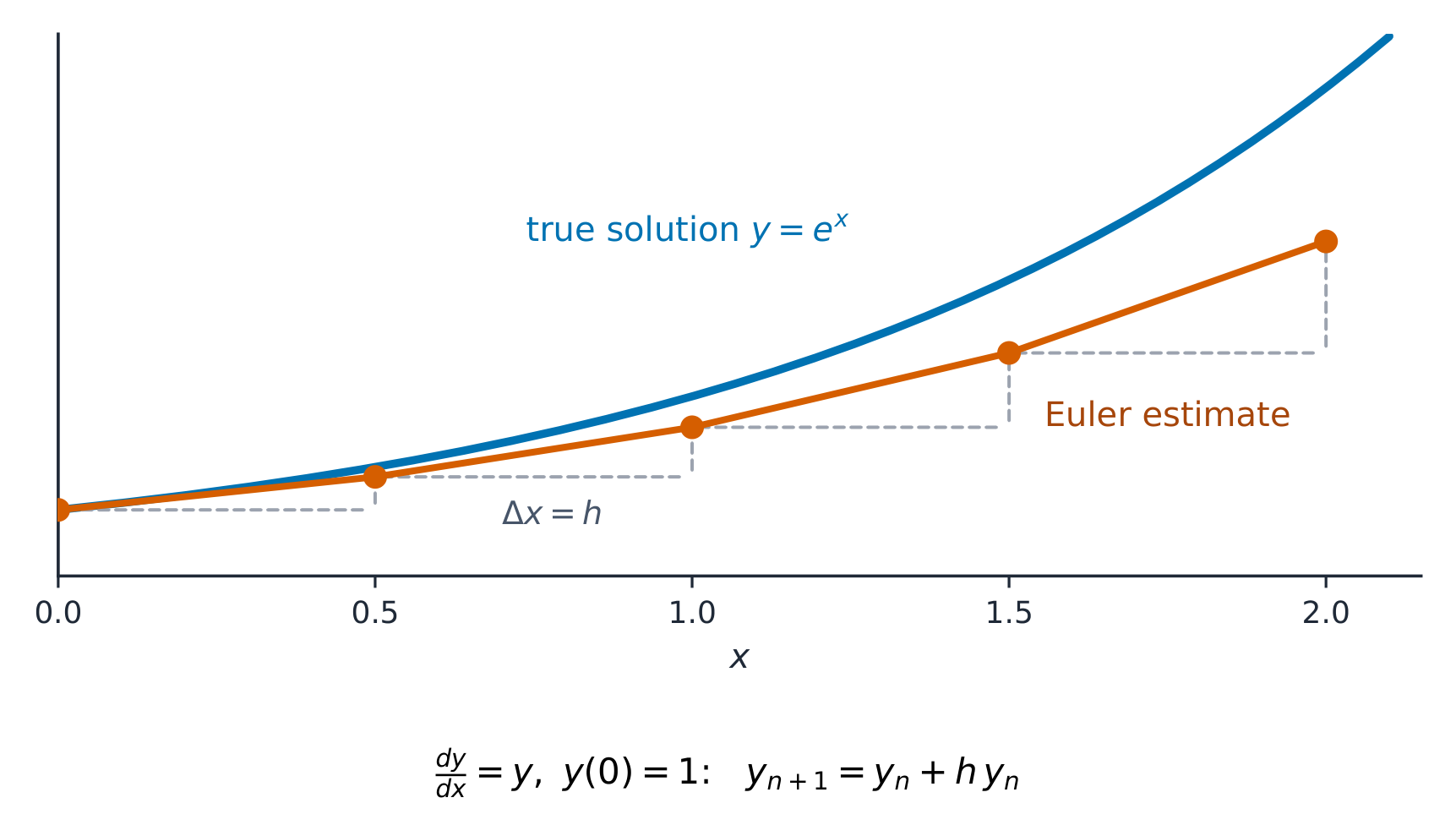
Euler's method steps along the tangent; the estimate drifts from the true solution
The slope field and exact exponential solution
This field is $dy/dx=ay$, with exact solution $y=y_0e^{ax}$. It illustrates tangent directions, without calculating Euler steps. The worked Euler example below instead uses $dy/dx=x+y$.
Euler's update rule is $y_{n+1}=$
Dificultad 1/5 · 100 monedas + un pequeño bono en el primer intento de hoy
Old $y$ plus slope times step.
The fixed increment $h$ used at each Euler step is called the ____ size.
Dificultad 1/5 · 100 monedas + un pequeño bono en el primer intento de hoy
$x$ advances by the step size $h$ each iteration.
Marching through a table
- Organize the work in a table: at each row, read $(x_n,y_n)$, compute the slope $f(x_n,y_n)$, then get $y_{n+1}$.
- Advance $x$ by $h$ each row and repeat until you reach the target $x$.
- Each step is just arithmetic; the differential equation supplies the slope.
- After a few rows you have an approximate $y$ at the target.
A favor $\dfrac{dy}{dx}=x+y$, $y(0)=1$, $h=0.5$: the slope at $(0,1)$ es $1$. Find $y_1$.
Dificultad 2/5 · 140 monedas + un pequeño bono en el primer intento de hoy
$1+0.5(1)=1.5$.
A favor $dy/dx=x+y$ with step $h=0.5$, the current point is $(0.5,1.5)$. Find the Euler estimate $y(1)\approx y_2$.
Dificultad 2/5 · 140 monedas + un pequeño bono en el primer intento de hoy
En $(0.5,1.5)$, the slope is $0.5+1.5=2$. Then $y_2=y_1+h f(x_1,y_1)=1.5+0.5(2)=2.5$.
Accuracy and step size
- Euler's method is only an approximation — it follows straight tangents, so it drifts from the true curve.
- A smaller step size $h$ generally gives a more accurate estimate for a smooth, stable problem (but more steps).
- On a concave-up curve Euler tends to underestimate; concave-down, overestimate.
- More steps, less error — the classic accuracy trade-off.
Using a smaller step size $h$ generally makes Euler's estimate...
Dificultad 1/5 · 100 monedas + un pequeño bono en el primer intento de hoy
Smaller steps drift less from the true curve.
You must recompute the slope at each new point, not reuse the initial slope.
Dificultad 1/5 · 100 monedas + un pequeño bono en el primer intento de hoy
The slope $f(x_n,y_n)$ changes each step.
Use the slope at the current point $(x_n,y_n)$ for each step, not a fixed slope. And each step updates both $x$ (by $h$) and $y$ (by $h\cdot f$). A common error is reusing the initial slope for every step — the slope must be recomputed at each new point.
Approximate $y(1)$ for $\dfrac{dy}{dx}=x+y$, $y(0)=1$, with step $h=0.5$.
- Step 1: slope at $(0,1)$ is $0+1=1$; $y_1=1+0.5(1)=1.5$, $x_1=0.5$.
- Step 2: slope at $(0.5,1.5)$ is $0.5+1.5=2$; $y_2=1.5+0.5(2)=2.5$, $x_2=1$.
- So $y(1)\approx 2.5$.
Euler's method approximates a differential equation's solution by stepping along tangents: $y_{n+1}=y_n+h\,f(x_n,y_n)$ with fixed step size $h$, recomputing the slope at each point. It's approximate (straight steps drift from the curve); a smaller $h$ generally improves accuracy for a smooth, stable problem.