Integrating Using Linear Partial Fractions
Introducido| English | Significado |
|---|---|
| Partial fractions/ˈpɑːʃl ˈfrækʃnz/ | fracciones parciales |
| linear factor/ˈlɪnɪə ˈfæktə/ | factor lineal |
Break one hard fraction into easy ones
- Some rational functions can't be integrated directly, but split apart they become simple logs.
- Partial fractions 部分分式 rewrites one fraction as a sum of smaller fractions.
- Each piece has a single linear factor 一次因式 in its denominator — easy to integrate as a $\ln$.
- It's the reverse of adding fractions over a common denominator.
Set up the decomposition
- Start with a rational function whose denominator factors into distinct linear factors.
- $\dfrac{1}{(x-1)(x+2)}=\dfrac{A}{x-1}+\dfrac{B}{x+2}$ for constants $A,B$ to be found.
- Each distinct linear factor $(x-r)$ gets its own term $\dfrac{\text{constant}}{x-r}$.
- (The numerator's degree must be less than the denominator's — divide first if not.)
One simple fraction after splitting
y = a / (x − b)
The graph shows the simple fraction $1/(x-1)$, with one vertical asymptote. Partial fractions combines such pieces; integrating this piece gives $\ln|x-1|+C$.
The partial-fraction form of $\dfrac{1}{(x-1)(x+2)}$ is...
Dificultad 1/5 · 100 monedas + un pequeño bono en el primer intento de hoy
One constant over each distinct linear factor.
If the numerator degree is not less than the denominator degree, you must divide first.
Dificultad 1/5 · 100 monedas + un pequeño bono en el primer intento de hoy
Partial fractions needs a proper fraction.
This lesson handles denominators that factor into distinct ____ factors.
Dificultad 1/5 · 100 monedas + un pequeño bono en el primer intento de hoy
Distinct linear factors $(x-r)$.
Solve for the constants
- Multiply both sides by the common denominator to clear fractions.
- Then find $A,B$ by matching coefficients or by plugging in the roots (a fast shortcut).
- For $\dfrac{1}{(x-1)(x+2)}$: at $x=1$, $1=A(3)\Rightarrow A=\tfrac13$; at $x=-2$, $1=B(-3)\Rightarrow B=-\tfrac13$.
- Now the integral is a sum of simple pieces.
A favor $\dfrac{1}{(x-1)(x+2)}=\dfrac{A}{x-1}+\dfrac{B}{x+2}$, find $A$ (plug $x=1$).
Dificultad 2/5 · 140 monedas + un pequeño bono en el primer intento de hoy
Clear the denominators first: $1=A(x+2)+B(x-1)$. This polynomial identity holds at $x=1$, giving $1=3A$ y $A=1/3$.
Integrate the pieces
- Each $\dfrac{A}{x-r}$ integrates to $A\ln|x-r|$.
- $\displaystyle\int\dfrac{1}{(x-1)(x+2)}\,dx=\tfrac13\ln|x-1|-\tfrac13\ln|x+2|+C$.
- So a messy rational integral becomes a combination of logarithms.
- Combine or leave the logs as the answer prefers.
Each partial-fraction piece $\dfrac{A}{x-r}$ integrates to...
Dificultad 1/5 · 100 monedas + un pequeño bono en el primer intento de hoy
$\int A/(x-r)\,dx=A\ln|x-r|+C$, on an interval excluding $x=r$.
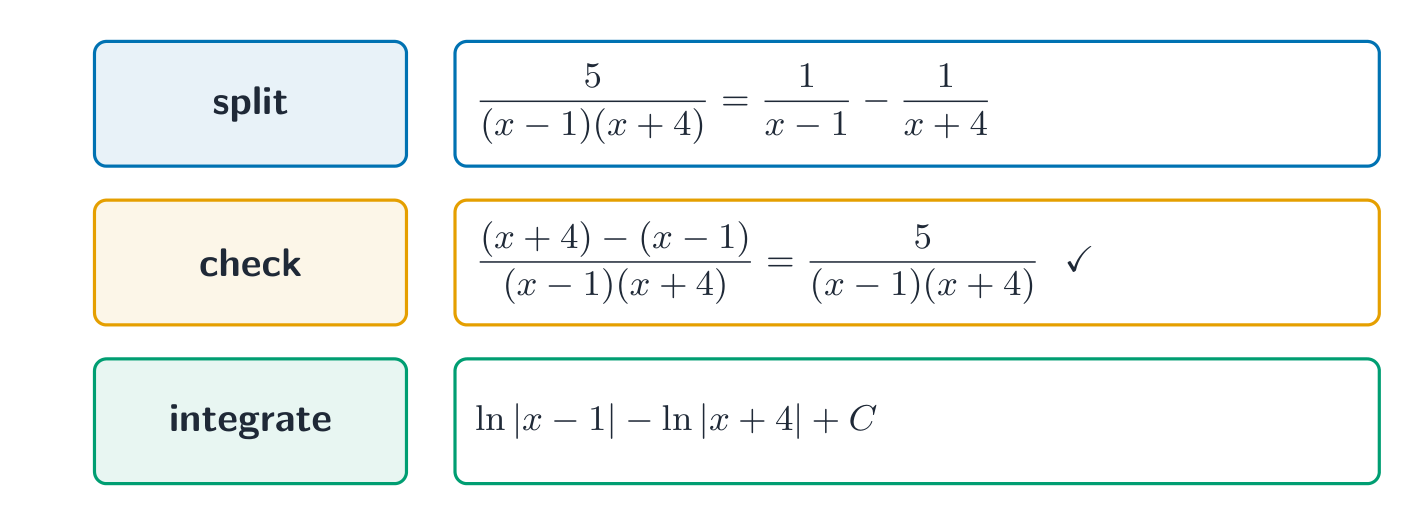
$\displaystyle\int\dfrac{5}{(x-1)(x+4)}\,dx$ (with $A=1$, $B=-1$) equals...
Dificultad 1/5 · 100 monedas + un pequeño bono en el primer intento de hoy
With $A=1$, $B=-1$, the integrand is $1/(x-1)-1/(x+4)$. Integrating each piece gives $\ln|x-1|-\ln|x+4|+C$.
Partial fractions needs the numerator degree less than the denominator's — if not, do long division first. And it requires the denominator to actually factor into linear pieces; a repeated factor $(x-r)^2$ or an irreducible quadratic needs extra terms (beyond this lesson's distinct linear case). Each distinct factor gets exactly one constant.
Evaluate $\displaystyle\int\dfrac{5}{(x-1)(x+4)}\,dx$.
- Decompose: $\dfrac{5}{(x-1)(x+4)}=\dfrac{A}{x-1}+\dfrac{B}{x+4}$. Clearing denominators gives $5=A(x+4)+B(x-1)$. At $x=1$: $5=5A\Rightarrow A=1$; at $x=-4$: $5=-5B\Rightarrow B=-1$.
- $\displaystyle\int\Big(\tfrac{1}{x-1}-\tfrac{1}{x+4}\Big)\,dx=\ln|x-1|-\ln|x+4|+C$.
Partial fractions splits a rational function with distinct linear factors into a sum $\frac{A}{x-r_1}+\frac{B}{x-r_2}+\cdots$; find the constants (match coefficients or plug in roots), then integrate each piece to a $\ln$. Requires numerator degree $<$ denominator degree — divide first otherwise.