Integración de Funciones mediante División Larga y Completando el Cuadrado
Introducido| English | Significado |
|---|---|
| completing the square/kəmˈpliːtɪŋ ðə skweə/ | completar el cuadrado |
| polynomial long division/ˌpɒlɪˈnəʊmɪəl lɒŋ dɪˈvɪʒn/ | división larga de polinomios |
Rewrite first, then integrate
- Some rational functions don't match any basic antiderivative — until you rewrite them.
- Two algebra tools prepare a stubborn integrand: long division and completing the square.
- Neither is calculus; both just reshape the fraction into a friendlier form.
- Then a basic rule or a known integral finishes the job.
Long division for "top-heavy" fractions
- If the numerator's degree is $\ge$ the denominator's, the fraction is improper.
- Use polynomial long division 多项式长除法 to split it into a polynomial plus a proper remainder.
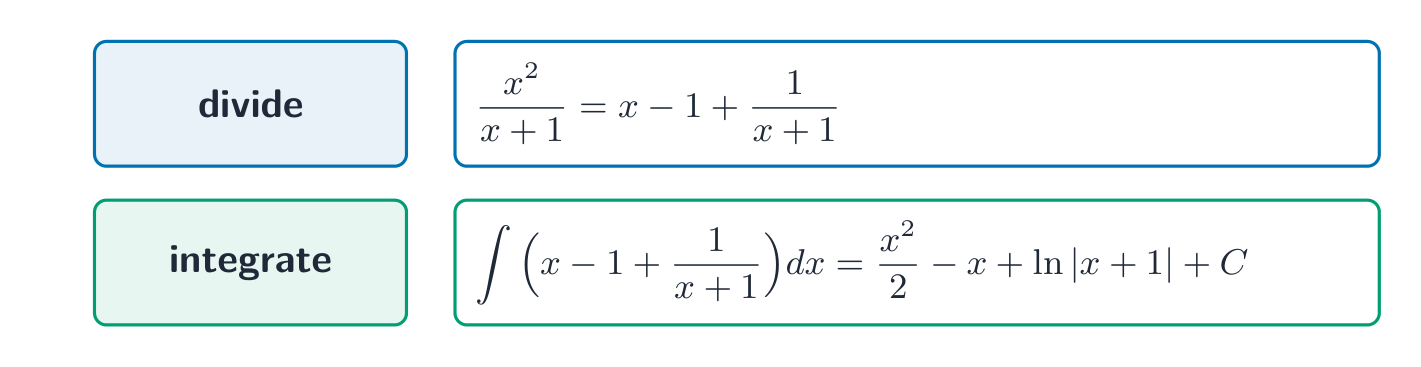
- $\dfrac{x^2}{x+1}=x-1+\dfrac{1}{x+1}$ — now each piece integrates easily.
- $\displaystyle\int\dfrac{x^2}{x+1}\,dx=\dfrac{x^2}{2}-x+\ln|x+1|+C$.
Una curva racional para reescribir
y = a / (x − b)
Una fracción impropia como $\tfrac{x^2}{x+1}$ se convierte en una línea más un pequeño residuo — cada parte se integra fácilmente.
Use la división larga de polinomios cuando el grado del numerador es...
Dificultad 1/5 · 100 monedas + un pequeño bono en el primer intento de hoy
Una fracción impropia (con numerador mayor) requiere división.
La división larga da $\dfrac{x^2}{x+1}=$
Dificultad 1/5 · 100 monedas + un pequeño bono en el primer intento de hoy
$x^2=(x+1)(x-1)+1$, por lo que el cociente es $x-1$ con residuo $1$.
Completing the square for inverse-trig forms
- A denominator like $x^2+4x+5$ hides a perfect square: complete the square 配方 to $(x+2)^2+1$.
- That $\dfrac{1}{(x+2)^2+1}$ shape matches the arctangent antiderivative.
- $\displaystyle\int\dfrac{1}{x^2+4x+5}\,dx=\int\dfrac{1}{(x+2)^2+1}\,dx=\arctan(x+2)+C$.
- Completing the square turns a messy quadratic denominator into the clean $u^2+a^2$ pattern.
Completando el cuadrado, $x^2+4x+5=$
Dificultad 1/5 · 100 monedas + un pequeño bono en el primer intento de hoy
$(x+2)^2=x^2+4x+4$, así que $x^2+4x+5=(x+2)^2+1$.
La forma $\dfrac{1}{(x+2)^2+1}$ se integra a una función de ____.
Dificultad 1/5 · 100 monedas + un pequeño bono en el primer intento de hoy
$\int\tfrac{1}{u^2+1}\,du=\arctan u+C$.
Recognize the signal
- Numerator degree $\ge$ denominator degree → reach for long division first.
- An irreducible quadratic denominator (no real roots) → try completing the square toward arctan.
- These are setup moves; the actual integration is a basic rule or u-sub afterward.
- Spotting which rewrite to use is half the battle.
$\displaystyle\int\dfrac{x^2}{x+1}\,dx=$
Dificultad 1/5 · 100 monedas + un pequeño bono en el primer intento de hoy
Divida primero, luego integre $x-1+\tfrac1{x+1}$.
Asocie la señal con la reescritura: seleccione todos los emparejamientos verdaderos.
Dificultad 2/5 · 140 monedas + un pequeño bono en el primer intento de hoy
La división larga es solo para fracciones impropias; ambas son reescrituras previas a la integración.
Do the long division only when the fraction is improper (numerator degree $\ge$ denominator's) — dividing a proper fraction gets you nowhere. And after completing the square, keep the constant right: $x^2+4x+5=(x+2)^2+1$, not $(x+2)^2+5$. A wrong constant breaks the arctan match.
Integrate $\displaystyle\int\dfrac{x^2}{x+1}\,dx$.
- Long division: $\dfrac{x^2}{x+1}=x-1+\dfrac{1}{x+1}$.
- Integrate term by term: $\dfrac{x^2}{2}-x+\ln|x+1|+C$.
- (Each rewritten piece uses a basic antiderivative rule.)
When a rational integrand fits no basic rule, rewrite it first: use polynomial long division on an improper fraction (numerator degree $\ge$ denominator's), or complete the square in an irreducible quadratic denominator to reach an arctangent form. Then finish with a basic antiderivative.