Interpreting the Behavior of Accumulation Functions Involving Area
Introducido| English | Significado |
|---|---|
| extrema/ekˈstremə/ | extremos |
Reading $g$ from the graph of $f$
- If $g(x)=\displaystyle\int_a^x f(t)\,dt$ with $f$ continuous, then $g'=f$ (FTC Part 1). So the graph of $f$ is the graph of $g'$.
- Everything from Unit 5 applies, and the areas under $f$ give the values of $g$.
When analyzing $g(x)=\int_a^x f\,dt$, the graph of $f$ acts as the graph of $g'$.
Dificultad 1/5 · 100 monedas + un pequeño bono en el primer intento de hoy
FTC Part 1: $g'=f$.
Increasing, decreasing and extrema of $g$
- $f>0$: $g$ is increasing (area is added). $f<0$: $g$ is decreasing (area is taken away).
- $f$ changes $+\to-$: $g$ has a local max. $f$ changes $-\to+$: a local min. These extrema 极值 sit where $f$ crosses the axis.
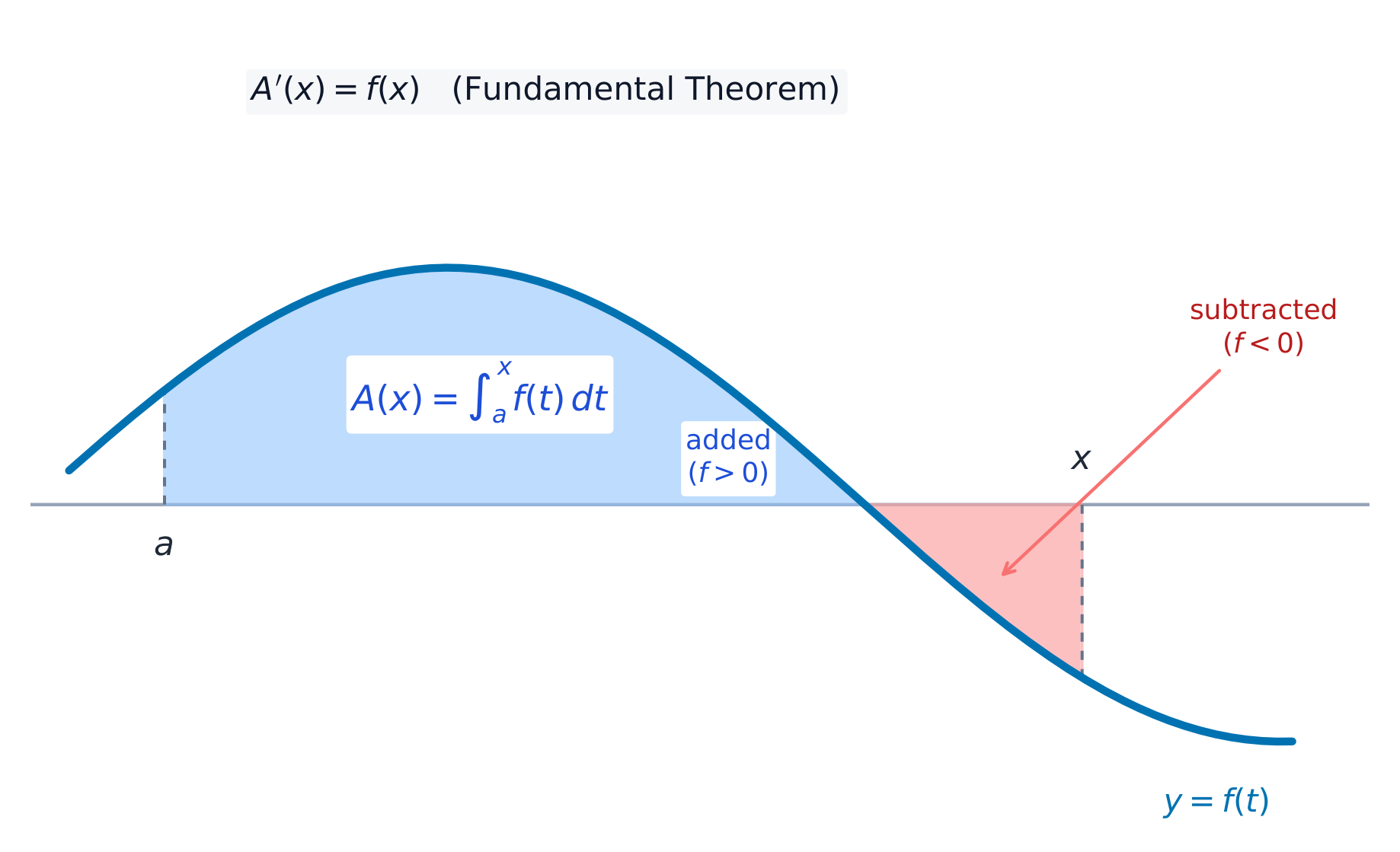
An accumulation function adds area where f > 0 and subtracts it where f < 0
g aumenta donde f es positiva
y = f(t) (the integrand = g′)
While $f$ (the shaded height) is positive, the accumulated area $g$ increases; when $f$ turns negative, $g$ decreases.
A favor $g(x)=\int_a^x f(t)\,dt$, $g$ is increasing exactly where...
Dificultad 1/5 · 100 monedas + un pequeño bono en el primer intento de hoy
$g'=f$, so $g$ increases where $f>0$.
$g$ has a local maximum where $f$ changes from...
Dificultad 1/5 · 100 monedas + un pequeño bono en el primer intento de hoy
$g'=f$ goes $+\to-$ → local max of $g$.
Concavity of $g$ from the slope of $f$
- $g''=f'$. Where $f$ is increasing, $g$ is concave up; where $f$ is decreasing, $g$ is concave down.
- Turning points of $f$ are inflection points of $g$.
Since $g''=f'$, $g$ is concave up where $f$ is ____.
Dificultad 1/5 · 100 monedas + un pequeño bono en el primer intento de hoy
$g''=f'>0$ where $f$ rises.
From the graph of $f$, you can read which features of $g=\int_a^x f\,dt$?
Dificultad 2/5 · 140 monedas + un pequeño bono en el primer intento de hoy
Increase/decrease, extrema, concavity — all from $f$. Exact values need the actual area.
Worked example: values from areas

Let $g(x)=\displaystyle\int_{-2}^{x} f(t)\,dt$. Add the signed areas, starting at $t=-2$:
| $x$ | $-3$ | $-2$ | $1$ | $3$ | $4$ |
|---|---|---|---|---|---|
| $g(x)$ | $1$ | $0$ | $3$ | $2$ | $2.5$ |
- $g(3)=3+(-1)=2$. Going left reverses the sign: $g(-3)=-\displaystyle\int_{-3}^{-2}f=-(-1)=1$.
- On $[-3,4]$ the candidates are the ends and the sign changes of $f$. Absolute max $g(1)=3$; absolute min $g(-2)=0$.
Use the graph and $g(x)=\displaystyle\int_{-2}^{x}f(t)\,dt$ from the worked example. Find $g(2)$.
Dificultad 2/5 · 140 monedas + un pequeño bono en el primer intento de hoy
From $-2$ hasta $1$ the area is $3$. From $1$ hasta $2$ the region is below the axis: a triangle with base 1 and height 1, area $-\tfrac12$. $g(2)=3-0.5=2.5$.
Justify like the AP exam. Using the same $g$, find where $g$ has a relative minimum on $(-3,4)$.
- $g'(x)=f(x)$. $f$ changes from negative to positive at $x=-2$ and at $x=3$.
- So $g$ has relative minima at $x=-2$ and $x=3$. (At $x=1$, $f$ changes from positive to negative: a relative maximum.)
Same $g$. Find $g'(0)+g''(0)$.
Dificultad 2/5 · 140 monedas + un pequeño bono en el primer intento de hoy
$g'(0)=f(0)=1$. $g''(0)=f'(0)$, the slope of the segment through $t=0$, which is $-1$. Sum: $0$.
- Don't read the height of $f$ as the height of $g$. Large $f$ means $g$ is rising fast, not that $g$ is large.
- $g(a)=0$ always: start adding area at the lower limit.
- Area to the left of the lower limit enters with the opposite sign.
A large positive value of $f$ at $x$ means that $g$ is...
Dificultad 1/5 · 100 monedas + un pequeño bono en el primer intento de hoy
$f=g'$ is the velocidad; a large $f$ means $g$ rises fast, not that $g$ is big.
For $g(x)=\int_a^x f(t)\,dt$: $g'=f$ and $g''=f'$. The sign of $f$ gives increase/decrease of $g$; its sign changes give extrema; its slope gives concavity. Values of $g$ are signed areas from $a$ to $x$.