Derivadas de Funciones Trigonométricas Inversas
Introducido| English | Significado |
|---|---|
| inverse trigonometric functions/ɪnˈvɜːs ˌtrɪɡənəʊˈmetrɪk ˈfʌŋkʃnz/ | Funciones trigonométricas inversas |
Derivatives that hide a square root
- The inverse trig functions — $\arcsin$, $\arctan$, and friends — undo sine, tangent, etc.
- Their derivatives are surprisingly algebraic: no trig at all, just powers and roots.
- Two are worth memorizing outright; the rest follow the same pattern.
- These inverse trigonometric functions 反三角函数 show up in integrals later, so knowing their derivatives pays off twice.
The two you must know
- $\dfrac{d}{dx}[\arcsin x]=\dfrac{1}{\sqrt{1-x^2}}$.
- $\dfrac{d}{dx}[\arctan x]=\dfrac{1}{1+x^2}$.
- Notice: $\arcsin$ has a root in the denominator; $\arctan$ has a clean $1+x^2$.
- Both are always positive on their domains — these inverses are increasing.
La suave pendiente de la arcotangente
y = a·tanh(bx) (forma similar a arctan)
$\arctan x$ crece más rápido en $0$ (pendiente $1$) y se aplanó — su derivada $\tfrac{1}{1+x^2}$ disminuye hacia $0$.
¿Cuál es $\dfrac{d}{dx}[\arcsin x]$?
Dificultad 1/5 · 100 monedas + un pequeño bono en el primer intento de hoy
$\arcsin$ tiene la forma raíz $\tfrac{1}{\sqrt{1-x^2}}$.
¿Cuál es $\dfrac{d}{dx}[\arctan x]$?
Dificultad 1/5 · 100 monedas + un pequeño bono en el primer intento de hoy
$\arctan$ tiene la forma limpia $\tfrac{1}{1+x^2}$ (sin raíz).
The rest of the family
- $\dfrac{d}{dx}[\arccos x]=-\dfrac{1}{\sqrt{1-x^2}}$ — same as $\arcsin$ but negative.
- $\dfrac{d}{dx}[\text{arccot}\,x]=-\dfrac{1}{1+x^2}$ — the negative of $\arctan$'s.
- $\dfrac{d}{dx}[\text{arcsec}\,x]=\dfrac{1}{|x|\sqrt{x^2-1}}$.
- The "co-" inverses carry a minus, echoing the ordinary trig pattern.
$\dfrac{d}{dx}[\arccos x]$ es el ____ de $\dfrac{d}{dx}[\arcsin x]$ (mismo valor absoluto, signo opuesto).
Dificultad 1/5 · 100 monedas + un pequeño bono en el primer intento de hoy
$\arccos$ lleva el signo menos.
Selecciona todas las derivadas trigonométricas inversas que contienen una raíz cuadrada.
Dificultad 2/5 · 140 monedas + un pequeño bono en el primer intento de hoy
$\arcsin$, $\arccos$ y arcsec tienen raíces; $\arctan$ es $\tfrac{1}{1+x^2}$ sin raíz.
Chain them up
- With the chain rule, replace $x$ by an inner function $u$ and multiply by $u'$.
- $\dfrac{d}{dx}[\arctan(3x)]=\dfrac{1}{1+(3x)^2}\cdot 3=\dfrac{3}{1+9x^2}$.
- $\dfrac{d}{dx}[\arcsin(x^2)]=\dfrac{1}{\sqrt{1-(x^2)^2}}\cdot 2x=\dfrac{2x}{\sqrt{1-x^4}}$.
- Same routine as any chain-rule problem: outer formula, then $\times\,u'$.
Para $y=\arctan(3x)$, $y'=\dfrac{3}{1+9x^2}$. Encuentra $y'$ en $x=0$.
Dificultad 2/5 · 140 monedas + un pequeño bono en el primer intento de hoy
En $x=0$: $\tfrac{3}{1+0}=3$.
$\dfrac{d}{dx}[\arctan(3x)]=\dfrac{1}{1+9x^2}$ (sin factor interno).
Dificultad 1/5 · 100 monedas + un pequeño bono en el primer intento de hoy
La regla de la cadena añade la derivada interna $3$: $\tfrac{3}{1+9x^2}$.
Don't confuse the two shapes: $\arcsin$ gives $\frac{1}{\sqrt{1-x^2}}$ (a root), while $\arctan$ gives $\frac{1}{1+x^2}$ (no root). And with the chain rule, never drop the inner derivative: $\frac{d}{dx}[\arctan(3x)]=\frac{3}{1+9x^2}$, not $\frac{1}{1+9x^2}$.
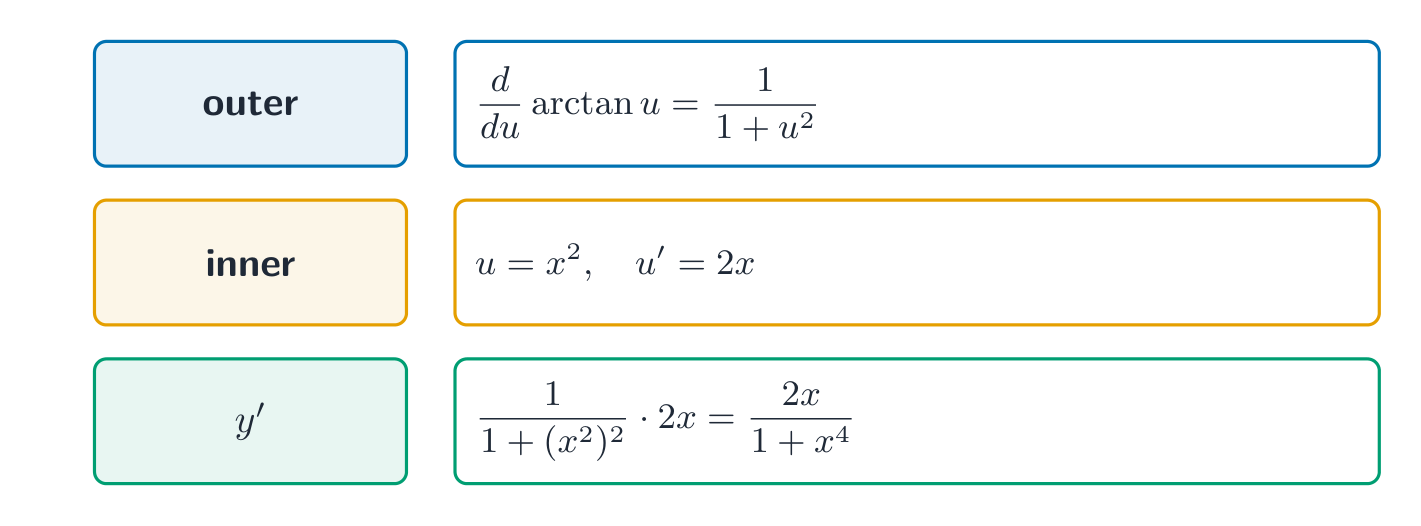
Differentiate $y=\arctan(x^2)$.
- Outer: $\arctan(u)$ with $u=x^2$, giving $\dfrac{1}{1+u^2}$.
- Inner derivative: $u'=2x$.
- $y'=\dfrac{1}{1+(x^2)^2}\cdot 2x=\dfrac{2x}{1+x^4}$.
Memorize $\frac{d}{dx}[\arcsin x]=\frac{1}{\sqrt{1-x^2}}$ and $\frac{d}{dx}[\arctan x]=\frac{1}{1+x^2}$. The "co-" inverses ($\arccos$, arccot) carry a minus. For composite inverse trigonometric functions, apply the chain rule — the standard formula times the inner derivative $u'$.