Applying the Power Rule
Introducido| English | Significado |
|---|---|
| power/ˈpaʊə/ | potencia |
| Power Rule/ˈpaʊə ruːl/ | Regla de la potencia |
| integer/ˈɪntɪdʒə/ | entero |
A shortcut that replaces the limit
- Working out every derivative from the limit definition is slow. For powers of $x$, one rule does it in a single line: the Power Rule 幂法则.
- Bring the exponent down in front, then subtract one from the exponent:
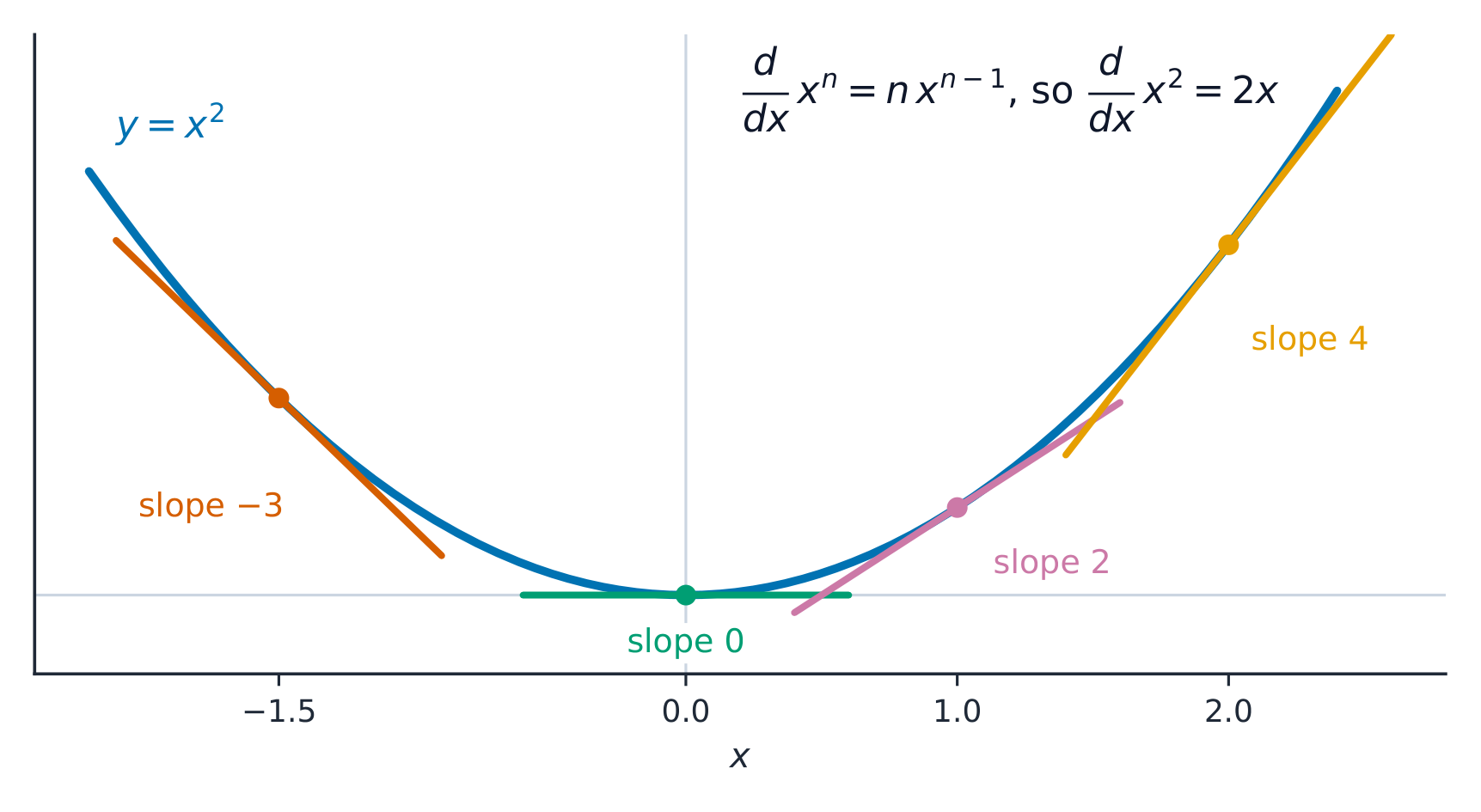
A power and its tangent slope
y = x²
A favor $y=x^2$ the power rule gives slope $2x$ — move the point and check the tangent slope matches $2x$.
Watch it work
- $\dfrac{d}{dx}[x^3]=3x^2$: the $3$ comes down in front and the exponent goes from $3$ to $2$. Also $\dfrac{d}{dx}[x^{10}]=10x^9$ and $\dfrac{d}{dx}[x]=1\cdot x^0=1$.
- It agrees with the limit definition, which gave $\frac{d}{dx}[x^2]=2x$, but takes one line instead of five.
What is $\dfrac{d}{dx}[x^5]$?
Dificultad 1/5 · 100 monedas + un pequeño bono en el primer intento de hoy
Bring down $5$, reduce exponent: $5x^{5-1}=5x^4$.
If $f(x)=x^4$, find $f'(2)$.
Dificultad 2/5 · 140 monedas + un pequeño bono en el primer intento de hoy
$f'(x)=4x^3$, so $f'(2)=4\cdot8=32$.
It works for any exponent
- $n$ can be negative or a fraction (rational), not just a positive integer 整数. Negative: $\dfrac{d}{dx}[x^{-2}]=-2x^{-3}$. Rational: $\dfrac{d}{dx}\big[x^{1/2}\big]=\tfrac12 x^{-1/2}$.
- The steps never change: bring down $n$, then reduce the exponent by one. With a negative exponent, "one less" means more negative: $-2\to-3$.
$\dfrac{d}{dx}[x^{-2}]=-2x^{\square}$. The exponent $\square$ is ____.
Dificultad 1/5 · 100 monedas + un pequeño bono en el primer intento de hoy
Reduce $-2$ by one: $-2-1=-3$.
The Power Rule differentiates which of these directly (after rewriting)?
Dificultad 2/5 · 140 monedas + un pequeño bono en el primer intento de hoy
All are powers of $x$ after rewriting; $5^x$ is an exponential, not a power of $x$.
Rewrite first, then differentiate
- Roots and fractions hide powers. Rewrite each term as a power $x^n$ first: $\sqrt{x}=x^{1/2}$, so $\dfrac{d}{dx}[\sqrt x]=\tfrac12 x^{-1/2}=\dfrac{1}{2\sqrt x}$.
- $\dfrac{1}{x^3}=x^{-3}$, so $\dfrac{d}{dx}\!\left[\dfrac1{x^3}\right]=-3x^{-4}=-\dfrac{3}{x^4}$. A number in front just stays: $\dfrac{d}{dx}[5x^{-3}]=-15x^{-4}$.
Rewrite and differentiate: $\dfrac{d}{dx}[\sqrt x]$ equals...
Dificultad 1/5 · 100 monedas + un pequeño bono en el primer intento de hoy
$\sqrt x=x^{1/2}\Rightarrow \tfrac12 x^{-1/2}=\tfrac1{2\sqrt x}$.
Differentiate $g(x)=\sqrt[3]{x^2}+\dfrac{1}{x}$.
- Rewrite as powers: $g(x)=x^{2/3}+x^{-1}$.
- Power rule term by term: $\tfrac23 x^{-1/3}$ and $-1\cdot x^{-2}$.
- $g'(x)=\tfrac23 x^{-1/3}-x^{-2}=\dfrac{2}{3\sqrt[3]{x}}-\dfrac1{x^2}$.
Split the fraction first. Find $f'(2)$ for $f(x)=\dfrac{x^3+4}{x^2}$.
- Divide each term by $x^2$: $f(x)=x+4x^{-2}$.
- $f'(x)=1-8x^{-3}=1-\dfrac{8}{x^3}$, so $f'(2)=1-\dfrac88=0$. The tangent at $x=2$ is horizontal.
Let $f(x)=\dfrac{x^2+3}{x}$. Split the fraction, then find $f'(1)$.
Dificultad 2/5 · 140 monedas + un pequeño bono en el primer intento de hoy
$f(x)=x+3x^{-1}$, so $f'(x)=1-3x^{-2}$ y $f'(1)=1-3=-2$.
A tangent line. Find the tangent to $y=\dfrac{8}{\sqrt x}$ at $x=4$.
- Rewrite: $y=8x^{-1/2}$. Point: $y(4)=\dfrac{8}{2}=4$.
- Slope: $y'=-4x^{-3/2}$, so $y'(4)=\dfrac{-4}{8}=-\dfrac12$. Tangent: $y-4=-\dfrac12(x-4)$.
Find the slope of $y=\dfrac{6}{\sqrt[3]{x}}$ at $x=8$. Give a decimal.
Dificultad 2/5 · 140 monedas + un pequeño bono en el primer intento de hoy
$y=6x^{-1/3}$, so $y'=-2x^{-4/3}$. At $x=8$: $x^{4/3}=16$, so $y'=-\dfrac{2}{16}=-0.125$.
- The Power Rule needs a variable base and a constant exponent ($x^n$). It does not work for $2^x$: $\frac{d}{dx}[2^x]\neq x\,2^{x-1}$. Exponentials come in the next lesson.
- Reduce the exponent: $\frac{d}{dx}[x^{-2}]=-2x^{-3}$, not $-2x^{-2}$.
- You can split a fraction only when its denominator is a single term: $\dfrac{x^3+4}{x^2}=x+4x^{-2}$, but $\dfrac{1}{x^2+1}$ is not $x^{-2}+1$.
The Power Rule applies to $2^x$, giving $x\cdot 2^{x-1}$.
Dificultad 1/5 · 100 monedas + un pequeño bono en el primer intento de hoy
The Power Rule needs a variable base with constant exponent; $2^x$ is an exponential (next lesson).
$\dfrac{1}{x^2+1}=x^{-2}+1$, so its derivative is $-2x^{-3}$.
Dificultad 1/5 · 100 monedas + un pequeño bono en el primer intento de hoy
A sum in the denominator cannot be split. $\dfrac{1}{x^2+1}$ needs the chain or quotient rule.
The Power Rule $\frac{d}{dx}[x^n]=n\,x^{n-1}$ works for any constant exponent — integer, negative, or rational. Rewrite radicals and reciprocals as powers first, then bring the exponent down and reduce it by one. It replaces the limit definition for power functions.