Mutaciones
Introducido| English | Significado |
|---|---|
| mutation/mjuːˈteɪʃn/ | mutación |
| substitution/ˌsʌbstɪˈtjuːʃn/ | sustitución |
| deletion/dɪˈliːʃn/ | deleción |
| insertion/ɪnˈsɜːʃn/ | inserción |
| mutagen/ˈmjuːtədʒn/ | mutágeno |
Mistakes in the code
- Copying billions of DNA bases is astonishingly accurate — but not perfect.
- Once in a while, a base gets changed.
- Such a change to the DNA is called a mutation.
- Mutations can be harmful, harmless, or, rarely, a lucky improvement.
What a mutation is
- A mutation 突变 is a change in the DNA base sequence.
- Because the sequence codes for proteins, a mutation can change a protein.
- A changed protein may work differently — or not at all.
- Even a single base swapped can matter.
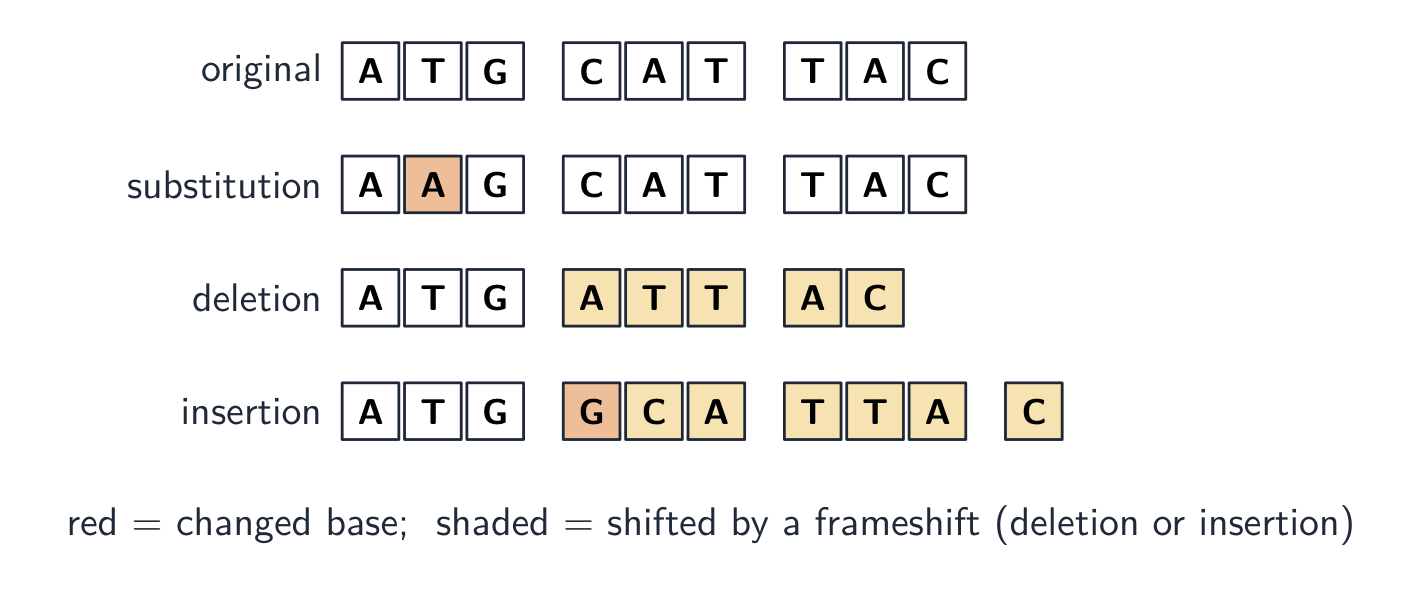
Substitution 替换, deletion 缺失, and insertion 插入 mutations
Una mutación es…
Dificultad 1/5 · 100 monedas + un pequeño bono en el primer intento de hoy
Una mutación es un cambio en la secuencia de ADN, lo cual puede alterar la proteína que produce un gen.
Types of mutation
- A substitution swaps one base for another.
- An insertion adds an extra base into the sequence.
- A deletion removes a base.
- Insertions and deletions shift the reading frame, often disrupting the whole protein.
Una mutación por sustitución ocurre cuando…
Dificultad 1/5 · 100 monedas + un pequeño bono en el primer intento de hoy
Una sustitución intercambia una base por otra; las inserciones y deleciones añaden o eliminan bases.
Effects and causes
- Many mutations have no effect at all — they are neutral.
- Some are harmful; a rare few are beneficial.
- Beneficial mutations provide the variation that drives evolution.
- A mutagen 诱变剂 — UV light, radiation, or some chemicals — raises the mutation rate.
¿Útiles, dañinas o neutrales?
Clasifica cada mutación según su efecto: muchas no hacen nada, algunas causan daño y unas pocas ayudan.
Un factor que aumenta la tasa de mutación, como la luz UV, es un ____.
Dificultad 1/5 · 100 monedas + un pequeño bono en el primer intento de hoy
Un mutágeno —luz UV, radiación o ciertos químicos— hace más probables las mutaciones.
Todas las mutaciones son nocivas.
Dificultad 1/5 · 100 monedas + un pequeño bono en el primer intento de hoy
Falso. Muchas mutaciones son neutras y algunas son beneficiosas; estas proporcionan la variación que impulsa la evolución.
Selecciona todas las afirmaciones verdaderas sobre las mutaciones.
Dificultad 2/5 · 140 monedas + un pequeño bono en el primer intento de hoy
No todas las mutaciones son dañinas; muchas son neutrales y algunas son beneficiosas. Las otras tres son correctas.
Not every mutation is bad. Most are neutral, some are harmful, and a rare few are beneficial — and those helpful changes are the raw material of evolution. Do not assume "mutation" always means damage.
One base, a big difference:
- Sickle-cell disease comes from a single substitution in the haemoglobin gene.
- That one changed base makes a faulty haemoglobin, harming red blood cells.
- Yet the same allele also protects against malaria — the very same mutation can be both harmful and helpful.
A mutation is a change in the DNA base sequence. Types include substitution (swap a base), insertion (add one), and deletion (remove one). Mutations can be harmful, neutral, or beneficial, and a mutagen raises their rate. Beneficial mutations supply the variation for evolution.
Write from this case
- One base is deleted from the coding sequence of a gene.
- The deletion is not a multiple of three.
¿Qué tipo de mutación es esta?
Los codones se leen en grupos de tres, por lo que la ausencia de una base desplaza los grupos.
¿Qué es la delección de una base codificante?
Dificultad 1/5 · 100 monedas + un pequeño bono en el primer intento de hoy
El marco de lectura cambia aguas abajo.