Environmental Effects on Phenotype
Introducido| English | Significado |
|---|---|
| environment/enˈvaɪrənmənt/ | entorno |
| phenotype/ˈfenətaɪp/ | phenotype: fenotipo |
| genotype/ˈdʒenətaɪp/ | genotype: genotipo |
Same genes, different results
- A Himalayan rabbit is white with black ears, nose, feet and tail. If you shave a patch on its back and keep an ice pack on it, the fur grows back black. The rabbit's genes did not change; the temperature did.
- An organism's phenotype 表型 (its observable traits) depends on its genotype 基因型 and its environment 环境. The ability of one genotype to produce different phenotypes in different environments is called phenotypic plasticity 表型可塑性.
An organism's phenotype is shaped by…
Dificultad 1/5 · 100 monedas + un pequeño bono en el primer intento de hoy
El phenotype is the result of the genotype y the environment working together.
The ability of one genotype to produce different phenotypes in different environments is called…
Dificultad 1/5 · 100 monedas + un pequeño bono en el primer intento de hoy
Phenotypic plasticity: same genes, different environments, different phenotypes.
How the environment changes a phenotype
- Environmental conditions influence gene expression 基因表达: whether a gene is transcribed, how much protein is made, and how well that protein works.
- In the rabbit, the gene for a pigment enzyme (tyrosinase) is the same in every cell, but the enzyme is temperature-sensitive: it works only in cooler body parts. Cold extremities → working enzyme → dark pigment.
Why do Himalayan rabbits grow dark fur only on their ears, nose, feet and tail?
Dificultad 1/5 · 100 monedas + un pequeño bono en el primer intento de hoy
Every cell has the same alleles. The temperature-sensitive enzyme is active only in the cooler extremities.
Examples the exam uses
| Environmental factor | Organism | Phenotype that changes |
|---|---|---|
| Temperature | Himalayan rabbits, Siamese cats | dark fur on cool body parts |
| Temperature | sea turtles, many reptiles | sex of hatchlings |
| Soil pH | hydrangea | flower colour: blue in acidic soil, pink in alkaline soil |
| UV light | humans and other animals | more melanin produced (a tan) |
| Diet | humans with phenylketonuria (PKU) | a low-phenylalanine diet prevents brain damage |
| Chemical signals | yeast and other fungi | mating pheromones are made only when the opposite mating type is present |
Genes, environment, or both?
Sort each trait by what most shapes it — the genotype, the environment, or a mix of both.
A suntan is an example of a trait caused mainly by…
Dificultad 1/5 · 100 monedas + un pequeño bono en el primer intento de hoy
A suntan comes from sunlight, an environmental effect — not from a change in the genes.
Temperature decides sex in sea turtles
- In many reptiles, sex is not set by sex chromosomes but by the temperature of the eggs during development. In sea turtles, warmer nests produce mostly females; cooler nests produce mostly males.
- This is a clear case of the same genotypes giving different phenotypes. It also makes turtles sensitive to climate change: on some warm beaches, almost all hatchlings are now female.
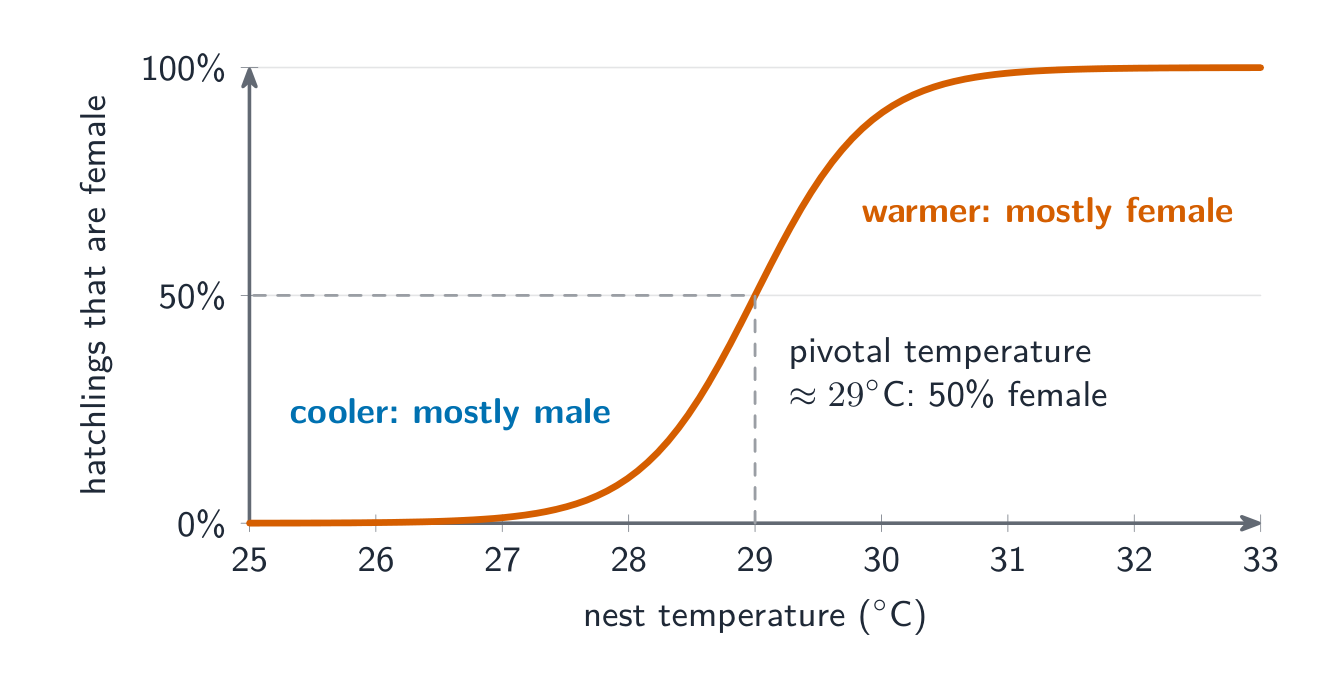
Using the graph, what is the most likely effect of a 2 °C rise in a beach's nest temperatures from 29 °C to 31 °C?
Dificultad 1/5 · 100 monedas + un pequeño bono en el primer intento de hoy
At 31 °C the curve is near 100% female. Sea turtles have no sex chromosomes that decide sex; temperature does.
Genes set a range; environment chooses within it
- Most traits depend on both: genes set the range of possible phenotypes, and the environment decides where within that range the organism ends up. Human height depends on genes and on childhood nutrition.
- Identical twins share the same genotype but can differ in weight, skin colour or disease, because their environments differ.
Human height depends on both genes and environment (such as nutrition).
Dificultad 1/5 · 100 monedas + un pequeño bono en el primer intento de hoy
Genes set a possible range for height; nutrition and health decide where within it you end up.
Identical twins have the same genes but can still differ because of their ____.
Dificultad 1/5 · 100 monedas + un pequeño bono en el primer intento de hoy
Different environments (diet, exercise, sun) give identical twins slightly different phenotypes.
Select todos true statements about phenotype.
Dificultad 2/5 · 140 monedas + un pequeño bono en el primer intento de hoy
Genes do not fix every trait — the environment matters too. The other three are correct.
Worked FRQ: design an experiment
A student claims that low temperature causes dark fur to grow on Himalayan rabbits.
(A) Identify the independent variable and a control. Independent variable: skin temperature. Control: a shaved patch with no ice pack, kept at normal body temperature.
(B) Predict the results if the claim is correct. Fur under the ice pack grows back black; fur on the control patch grows back white.
(C) Explain the result at the molecular level. The enzyme that makes the dark pigment is temperature-sensitive: it is active at low temperatures and inactive at body temperature. The genotype is the same in both patches; only the enzyme's activity, and so the phenotype, differs.
- Why it scores: (A) names a real control (same shaving, no cooling). (C) links environment → protein activity or gene expression → phenotype, and states that the DNA did not change.
- Phenotypic plasticity is not mutation. The DNA sequence does not change, so the new phenotype is not inherited by offspring through the DNA.
- A tan is not evolution. Individuals change their phenotype; populations evolve when allele frequencies change.
- Say how: "the environment affects gene expression or enzyme activity", not just "the environment changes the trait".
A hydrangea that turns blue in acidic soil will pass the blue colour to its offspring through its DNA.
Dificultad 1/5 · 100 monedas + un pequeño bono en el primer intento de hoy
The DNA did not change. Offspring grown in alkaline soil will be pink.
Environmental conditions influence gene expression, so the same genotype can produce different phenotypes: phenotypic plasticity. Examples: temperature and Himalayan rabbit fur, temperature and sea turtle sex, soil pH and hydrangea colour, UV light and melanin, diet and PKU, and the presence of the opposite mating type and yeast pheromones. Genes set a range; the environment acts within it. The DNA does not change.