Radioactive decay · Desintegración radiactiva
| English | Español |
|---|---|
| random/ˈrændəm/ | aleatorio |
| spontaneous/spɒnˈteɪnɪəs/ | espontánea |
| count rate/kaʊnt reɪt/ | tasa de conteo |
| activity/ækˈtɪvɪti/ | actividad |
| decay constant/dɪˈkeɪ ˈkɒnstənt/ | constante de desintegración |
| radionuclide/ˌreɪdiəʊˈnjuːklaɪd/ | radionucleido |
| becquerel/ˈbekwərəl/ | becquerel |
| half-life/hɑːf laɪf/ | vida media |
| exponential decay/ˌekspəˈnenʃl dɪˈkeɪ/ | decaimiento exponencial |
Clicks that never come evenly
- Put a Geiger counter beside a long-lived source and listen. The clicks come in bursts and gaps, never in a steady rhythm.
- Count for ten seconds, again and again, and no two counts match. Yet the long-run average is perfectly steady.
- That fluctuation is not sloppy apparatus. It is the evidence that decay is random 随机.
- This lesson is what "random and spontaneous" means precisely, and the exponential law that follows from it.
Clics que nunca llegan de forma uniforme
- Coloca un contador Geiger junto a una fuente de larga vida media y escucha. Los clics llegan en ráfagas y silencios, nunca con un ritmo constante.
- Cuenta durante diez segundos, una y otra vez, y ninguna dos conteos son iguales. Sin embargo, el promedio a largo plazo es perfectamente estable.
- Esa fluctuación no se debe a un equipo defectuoso. Es la evidencia de que el decaimiento es aleatorio.
- Esta lección define exactamente qué significa "aleatorio y espontáneo", y la ley exponencial que deriva de ello.
Random and spontaneous
- Spontaneous 自发 means the decay happens with no outside trigger, and the rate is unaffected by temperature, pressure or chemical state.
- Random means it is impossible to predict which nucleus will decay next, or when a given nucleus will decay. Only a probability can be given.
- The evidence for randomness is the fluctuating count rate: counts in equal intervals from the same source are never the same twice, even when the activity is not changing.
- Naming the two words is not the answer. The marks are on not affected by external factors and cannot predict which or when.
A steady average made of unsteady counts
Aleatorio y espontáneo
- Espontáneo significa que el decaimiento ocurre sin ningún estímulo externo, y su tasa no se ve afectada por la temperatura, la presión ni el estado químico.
- Aleatorio significa que es imposible predecir cuál núcleo decaerá a continuación, o cuándo decaerá un núcleo dado. Solo se puede dar una probabilidad.
- La evidencia de aleatoriedad es la tasa de conteo fluctuante: los conteos en intervalos iguales procedentes de la misma fuente nunca son idénticos dos veces, incluso cuando la actividad no cambia.
- Nombrar estas dos palabras no basta para obtener puntos. Las marcas están en no afectado por factores externos y imposibilidad de predecir cuál o cuándo.
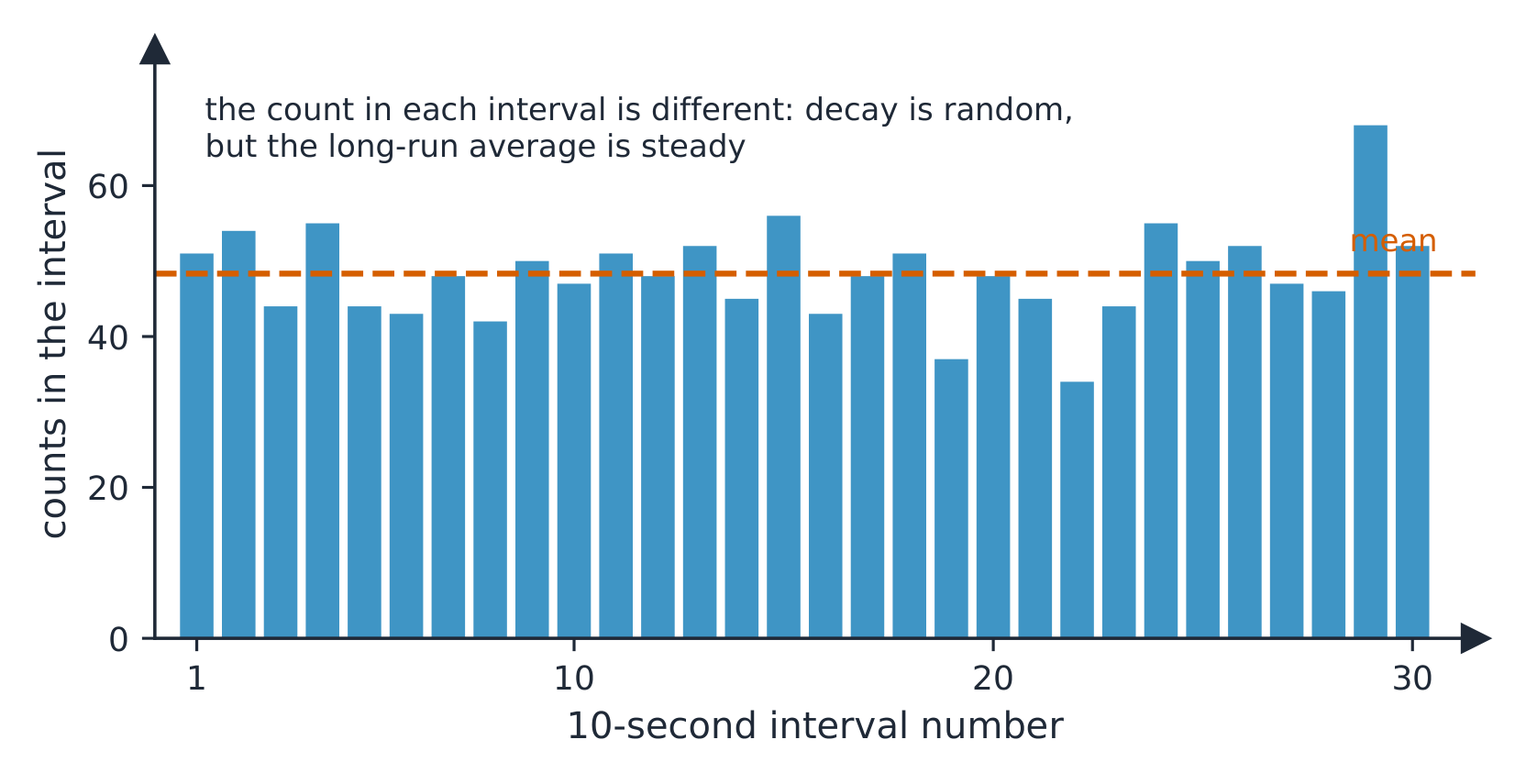
Una media estable compuesta por conteos inestables
Select all · todos the true statements about radioactive decay. · Seleccione todas las afirmaciones verdaderas sobre la desintegración radiactiva.
It is spontaneous and random, and the rate does not depend on conditions. You can only give the probability of a single decay. · Es espontánea y aleatoria, y la tasa no depende de las condiciones. Solo puede dar la probabilidad de una única desintegración.
What is the evidence that radioactive decay is random? · ¿Cuál es la evidencia de que la desintegración radiactiva es aleatoria?
A falling activity shows decay happens; a constant half-life shows the probability is fixed; heating shows it is SPONTANEOUS. Only the fluctuation shows randomness. · Una actividad decreciente muestra que ocurre la desintegración; una vida media constante muestra que la probabilidad es fija; el calentamiento muestra que es ESPONTÁNEA. Solo la fluctuación demuestra aleatoriedad.
Activity and the decay constant
- For $N$ undecayed nuclei of a radionuclide 放射性核素:
- Activity 活度 is the number of decays per unit time, measured in becquerel 贝克勒尔 (Bq), where $1\ \text{Bq} = 1$ decay per second.
- The decay constant 衰变常数 is the probability per unit time that a nucleus will decay, also in $\text{s}^{-1}$.
- They share a unit but they are not the same idea: $A$ counts events, $\lambda$ is a probability. Calling $\lambda$ "the rate of decay" is the standard lost mark.
Actividad y constante de decaimiento
- Para $N$ núcleos no decaídos de un radionucleido:
- Actividad es el número de decaimientos por unidad de tiempo, medida en becquerel (Bq), donde $1\ \text{Bq} = 1$ decaimiento por segundo.
- La constante de decaimiento es la probabilidad por unidad de tiempo de que un núcleo decaiga, también expresada en $\text{s}^{-1}$.
- Comparten una unidad, pero no son lo mismo: $A$ cuenta eventos, mientras que $\lambda$ es una probabilidad. Llamar a $\lambda$ "la tasa de decaimiento" es un error que hace perder puntos.
The activity of a radioactive source is: · La actividad de una fuente radiactiva es:
Activity = decay constant × number of undecayed nuclei, measured in becquerel. · Actividad = constante de desintegración × número de núcleos sin desintegrar, medida en bequerel.
Match each quantity to its definition. · Empareje cada cantidad con su definición.
Activity and the decay constant share the unit s^-1 but are different quantities. Calling the decay constant "the rate of decay" is the standard lost mark. · La actividad y la constante de desintegración comparten la unidad s^-1 pero son cantidades diferentes. Llamar a la constante de desintegración "la tasa de desintegración" es la pérdida estándar de puntos.
Worked example: a tiny mass, a huge activity
- Fluorine-18 has a half-life of $110$ minutes. Show that $\lambda = 1.05\times10^{-4}\ \text{s}^{-1}$, and find the activity of $2.1\times10^{-12}\ \text{kg}$ of it.
- $\lambda = \dfrac{0.693}{110\times60} = 1.05\times10^{-4}\ \text{s}^{-1}$. Convert the half-life to seconds first, or $\lambda$ comes out per minute.
- Number of nuclei: $N = \dfrac{2.1\times10^{-12}}{18\times1.661\times10^{-27}} = 7.0\times10^{13}$.
- $A = \lambda N = (1.05\times10^{-4})(7.0\times10^{13}) = 7.4\times10^{9}\ \text{Bq}$.
- A picogram gives billions of decays a second because the half-life is short. The same mass of uranium-238, half-life $4.5\times10^{9}$ years, gives about $10^{-5}\ \text{Bq}$.
Ejemplo resuelto: una masa minúscula, una actividad enorme
- El Flúor-18 tiene una vida media de $110$ minutos. Demuestra que $\lambda = 1.05\times10^{-4}\ \text{s}^{-1}$ y calcula la actividad de $2.1\times10^{-12}\ \text{kg}$ de este isótopo.
- $\lambda = \dfrac{0.693}{110\times60} = 1.05\times10^{-4}\ \text{s}^{-1}$. Convierte primero la vida media a segundos, o $\lambda$ resultará por minuto.
- Número de núcleos: $N = \dfrac{2.1\times10^{-12}}{18\times1.661\times10^{-27}} = 7.0\times10^{13}$.
- $A = \lambda N = (1.05\times10^{-4})(7.0\times10^{13}) = 7.4\times10^{9}\ \text{Bq}$.
- Un picogramo produce miles de millones de decaimientos por segundo debido a la corta vida media. La misma masa de uranio-238, con una vida media de $4.5\times10^{9}$ años, produce aproximadamente $10^{-5}\ \text{Bq}$.
A source has $\lambda = 0.010$ per second and $1.0 \times 10^{6}$ undecayed nuclei. What is its activity? · Una fuente tiene $\lambda = 0.010$ por segundo y $1.0 \times 10^{6}$ núcleos sin desintegrar. ¿Cuál es su actividad?
$A = \lambda N = 0.010 \times 1.0 \times 10^{6} = 1.0 \times 10^{4}\ \text{Bq}$.
Why the decay is exponential
- Since $\lambda$ is the fractional decay rate, $\dfrac{dN}{dt} = -\lambda N$, and the solution is an exponential decay 指数衰减:
- Any count rate 计数率 proportional to the activity follows the same law, which is why the equation is usually quoted as $x = x_0 e^{-\lambda t}$.
- The three-mark explanation: (1) $\lambda$ is the probability per unit time and is the same for every nucleus whatever its age; (2) so the rate of decay is proportional to the number of undecayed nuclei, $A = \lambda N$; (3) a rate of change proportional to the quantity itself gives an exponential, meaning the same fraction decays in each equal interval.
- So the number never quite reaches zero. It only halves, again and again.
Por qué el decaimiento es exponencial
- Dado que $\lambda$ es la tasa de decaimiento fraccional, $\dfrac{dN}{dt} = -\lambda N$, y su solución es un decaimiento exponencial:
- Cualquier tasa de conteo proporcional a la actividad sigue la misma ley, razón por la cual la ecuación suele citarse como $x = x_0 e^{-\lambda t}$.
- La explicación de tres puntos: (1) $\lambda$ es la probabilidad por unidad de tiempo y es la misma para cada núcleo independientemente de su edad; (2) por tanto, la tasa de decaimiento es proporcional al número de núcleos no decaídos, $A = \lambda N$; (3) una tasa de cambio proporcional a la propia cantidad da lugar a una función exponencial, lo que significa que la misma fracción decae en cada intervalo igual.
- Por eso, el número nunca llega a cero. Solo se reduce a la mitad, una y otra vez.
Decay equations (α, β, γ) · Ecuaciones de desintegración (α, β, γ)
Choose a decay type; the daughter nuclide is fixed so the nucleon number A and the proton number Z both balance. · Elija un tipo de desintegración; el núcleo hija está fijo para que tanto el número másico A como el número atómico Z se equilibren.
Half-life — watch the nuclei decay · Semivida — observa la desintegración de los núcleos
Each nucleus has a fixed chance of decaying, at random. Move time forward: about half the remaining nuclei decay every half-life — so the count halves, then halves again. · Cada núcleo tiene una probabilidad fija de desintegrarse, al azar. Avanza en el tiempo: aproximadamente la mitad de los núcleos restantes se desintegran cada semivida, por lo que el conteo se reduce a la mitad, luego a la mitad nuevamente.
The activity of a radioactive source decays exponentially with time. · La actividad de una fuente radiactiva decae exponencialmente con el tiempo.
The same fraction decays each second, giving $A = A_0 e^{-\lambda t}$. · La misma fracción se desintegra cada segundo, dando $A = A_0 e^{-\lambda t}$.
Put the three-mark explanation of why decay is exponential in order. · Ordene la explicación de tres puntos sobre por qué la desintegración es exponencial.
Each of the first three is a mark. Writing only the formula N = N0 e^(-lambda t) answers none of them. · Cada uno de los primeros tres es un punto. Escribir solo la fórmula N = N0 e^(-lambda t) no responde ninguno de ellos.
Half-life
- The half-life 半衰期 $t_{1/2}$ is the time for the number of undecayed nuclei, or the activity, or the count rate, to fall to half.
- Put $N = N_0/2$ into the exponential law and the $N_0$ cancels:
- Because $N_0$ cancels, the half-life does not depend on how much you started with. A gram and a tonne of the same nuclide halve in the same time.
Vida media
- La vida media $t_{1/2}$ es el tiempo que tarda el número de núcleos no decaídos, o la actividad, o la tasa de conteo, en reducirse a la mitad.
- Sustituye $N = N_0/2$ en la ley exponencial y el $N_0$ se cancela:
- Como el $N_0$ se cancela, la vida media no depende de cuánto tenías inicialmente. Un gramo y una tonelada del mismo radionucleido se reducen a la mitad en el mismo tiempo.
The half-life is related to the decay constant by: · La vida media está relacionada con la constante de desintegración mediante:
Setting $N = \tfrac{1}{2}N_0$ in · hacia adentro $N = N_0 e^{-\lambda t}$ gives $\lambda t_{1/2} = \ln 2$. · Al sustituir $N = \tfrac{1}{2}N_0$ en $N = N_0 e^{-\lambda t}$ se obtiene $\lambda t_{1/2} = \ln 2$.
The half-life of a nuclide is unaffected by which of these? Select all · todos that apply. · ¿Qué factor NO afecta la vida media de un núcleo? Seleccione todos los que correspondan.
N0 cancels in the half-life derivation, so the amount is irrelevant, and spontaneity rules out external conditions. The nuclide itself is the ONLY thing that sets it. · N0 se cancela en la derivación de la vida media, por lo que la cantidad es irrelevante, y la espontaneidad descarta condiciones externas. El propio núcleo es LA ÚNICA cosa que la determina.
Worked example: reading a decay backwards
- A source's activity falls from $8.0\times10^{5}\ \text{Bq}$ to $1.0\times10^{5}\ \text{Bq}$ in $24$ minutes. Find the half-life and the decay constant.
- The activity has fallen to $\tfrac{1}{8}$, and $\tfrac{1}{8} = (\tfrac{1}{2})^3$, so three half-lives have passed: $t_{1/2} = 24/3 = 8.0$ minutes.
- $\lambda = \dfrac{0.693}{8.0\times60} = 1.4\times10^{-3}\ \text{s}^{-1}$.
- When the ratio is a neat power of $\tfrac{1}{2}$, count half-lives. Otherwise take logs: $\lambda t = \ln(A_0/A)$.
- Always convert the half-life to seconds before quoting $\lambda$ in $\text{s}^{-1}$.
Ejemplo resuelto: leer un decaimiento hacia atrás
- La actividad de una fuente cae de $8.0\times10^{5}\ \text{Bq}$ a $1.0\times10^{5}\ \text{Bq}$ en $24$ minutos. Calcula la vida media y la constante de decaimiento.
- La actividad ha descendido a $\tfrac{1}{8}$, y $\tfrac{1}{8} = (\tfrac{1}{2})^3$, por lo que han transcurrido tres vidas medias: $t_{1/2} = 24/3 = 8.0$ minutos.
- $\lambda = \dfrac{0.693}{8.0\times60} = 1.4\times10^{-3}\ \text{s}^{-1}$.
- Cuando la relación es una potencia exacta de $\tfrac{1}{2}$, cuenta las vidas medias. De lo contrario, usa logaritmos: $\lambda t = \ln(A_0/A)$.
- Siempre convierte la vida media a segundos antes de expresar $\lambda$ en $\text{s}^{-1}$.
What fraction of the nuclei remain after 3 half-lives? · ¿Qué fracción de los núcleos permanece después de 3 vidas medias?
Each half-life halves the number: $\left(\tfrac{1}{2}\right)^{3} = \tfrac{1}{8} = 0.125$. · Cada vida media reduce a la mitad el número: $\left(\tfrac{1}{2}\right)^{3} = \tfrac{1}{8} = 0.125$.
A source's activity falls from 8.0e5 Bq to 1.0e5 Bq in 24 minutes. What is its half-life, in minutes? · La actividad de una fuente disminuye de 8.0e5 Bq a 1.0e5 Bq en 24 minutos. ¿Cuál es su vida media, en minutos?
The activity is one eighth, and 1/8 = (1/2)^3, so three half-lives fit in 24 minutes. When the ratio is not a neat power of a half, take logs instead: lambda t = ln(A0/A). · La actividad es un octavo, y 1/8 = (1/2)^3, por lo que caben tres vidas medias en 24 minutos. Cuando la relación no es una potencia exacta de medio, use logaritmos: lambda t = ln(A0/A).
Before using a measured count rate in a decay calculation, subtract the ____ count. · Antes de usar una tasa de conteo medida en un cálculo de desintegración, resté el conteo de ____.
The background is quoted in the question precisely so that you subtract it. Forgetting to makes every derived half-life too long. · El fondo se cita en la pregunta precisamente para que usted lo reste. Olvidarlo hace que todas las vidas medias derivadas sean demasiado largas.
Marks that slip away
- Activity is decays per unit time. The decay constant is a probability per unit time. Same unit, different quantity.
- The evidence for randomness is the fluctuating count rate, not the fact that the activity falls.
- Convert the half-life to seconds before using $\lambda = 0.693/t_{1/2}$.
- Half-life is independent of the amount of substance, and of temperature, pressure and chemical state.
- $x_0$ in $x = x_0 e^{-\lambda t}$ is the value at $t = 0$, not the value at the start of the observation, unless the clock is set there.
- Subtract the background count before using a measured count rate. It is quoted in the question precisely so you will.
Puntos que se pierden fácilmente
- La actividad es decaimientos por unidad de tiempo. La constante de decaimiento es una probabilidad por unidad de tiempo. Misma unidad, diferente magnitud.
- La evidencia de aleatoriedad es la tasa de conteo fluctuante, no el hecho de que la actividad disminuya.
- Convierte la vida media a segundos antes de usar $\lambda = 0.693/t_{1/2}$.
- La vida media es independiente de la cantidad de sustancia, así como de la temperatura, la presión y el estado químico.
- El valor $x_0$ en $x = x_0 e^{-\lambda t}$ es el valor en $t = 0$, no el valor al inicio de la observación, a menos que el cronómetro esté configurado en ese instante.
- Resta el conteo de fondo antes de usar una tasa de conteo medida. Se proporciona en el enunciado precisamente para que lo hagas.
You've got it
- decay is spontaneous (unaffected by external factors) and random (which nucleus and when are unpredictable), evidenced by a fluctuating count rate
- activity is decays per unit time in becquerel, the decay constant is the probability of decay per unit time, and $A = \lambda N$
- decay is exponential because a fixed probability per nucleus makes the rate proportional to the number left: $x = x_0 e^{-\lambda t}$
- the half-life is the time to fall to half, is independent of the starting amount, and $\lambda = 0.693/t_{1/2}$
Ya lo dominas
- El decaimiento es espontáneo (sin afectación por factores externos) y aleatorio (es impredecible cuál núcleo y cuándo decaerá), evidenciado por una tasa de conteo fluctuante.
- La actividad son decaimientos por unidad de tiempo en becquerel; la constante de decaimiento es la probabilidad de decaimiento por unidad de tiempo, y $A = \lambda N$.
- El decaimiento es exponencial porque una probabilidad fija por núcleo hace que la tasa sea proporcional al número restante: $x = x_0 e^{-\lambda t}$.
- La vida media es el tiempo para reducirse a la mitad, es independiente de la cantidad inicial, y $\lambda = 0.693/t_{1/2}$.