Production and use of ultrasound · Producción y uso de ultrasonido
| English | Español |
|---|---|
| transducer/trænsˈdjuːsə/ | transductor |
| ultrasound/ˌʊltrəˈsaʊnd/ | ultrasonido |
| piezo-electric/piˌeɪtsəʊ ɪˈlektrɪk/ | piezoeléctrico |
| electromotive force/ɪˌlektrəʊˈməʊtɪv fɔːs/ | fuerza electromotriz |
| longitudinal/ˌlɒŋɡɪˈtjuːdɪnl/ | longitudinal |
| resolution/ˌrezəˈluːʃn/ | resolución |
| specific acoustic impedance/spəˈsɪfɪk əˈkuːstɪk ɪmˈpiːdəns/ | impedancia acústica específica |
| density/ˈdensɪti/ | densidad |
| intensity reflection coefficient/ɪnˈtensɪti rɪˈflekʃn ˌkəʊɪˈfɪʃənt/ | coeficiente de reflexión de intensidad |
Without the jelly you would see nothing at all
- Before a scan the sonographer smears cold gel on the skin. It looks like a comfort measure. It is not.
- Without it there is a thin layer of air between the transducer and the skin, and 99.9% of the pulse reflects straight back off it.
- With the gel, only about $0.2\%$ reflects and almost the whole pulse enters the body.
- One number, computed from $Z = \rho c$, decides that. This lesson is how ultrasound is made, how it is used, and what that number means.
Sin el gel, no verías nada en absoluto
- Antes de un escaneo, el ecografista aplica gel frío sobre la piel. Parece una medida de confort, pero no lo es.
- Sin ella, hay una fina capa de aire entre el transductor y la piel, y un 99.9% del pulso se refleja directamente hacia atrás.
- Con el gel, solo aproximadamente $0.2\%$ se refleja y casi todo el pulso entra en el cuerpo.
- Un número, calculado a partir de $Z = \rho c$, decide esto. Esta lección trata sobre cómo se genera el ultrasonido, cómo se utiliza y qué significa ese número.
The piezo-electric effect
- A piezo-electric 压电 crystal such as quartz or PZT does two linked things, and both are needed.
- Put a p.d. across it and it changes shape. That is how vibrations are made.
- Change its shape, by squeezing it, and an electromotive force 电动势 appears across it. That is how vibrations are detected.
- The two effects are exact opposites of each other, which is why one crystal can do both jobs.
Push it and it speaks, speak to it and it pushes back
El efecto piezoeléctrico
- Un cristal piezoeléctrico 压电 como el cuarzo o el PZT realiza dos acciones vinculadas, y ambas son necesarias.
- Si se aplica una diferencia de potencial (p.d.) a través de él, este cambia de forma. Así es como se generan las vibraciones.
- Si se cambia su forma, apretándolo, aparece una fuerza electromotriz 电动势 a través de él. Así es como se detectan las vibraciones.
- Los dos efectos son exactos opuestos entre sí, por lo que un solo cristal puede realizar ambas tareas.

Presión y habla: empuja y habla; escucha y presiona
A piezo-electric crystal: · Un cristal piezoeléctrico:
Both effects let one crystal send ultrasound (apply p.d.) and detect it (read the e.m.f.). · Ambos efectos permiten que un cristal envíe ultrasonido (aplicar d.p.) y lo detecte (leer la f.e.m.).
The transducer
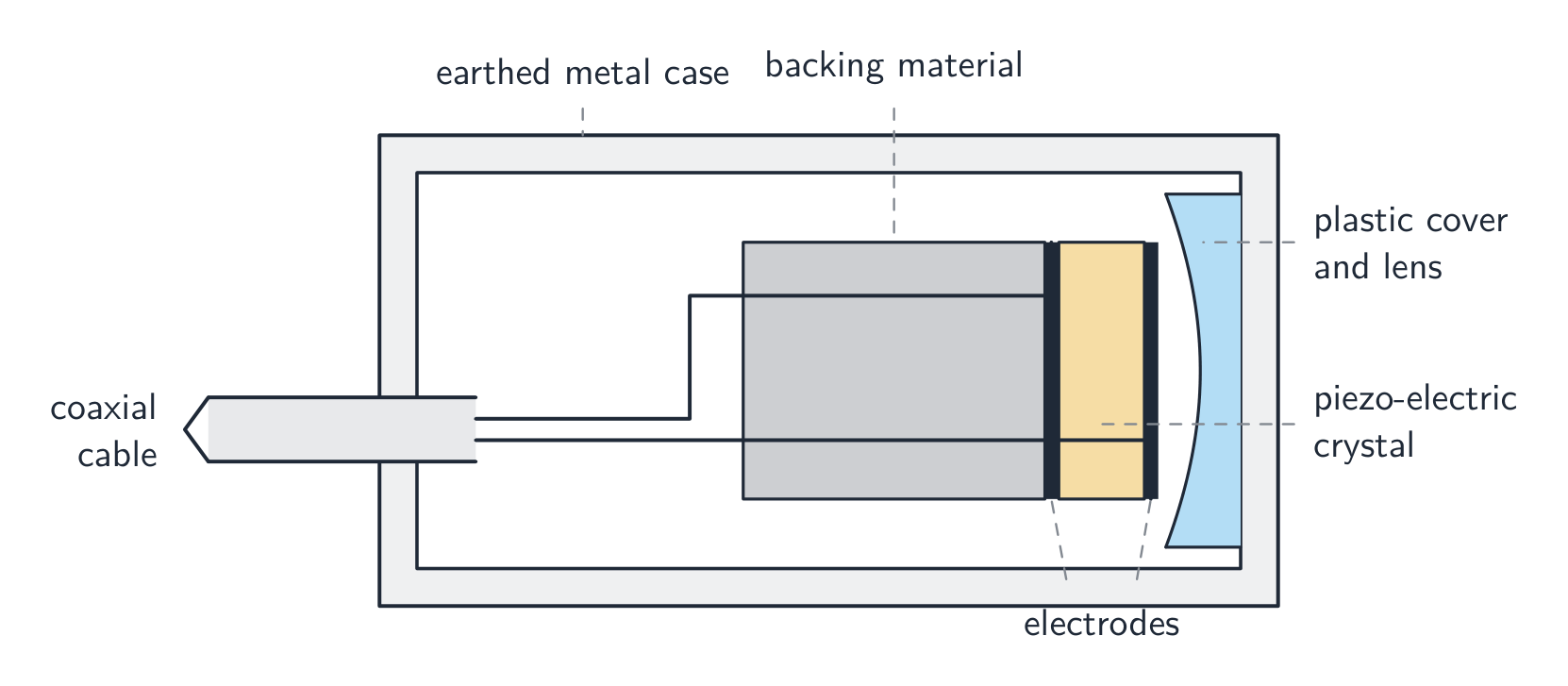
- A transducer 换能器 uses that effect to both make and detect ultrasound 超声波, meaning longitudinal 纵波 waves above $20\ \text{kHz}$.
- Generating, for three marks: an alternating p.d. is applied across the crystal; the crystal expands and contracts at the frequency of the p.d.; the p.d. is set at the crystal's resonant frequency so the vibration is large, and the faces push on the tissue.
- Detecting, for two marks: the returning wave's pressure variations change the shape of the crystal, and a changing shape generates an e.m.f., which is amplified and recorded.
- The same crystal does both, switched between transmitting and listening.
One crystal, two jobs
El transductor
- Un transductor 换能器 utiliza ese efecto para generar y detectar ultrasonido 超声波, es decir, ondas longitudinales 纵por encima de $20\ \text{kHz}$.
- Generación, para tres puntos: se aplica una diferencia de potencial (p.d.) alternante a través del cristal; el cristal se expande y contrae a la frecuencia de la p.d.; la p.d. se ajusta a la frecuencia resonante del cristal para que la vibración sea grande, y las caras empujan contra el tejido.
- Detección, para dos puntos: las variaciones de presión de la onda de retorno cambian la forma del cristal, y un cambio de forma genera una f.e.m., que se amplifica y registra.
- El mismo cristal hace ambas cosas, conmutando entre transmitir y escuchar.
Un cristal, dos trabajos
Put the generation of ultrasound by a transducer in order. · Ordena la generación de ultrasonido por un transductor.
Detection is the reverse: the returning wave changes the crystal's shape, and a changing shape generates an e.m.f. · La detección es lo inverso: la onda de retorno cambia la forma del cristal, y un cambio de forma genera una f.e.m.
Pulse-echo imaging
- The four-mark outline runs: a pulse is sent in through coupling gel; at each boundary part reflects and returns; the time delay gives the depth; the intensity of the echo says what kind of boundary it was.
- Depth comes from the there-and-back trip:
- Sweeping the transducer, or using an array, builds a two-dimensional image.
- The factor of $2$ is the single commonest arithmetic slip in this topic.
One spike out, several back
Imagen por pulso-eco
- La estructura de cuatro puntos es: se envía un pulso a través del gel de acoplamiento; en cada límite parte se refleja y retorna; el retraso temporal da la profundidad; la intensidad del eco indica qué tipo de límite fue.
- La profundidad proviene del viaje de ida y vuelta:
- Barrer el transductor o usar una matriz construye una imagen bidimensional.
- El factor de $2$ es el error aritmético más común en este tema.

Un pico hacia afuera, varios hacia adentro
Worked example: how deep is the boundary
- A pulse returns $60\ \mu\text{s}$ after it was sent, and the speed of sound in the tissue is $1500\ \text{m/s}$. Find the depth of the reflecting boundary.
- $d = \dfrac{ct}{2} = \dfrac{1500 \times 60\times10^{-6}}{2} = 0.045\ \text{m} = 4.5\ \text{cm}$.
- Halve it, because the pulse travelled there and back. Forgetting to gives $9.0\ \text{cm}$, which is a whole answer wrong for a reason worth remembering.
Ejemplo resuelto: ¿qué tan profundo está el límite?
- Un pulso regresa $60\ \mu\text{s}$ después de ser enviado, y la velocidad del sonido en el tejido es $1500\ \text{m/s}$. Encuentra la profundidad del límite reflector.
- $d = \dfrac{ct}{2} = \dfrac{1500 \times 60\times10^{-6}}{2} = 0.045\ \text{m} = 4.5\ \text{cm}$.
- Divídelo entre dos, porque el pulso viajó hasta allí y de regreso. Olvidar hacerlo da $9.0\ \text{cm}$, que es una respuesta completamente incorrecta por una razón que vale la pena recordar.
An echo returns after $2.0 \times 10^{-4}\ \text{s}$; the speed of sound is $1500\ \dfrac{\text{m}}{\text{s}}$. How deep is the boundary? · Un eco regresa después de $2.0 \times 10^{-4}\ \text{s}$; la velocidad del sonido es $1500\ \dfrac{\text{m}}{\text{s}}$. ¿Qué profundidad tiene la interfaz?
$d = \dfrac{ct}{2} = \dfrac{1500 \times 2.0 \times 10^{-4}}{2} = 0.15\ \text{m}$ (the pulse travels there and back). · $d = \dfrac{ct}{2} = \dfrac{1500 \times 2.0 \times 10^{-4}}{2} = 0.15\ \text{m}$ (el pulso viaja allí y vuelve).
An ultrasound pulse returns 60 microseconds after transmission, with a speed of sound of 1500 m/s. How deep is the boundary, in cm? · Un pulso de ultrasonido regresa 60 microsegundos después de la transmisión, con una velocidad del sonido de 1500 m/s. ¿Qué profundidad tiene la interfaz, en cm?
d = ct/2 = 4.5 cm. Halve it: the pulse travelled there AND back. Forgetting the 2 gives 9.0 cm. · d = ct/2 = 4.5 cm. Dividirlo por dos: el pulso viajó allá Y regresó. Olvidar el 2 da 9.0 cm.
Why pulses, and why megahertz
- The transducer sends a short pulse and then listens. Every echo must arrive before the next pulse leaves, or echoes from different pulses could not be told apart, and the crystal cannot transmit and receive at the same moment.
- The frequency is a compromise. A higher frequency means a shorter wavelength and finer detail, better resolution 分辨率.
- But a higher frequency is also attenuated more strongly, so a deep organ needs a lower frequency than a shallow one.
- Medical scanning uses $1$ to $15\ \text{MHz}$, giving wavelengths of a fraction of a millimetre in tissue.
Por qué pulsos y por qué megahercios
- El transductor envía un pulso corto y luego escucha. Cada eco debe llegar antes de que salga el siguiente pulso; de lo contrario, los ecos de diferentes pulsos no podrían distinguirse, y el cristal no puede transmitir y recibir al mismo tiempo.
- La frecuencia es un compromiso. Una frecuencia más alta significa una longitud de onda más corta y detalles más finos, mejor resolución 分辨率.
- Pero una frecuencia más alta también se atenua con mayor fuerza, por lo que un órgano profundo necesita una frecuencia más baja que uno superficial.
- La exploración médica usa $1$ a $15\ \text{MHz}$, dando longitudes de onda de una fracción de milímetro en el tejido.
A higher ultrasound frequency has which effects? Select all · todos that apply. · Una frecuencia de ultrasonido más alta tiene qué efectos? Selecciona todos los que correspondan.
Reflection is set by the impedance mismatch, not the frequency. The frequency choice is a resolution-against-penetration compromise, so a deep organ is scanned at a lower frequency. · El reflejo está determinado por el desajuste de impedancias, no por la frecuencia. La elección de la frecuencia es un compromiso entre resolución y penetración, por lo que un órgano profundo se escanea a una frecuencia más baja.
Specific acoustic impedance
- The specific acoustic impedance 声阻抗 of a medium is the product of its density and the speed of sound in it.
- Both quantities must be named for the two marks. "How hard sound finds it to pass" scores nothing.
- Density 密度 alone does not decide it: water and soft tissue have very different compositions and nearly the same $Z$, and it is $Z$, not density, that fixes how much reflects.
- For soft tissue: $Z = 1060 \times 1540 = 1.6\times10^{6}\ \text{kg/(m}^2\text{ s)}$.
Impedancia acústica específica
- La impedancia acústica específica 声阻抗 de un medio es el producto de su densidad y la velocidad del sonido en ella.
- Ambas cantidades deben nombrarse para obtener los dos puntos. "Qué tan difícil le resulta al sonido pasar" no otorga puntos.
- La densidad 密度 sola no lo determina: el agua y el tejido blando tienen composiciones muy diferentes y casi la misma $Z$, y es $Z$, no la densidad, lo que fija cuánto se refleja.
- Para tejido blando: $Z = 1060 \times 1540 = 1.6\times10^{6}\ \text{kg/(m}^2\text{ s)}$.
Acoustic impedance Z = density × ____. · Impedancia acústica Z = densidad × ____.
$Z = \rho c$ — density times the speed of sound in the medium. · $Z = \rho c$ — densidad por la velocidad del sonido en el medio.
Match each boundary to what happens to the pulse. · Empareja cada interfaz con lo que sucede al pulso.
Imaging needs the middle case. The gel exists to convert the first case into the third at the skin. · La imagen necesita el caso intermedio. El gel existe para convertir el primer caso en el tercero en la piel.
How much reflects at a boundary
- At a boundary between impedances $Z_1$ and $Z_2$, the intensity reflection coefficient 强度反射系数 is
- Very different impedances reflect almost everything, which is the skin-air problem.
- Very similar impedances reflect almost nothing, so the boundary is invisible.
- The useful case for imaging is in between: different enough to give an echo, similar enough that the pulse carries on to the next boundary.
The mismatch is the echo
Cuánto se refleja en un límite
- En un límite entre impedancias $Z_1$ y $Z_2$, el coeficiente de reflexión de intensidad 强度反射系数 es
- Impedancias muy diferentes reflejan casi todo, que es el problema piel-aire.
- Impedancias muy similares reflejan casi nada, por lo que el límite es invisible.
- El caso útil para la imagen está en medio: diferente lo suficiente como para dar un eco, similar lo suficiente como para que el pulso continúe hacia el siguiente límite.

El desajuste es el eco
Ultrasound scan route · Ruta de escaneo por ultrasonido
Follow a pulse from transducer to echo image. · Seguir un pulso desde el transductor hasta la imagen del eco.
Two media with very similar acoustic impedance give almost no echo. · Dos medios con impedancia acústica muy similar dan casi ningún eco.
The reflected fraction depends on the impedance difference; similar impedances reflect very little, so the boundary is hard to see. · La fracción reflejada depende de la diferencia de impedancias; las impedancias similares reflejan muy poco, por lo que la interfaz es difícil de ver.
Worked example: why the gel is not optional
- Air has $\rho = 1.29\ \text{kg/m}^3$ and $c = 343\ \text{m/s}$. Gel has $Z = 1.50\times10^{6}$ and soft tissue $Z = 1.63\times10^{6}\ \text{kg/(m}^2\text{ s)}$. Compare the reflection at an air-tissue and a gel-tissue boundary.
- $Z_{\text{air}} = 1.29 \times 343 = 442\ \text{kg/(m}^2\text{ s)}$, which is smaller than tissue's by a factor of nearly $4000$.
- Air-tissue: $\left(\dfrac{442 - 1.63\times10^{6}}{442 + 1.63\times10^{6}}\right)^2 = 0.9989$, so $99.9\%$ reflects and only $0.1\%$ enters the body.
- Gel-tissue: $\left(\dfrac{1.50 - 1.63}{1.50 + 1.63}\right)^2 = 0.0017$, so only $0.2\%$ reflects.
- The gel replaces the air with something whose impedance nearly matches skin, so almost the whole pulse gets in, and the echoes get back out the same way.
Ejemplo resuelto: por qué el gel no es opcional
- El aire tiene $\rho = 1.29\ \text{kg/m}^3$ y $c = 343\ \text{m/s}$. El gel tiene $Z = 1.50\times10^{6}$ y el tejido blando $Z = 1.63\times10^{6}\ \text{kg/(m}^2\text{ s)}$. Compare la reflexión en una frontera de aire-tejido y una frontera de gel-tejido.
- $Z_{\text{air}} = 1.29 \times 343 = 442\ \text{kg/(m}^2\text{ s)}$, que es menor que el del tejido por un factor cercano a $4000$.
- Aire-tejido: $\left(\dfrac{442 - 1.63\times10^{6}}{442 + 1.63\times10^{6}}\right)^2 = 0.9989$, por lo tanto $99.9\%$ refleja y solo $0.1\%$ entra al cuerpo.
- Gel-tejido: $\left(\dfrac{1.50 - 1.63}{1.50 + 1.63}\right)^2 = 0.0017$, por lo tanto solo $0.2\%$ refleja.
- El gel reemplaza al aire con algo cuya impedancia casi coincide con la de la piel, así que casi todo el pulso entra y los ecos salen de la misma manera.
The coupling gel between the probe and the skin: · El gel de acoplamiento entre la sonda y la piel:
Without it, the huge skin–air impedance difference would reflect almost all the ultrasound at the surface. · Sin él, la enorme diferencia de impedancias piel-aire reflejaría casi todo el ultrasonido en la superficie.
Gel has Z = 1.50e6 and soft tissue Z = 1.63e6 kg/(m^2 s). What percentage of the intensity reflects at the gel-tissue boundary? · El gel tiene Z = 1.50e6 y el tejido blando Z = 1.63e6 kg/(m^2 s). ¿Qué porcentaje de la intensidad se refleja en la interfaz gel-tejido?
((1.50-1.63)/(1.50+1.63))^2 = 0.0017, that is 0.17%. At an air-tissue boundary the same formula gives 99.9%, which is why the gel is not optional. · ((1.50-1.63)/(1.50+1.63))^2 = 0.0017, eso es 0.17%. En una interfaz aire-tejido, la misma fórmula da 99.9%, por eso el gel no es opcional.
Attenuation
- Ultrasound weakens as it travels, by the same exponential law that governs X-rays and radioactive decay:
- $\mu$ is the attenuation coefficient of the medium, and a higher frequency has a larger $\mu$, which is the trade-off behind the choice of frequency.
- To find a thickness, take logs: $x = \dfrac{1}{\mu}\ln\dfrac{I_0}{I}$.
- Watch the units: $\mu$ in $\text{cm}^{-1}$ needs $x$ in cm. Mixing them is the standard error and gives an answer wrong by a factor of $100$ in the exponent.
Atenuación
- La ultrasonido se debilita a medida que viaja, según la misma ley exponencial que rige a los rayos X y la desintegración radiactiva:
- $\mu$ es el coeficiente de atenuación del medio, y una frecuencia más alta tiene un mayor $\mu$, que es el compromiso detrás de la elección de la frecuencia.
- Para encontrar un espesor, tome logaritmos: $x = \dfrac{1}{\mu}\ln\dfrac{I_0}{I}$.
- Tenga cuidado con las unidades: $\mu$ en $\text{cm}^{-1}$ necesita $x$ en cm. Mezclarlas es el error estándar y da una respuesta incorrecta por un factor de $100$ en el exponente.
Marks that slip away
- Halve the distance in the pulse-echo calculation. The pulse goes there and back.
- $Z = \rho c$ needs both density and speed named in the definition.
- The reflection formula uses the difference over the sum, squared. Forgetting to square it changes the answer completely.
- The gel matches impedances, it does not "help the sound travel". Say what it replaces and why.
- Higher frequency gives better resolution but more attenuation. A question about a deep organ is asking for that trade-off.
Puntos que se pierden fácilmente
- Reduzca a la mitad la distancia en el cálculo de pulso-eco. El pulso va y regresa.
- $Z = \rho c$ requiere que ambas, densidad y velocidad, estén nombradas en la definición.
- La fórmula de reflexión usa la diferencia sobre la suma, al cuadrado. Olvidar elevarlo al cuadrado cambia completamente la respuesta.
- El gel iguala las impedancias, no "ayuda a que el sonido viaje". Diga qué reemplaza y por qué.
- Una frecuencia más alta ofrece mejor resolución pero más atenuación. Una pregunta sobre un órgano profundo está buscando ese compromiso.
You've got it
- a piezo-electric crystal changes shape under a p.d. and generates an e.m.f. when its shape changes, so one transducer both sends and detects
- pulse-echo imaging gives depth from $d = ct/2$ and tissue type from the echo's intensity
- specific acoustic impedance is $Z = \rho c$, and $I_R/I_0 = \left(\frac{Z_1-Z_2}{Z_1+Z_2}\right)^2$, which is why an air gap reflects $99.9\%$ and the gel is essential
- ultrasound is attenuated as $I = I_0 e^{-\mu x}$, and a higher frequency trades better resolution for worse penetration
Lo has entendido
- un cristal piezoeléctrico cambia de forma bajo una d.d.p. y genera una f.e.m. cuando su forma cambia, por lo que un único transductor tanto envía como detecta
- la imagen por pulso-eco da profundidad a partir de $d = ct/2$ y tipo de tejido a partir de la intensidad del eco
- la impedancia acústica específica es $Z = \rho c$, y $I_R/I_0 = \left(\frac{Z_1-Z_2}{Z_1+Z_2}\right)^2$, por eso una brecha de aire refleja $99.9\%$ y el gel es esencial
- la ultrasonido se atenúa como $I = I_0 e^{-\mu x}$, y una frecuencia más alta intercambia mejor resolución por peor penetración