Gravitational field of a point mass · Campo gravitatorio de una masa puntual
| English | Español |
|---|---|
| orbit/ˈɔːbɪt/ | órbita |
| orbital speed/ˈɔːbɪtl spiːd/ | velocidad orbital |
| satellite/ˈsætəlaɪt/ | satélite |
| Kepler's third law/ˈkepləz θɜːd lɔː/ | Tercera ley de Kepler |
| geostationary/ˌdʒiːəʊˈsteɪʃənəri/ | geoestacionario |
| equator/ɪˈkweɪtə/ | ecuator |
| free fall/friː fɔːl/ | caída libre |
Why the Moon doesn't fall
- The Moon is always falling toward Earth — but it also moves sideways fast.
- So it keeps missing: it is in orbit 轨道.
- Gravity provides exactly the centripetal force needed.
Por qué la Luna no cae
- La Luna siempre está cayendo hacia la Tierra — pero también se mueve lateralmente rápido.
- Así que sigue fallando: está en órbita 轨道.
- La gravedad proporciona exactamente la fuerza centrípeta necesaria.
Field of a point mass
- At distance $r$ from a mass $M$: $g = \dfrac{GM}{r^{2}}$ — falling off as $\dfrac{1}{r^{2}}$.
- Near Earth's surface $r \approx R$ is huge, so climbing a building barely changes $g$.
Field strength drops off as 1/r²: doubling the distance quarters the pull
Field-line spacing shows the field strength — closer lines mean a stronger field
Campo de una masa puntual
- A una distancia $r$ de una masa $M$: $g = \dfrac{GM}{r^{2}}$ — decayendo según $\dfrac{1}{r^{2}}$.
- Cerca de la superficie de la Tierra $r \approx R$ es enorme, por lo que subir un edificio apenas cambia $g$.

La intensidad del campo disminuye como 1/r²: duplicar la distancia reduce la atracción a un cuarto

El espaciado de las líneas de campo indica la intensidad del campo —líneas más cercanas significan un campo más fuerte
Field of a point mass · Campo de una masa puntual
g ∝ M/r²
Gravitational field strength obeys the inverse-square law — halve the distance and it quadruples. · La intensidad del campo gravitatorio obedece a la ley del inverso al cuadrado — si se reduce la distancia a la mitad, la intensidad se multiplica por cuatro.
The gravitational field strength at distance $r$ from a point mass $M$ is: · La intensidad del campo gravitatorio a una distancia $r$ de una masa puntual $M$ es:
From $g = \dfrac{F}{m}$ with $F = \dfrac{GMm}{r^{2}}$, the test mass cancels: $g = \dfrac{GM}{r^{2}}$. · De $g = \dfrac{F}{m}$ con $F = \dfrac{GMm}{r^{2}}$, la masa de prueba se cancela: $g = \dfrac{GM}{r^{2}}$.
Climbing a tall building changes the value of g by a large amount. · Escalar un edificio alto cambia el valor de g en gran medida.
Earth's radius is ~6400 km, so a few metres of height barely changes $r$ — $g$ is effectively constant. · El radio de la Tierra es ~6400 km, por lo que unos pocos metros de altura apenas cambian $r$ — $g$ es efectivamente constante.
Orbital speed 轨道速度
- Gravity = centripetal force: $\dfrac{GMm}{r^{2}} = \dfrac{mv^{2}}{r}$.
- The mass $m$ cancels: $v = \sqrt{\dfrac{GM}{r}}$ — independent of the satellite 卫星's mass.
Velocidad orbital
- Gravedad = fuerza centrípeta: $\dfrac{GMm}{r^{2}} = \dfrac{mv^{2}}{r}$.
- La masa $m$ se cancela: $v = \sqrt{\dfrac{GM}{r}}$ — independiente de la masa del satélite 卫星.
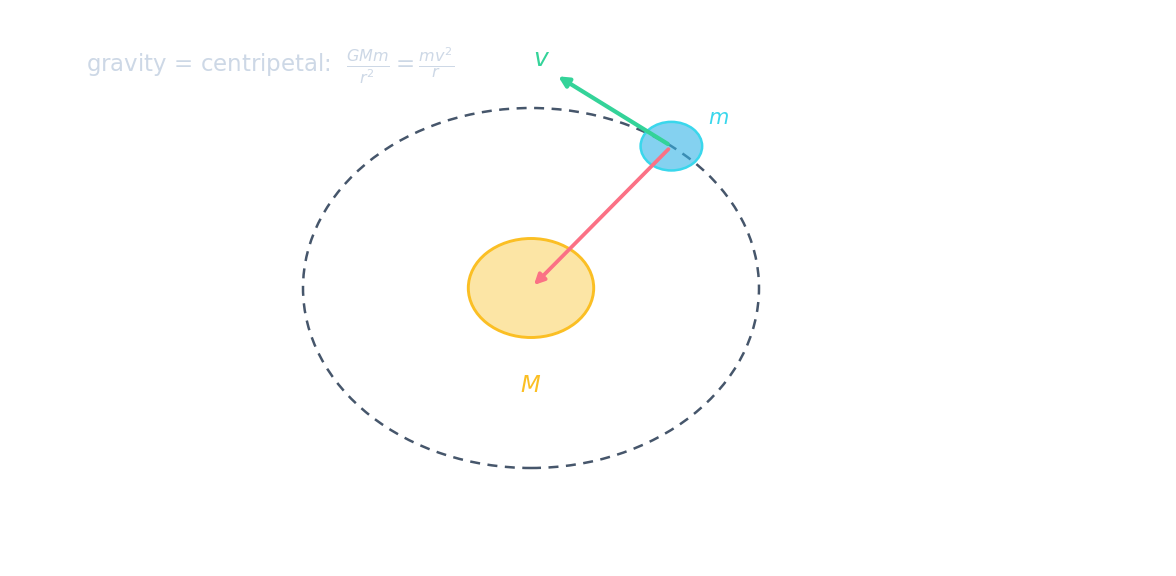
A satellite's orbital speed does not depend on its own mass. · La velocidad orbital de un satélite no depende de su propia masa.
The mass $m$ cancels in $\dfrac{GMm}{r^{2}} = \dfrac{mv^{2}}{r}$, leaving $v = \sqrt{\dfrac{GM}{r}}$. · La masa $m$ se cancela en $\dfrac{GMm}{r^{2}} = \dfrac{mv^{2}}{r}$, dejando $v = \sqrt{\dfrac{GM}{r}}$.
Kepler's third law 开普勒第三定律
- From $T = \dfrac{2\pi r}{v}$: $T^{2} = \dfrac{4\pi^{2}}{GM}\,r^{3}$, so $T^{2} \propto r^{3}$.
- A graph of $T^{2}$ against $r^{3}$ is a straight line — its gradient gives the central mass.
Plotting T² against r³ gives a straight line through the origin — its gradient fixes the central mass M
La tercera ley de Kepler 开普勒第三定律
- De $T = \dfrac{2\pi r}{v}$: $T^{2} = \dfrac{4\pi^{2}}{GM}\,r^{3}$, por lo tanto $T^{2} \propto r^{3}$.
- Un gráfico de $T^{2}$ contra $r^{3}$ es una línea recta — su gradiente da la masa central.

Graficar T² contra r³ da una línea recta que pasa por el origen — su gradiente fija la masa central M
Kepler's third law (for circular orbits) states: · La tercera ley de Kepler (para órbitas circulares) establece:
$T^{2} = \dfrac{4\pi^{2}}{GM}\,r^{3}$, so the square of the period is proportional to the cube of the radius. · $T^{2} = \dfrac{4\pi^{2}}{GM}\,r^{3}$, por lo que el cuadrado del período es proporcional al cubo del radio.
If an orbit radius increases by a factor of 4, the period increases by a factor of: · Si el radio de una órbita aumenta en un factor de 4, el período aumenta en un factor de:
$T \propto r^{3/2}$, so $T$ scales by $4^{3/2} = 8$. · $T \propto r^{3/2}$, por lo que $T$ escala por $4^{3/2} = 8$.
Worked example: a satellite above Mars
A satellite orbits Mars (mass $6.4 \times 10^{23}\ \text{kg}$, radius $3.4 \times 10^{6}\ \text{m}$) at a height of $1.7 \times 10^{6}\ \text{m}$ above the surface. Find its speed and period.
- Orbit radius, from the centre: $r = 3.4 \times 10^{6} + 1.7 \times 10^{6} = 5.1 \times 10^{6}\ \text{m}$.
- Speed: $v = \sqrt{\dfrac{GM}{r}} = \sqrt{\dfrac{6.67 \times 10^{-11} \times 6.4 \times 10^{23}}{5.1 \times 10^{6}}} = 2.9 \times 10^{3}\ \dfrac{\text{m}}{\text{s}}$.
- Period: $T = \dfrac{2\pi r}{v} = \dfrac{2\pi \times 5.1 \times 10^{6}}{2.9 \times 10^{3}} = 1.1 \times 10^{4}\ \text{s}$, about three hours.
- Check: the satellite's own mass never appeared — every satellite at this height moves at this speed. Using the height alone for $r$ gives a speed that is far too high.
Ejemplo resuelto: un satélite sobre Marte
Un satélite orbita Marte (masa $6.4 \times 10^{23}\ \text{kg}$, radio $3.4 \times 10^{6}\ \text{m}$) a una altura de $1.7 \times 10^{6}\ \text{m}$ sobre la superficie. Encuentra su velocidad y período.
- Radio orbital, desde el centro: $r = 3.4 \times 10^{6} + 1.7 \times 10^{6} = 5.1 \times 10^{6}\ \text{m}$.
- Velocidad: $v = \sqrt{\dfrac{GM}{r}} = \sqrt{\dfrac{6.67 \times 10^{-11} \times 6.4 \times 10^{23}}{5.1 \times 10^{6}}} = 2.9 \times 10^{3}\ \dfrac{\text{m}}{\text{s}}$.
- Período: $T = \dfrac{2\pi r}{v} = \dfrac{2\pi \times 5.1 \times 10^{6}}{2.9 \times 10^{3}} = 1.1 \times 10^{4}\ \text{s}$, unas tres horas.
- Verificación: la masa propia del satélite nunca apareció — todos los satélites a esta altura se mueven a esta velocidad. Usar solo la altura para $r$ da una velocidad que es demasiado alta.
A satellite orbits the Earth (mass $6.0 \times 10^{24}\ \text{kg}$) at a radius of $8.0 \times 10^{6}\ \text{m}$ from the centre. What is its orbital speed, in km/s? · Un satélite orbita la Tierra (masa $6.0 \times 10^{24}\ \text{kg}$) a un radio de $8.0 \times 10^{6}\ \text{m}$ desde el centro. ¿Cuál es su velocidad orbital, en km/s?
$v = \sqrt{\dfrac{GM}{r}} = \sqrt{\dfrac{6.67 \times 10^{-11} \times 6.0 \times 10^{24}}{8.0 \times 10^{6}}} = 7.1 \times 10^{3}\ \dfrac{\text{m}}{\text{s}} = 7.1\ \dfrac{\text{km}}{\text{s}}$.
Geostationary 地球同步 orbit
- Period 24 hours, directly above the equator 赤道, orbiting west to east — the same direction as the Earth turns.
- It stays fixed above one point — perfect for a TV dish. From $r^{3} = \dfrac{GMT^{2}}{4\pi^{2}}$ with $T = 86\,400\ \text{s}$, the radius is $\approx 4.2 \times 10^{7}\ \text{m}$, about $3.6 \times 10^{7}\ \text{m}$ above the surface.
Geostationary 地球同步 orbit
- Período 24 horas, directamente sobre el ecuador 赤道, orbitando de oeste a este — la misma dirección en la que gira la Tierra.
- Permanece fijo sobre un punto — perfecto para un plato de TV. De $r^{3} = \dfrac{GMT^{2}}{4\pi^{2}}$ con $T = 86\,400\ \text{s}$, el radio es $\approx 4.2 \times 10^{7}\ \text{m}$, aproximadamente $3.6 \times 10^{7}\ \text{m}$ sobre la superficie.
Select all · todos the features of a geostationary satellite. · Seleccione todas las características de un satélite geoestacionario.
It matches Earth's rotation (24 h, west to east) above the equator, so it stays fixed above one point. A polar orbit does not. · Coincide con la rotación de la Tierra (24 h, de oeste a este) sobre el ecuador, por lo que permanece fijo sobre un mismo punto. Una órbita polar no lo hace.
Synchronous orbits elsewhere
- Any planet has its own synchronous orbit: the period equals the planet's rotation period, and the orbit lies above the equator, moving with the rotation.
- Mars turns once in about $25$ hours, so a satellite with a $25$-hour period above its equator stays over one Martian spot.
- Change the period and the radius follows from Kepler's law: a longer period means a larger orbit.
Órbitas sincrónicas en otros lugares
- Cualquier planeta tiene su propia órbita sincrónica: el período es igual al período de rotación del planeta, y la órbita está sobre el ecuador, moviéndose con la rotación.
- Marte gira una vez en aproximadamente $25$ horas, por lo que un satélite con un período de $25$-hora sobre su ecuador permanece sobre un punto marciano específico.
- Cambia el período y el radio sigue de la ley de Kepler: un período más largo significa una órbita mayor.
In every orbit formula $r$ is measured from the centre of the planet — add the planet's radius to a height. The satellite's mass cancels, so "a heavier satellite must go faster" is wrong. A geostationary orbit must be over the equator: any other orbit crosses the equator twice a day and drifts north and south as seen from the ground.
En cada fórmula orbital $r$ se mide desde el centro del planeta — suma el radio del planeta a una altura. La masa del satélite se cancela, por lo que "un satélite más pesado debe ir más rápido" es incorrecto. Una órbita geoestacionaria debe estar sobre el ecuador: cualquier otra órbita cruza el ecuador dos veces al día y se desvía hacia el norte y el sur vista desde el suelo.
A satellite is $600\ \text{km}$ above the surface of a planet of radius $6400\ \text{km}$. In the orbit equations, $r$ = ____ km. · Un satélite está a $600\ \text{km}$ sobre la superficie de un planeta de radio $6400\ \text{km}$. En las ecuaciones orbitales, $r$ = ____ km.
$r$ is measured from the centre: $6400 + 600 = 7000\ \text{km}$. · $r$ se mide desde el centro: $6400 + 600 = 7000\ \text{km}$.
Not weightless — falling
- At the Space Station's height of $400\ \text{km}$, $g = 9.81 \times \left(\dfrac{6370}{6770}\right)^{2} = 8.7\ \dfrac{\text{N}}{\text{kg}}$ — nearly the surface value.
- Astronauts float because they and the station are in free fall 自由落体 together, not because gravity has vanished.
No es ingravidez — caída
- A la altura de la Estación Espacial de $400\ \text{km}$, $g = 9.81 \times \left(\dfrac{6370}{6770}\right)^{2} = 8.7\ \dfrac{\text{N}}{\text{kg}}$ — casi el valor superficial.
- Los astronautas flotan porque ellos y la estación están en caída libre 自由落eta juntos, no porque la gravedad haya desaparecido.
Earth's radius is $6370\ \text{km}$ and its surface field strength is $9.81\ \dfrac{\text{N}}{\text{kg}}$. What is the field strength at a height of $400\ \text{km}$, in N/kg? · El radio de la Tierra es $6370\ \text{km}$ y su intensidad de campo superficial es $9.81\ \dfrac{\text{N}}{\text{kg}}$. ¿Cuál es la intensidad de campo a una altura de $400\ \text{km}$, en N/kg?
$g \propto \dfrac{1}{r^{2}}$, so $g = 9.81 \times \left(\dfrac{6370}{6770}\right)^{2} = 8.7\ \dfrac{\text{N}}{\text{kg}}$ — the astronauts are not weightless, they are falling. · $g \propto \dfrac{1}{r^{2}}$, por lo que $g = 9.81 \times \left(\dfrac{6370}{6770}\right)^{2} = 8.7\ \dfrac{\text{N}}{\text{kg}}$ — los astronautas no están en ausencia de peso, están cayendo.
You've got it
- field of a point mass: $g = \dfrac{GM}{r^{2}}$ (so $g$ is nearly constant near the surface)
- orbit: $v = \sqrt{\dfrac{GM}{r}}$ with $r$ from the centre (independent of satellite mass); $T^{2} \propto r^{3}$
- geostationary: 24 h, above the equator, west to east; a synchronous orbit matches any planet's rotation
Lo has entendido
- campo de una masa puntual: $g = \dfrac{GM}{r^{2}}$ (por lo tanto $g$ es casi constante cerca de la superficie)
- órbita: $v = \sqrt{\dfrac{GM}{r}}$ con $r$ desde el centro (independiente de la masa del satélite); $T^{2} \propto r^{3}$
- geoestacionaria: 24 h, sobre el ecuador, de oeste a este; una órbita sincrónica coincide con la rotación de cualquier planeta