Gravitational potential · Potencial gravitatorio
| English | Español |
|---|---|
| escape velocity/eˈskeɪp vəˈlɒsɪti/ | velocidad de escape |
| gravitational potential/ˌɡrævɪˈteɪʃənl pəˈtenʃl/ | potencial gravitatorio |
| infinity/ɪnˈfɪnɪti/ | infinito |
| gravitational potential energy/ˌɡrævɪˈteɪʃənl pəˈtenʃl ˈenədʒi/ | energía potencial gravitatoria |
| tightly bound/ˈtaɪtli baʊnd/ | estrictamente ligado |
How fast to escape forever?
- Throw a ball up and it comes back. Throw it fast enough and it never returns.
- That "never returns" speed is the escape velocity 逃逸速度.
- To find it we need gravitational potential 引力势.
¿A qué velocidad escapar para siempre?
- Lanza una pelota hacia arriba y vuelve. Lánzala lo suficientemente rápido y nunca regresará.
- Esa "velocidad de nunca regresar" es la velocidad de escape 逃逸速度.
- Para encontrarla necesitamos el potencial gravitatorio 引力势.
Gravitational potential
- $\phi$ is the work done per unit mass to bring a small test mass from infinity 无穷远 to a point: $\phi = \dfrac{W}{m}$. Unit: $\dfrac{\text{J}}{\text{kg}}$.
- Taken as zero at infinity, so $\phi = -\dfrac{GM}{r}$ is negative everywhere else.
Potencial gravitatorio
- $\phi$ es el trabajo realizado por unidad de masa para traer una pequeña masa de prueba desde el infinito 无穷远 hasta un punto: $\phi = \dfrac{W}{m}$. Unidad: $\dfrac{\text{J}}{\text{kg}}$.
- Se toma como cero en el infinito, por lo que $\phi = -\dfrac{GM}{r}$ es negativo en cualquier otro lugar.
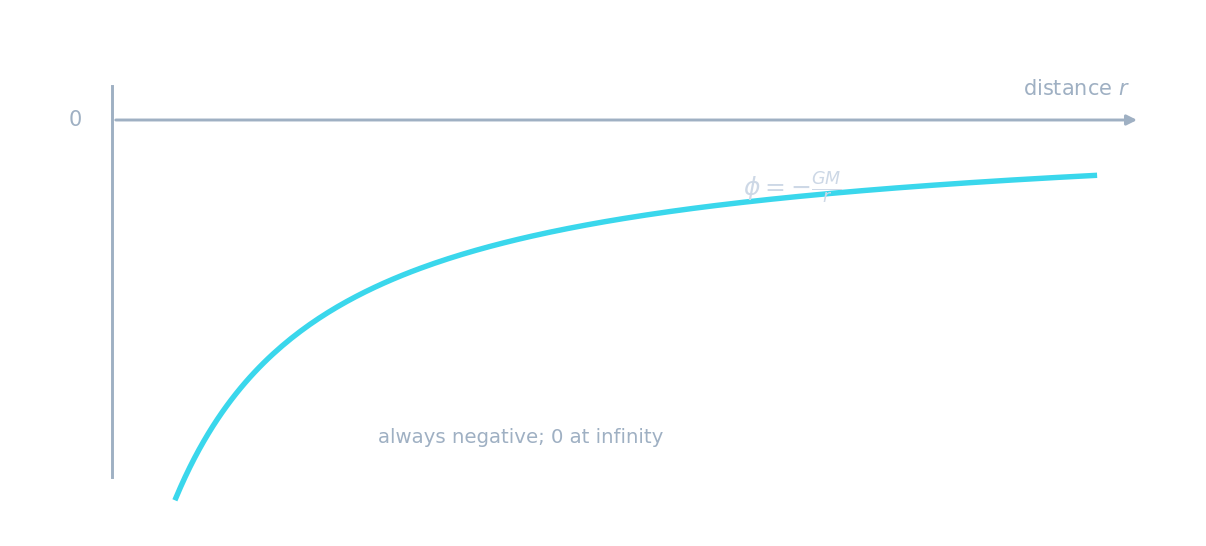
Gravitational potential · Potencial gravitatorio
V = −GM / r
Potential ∝ −1/r — deep near the mass, flattening with distance. · Potencial ∝ −1/r — profundo cerca de la masa, aplanándose con la distancia.
Gravitational potential is: · El potencial gravitatorio es:
Gravity does the work as a mass falls in, so $\phi = -\dfrac{GM}{r}$ is negative, reaching zero only at infinity. · La gravedad realiza el trabajo cuando una masa cae, por lo que $\phi = -\dfrac{GM}{r}$ es negativo, alcanzando cero solo en el infinito.
Gravitational potential is taken to be zero at ____. · Se toma el potencial gravitatorio como cero en ____.
That choice makes the potential negative everywhere a mass actually is. · Esa elección hace que el potencial sea negativo en todas partes donde hay una masa.
Gravitational potential energy 重力势能
- A mass $m$ at potential $\phi$ has $E_{\text{P}} = m\phi = -\dfrac{GMm}{r}$.
- It is negative; closer masses are more negative — more tightly bound 紧密束缚.
Gravity provides the centripetal force that keeps a planet in a circular orbit
Energía potencial gravitatoria 重力势能
- Una masa $m$ a un potencial $\phi$ tiene $E_{\text{P}} = m\phi = -\dfrac{GMm}{r}$.
- Es negativa; las masas más cercanas son más negativas — están más estrechamente ligadas 紧密束缚.

La gravedad proporciona la fuerza centrípeta que mantiene a un planeta en órbita circular
Two masses closer together have a more negative (lower) gravitational potential energy. · Dos masas más cercanas tienen una energía potencial gravitatoria más negativa (menor).
$E_{\text{P}} = -\dfrac{GMm}{r}$ — smaller $r$ gives a more negative value, i.e. a more tightly bound pair. · $E_{\text{P}} = -\dfrac{GMm}{r}$ — un $r$ menor da un valor más negativo, es decir, un par más fuertemente ligado.
Match each term to the definition the examiner marks. · Relaciona cada término con la definición que marca el examinador.
Two of these are per unit mass and one is per unit mass of WORK. That single word is what separates potential from field strength. · Dos de estos son por unidad de masa y uno es por unidad de masa de TRABAJO. Esa única palabra es lo que separa el potencial de la intensidad del campo.
Link with $mg\Delta h$
- For small height changes near the surface, $r$ barely changes, so $\Delta E_{\text{P}} \approx mg\Delta h$.
- For large changes (raising a satellite), use $-\dfrac{GMm}{r}$ at each radius and subtract.
Vinculación con $mg\Delta h$
- Para cambios de altura pequeños cerca de la superficie, $r$ apenas cambia, por lo que $\Delta E_{\text{P}} \approx mg\Delta h$.
- Para cambios grandes (elevar un satélite), use $-\dfrac{GMm}{r}$ en cada radio y resta los valores.
The simple formula $\Delta E_{\text{P}} = mg\Delta h$ is valid when: · La fórmula simple $\Delta E_{\text{P}} = mg\Delta h$ es válida cuando:
It assumes a uniform field. For big changes in $r$, use $-\dfrac{GMm}{r}$ at each radius instead. · Asume un campo uniforme. Para grandes cambios en $r$, use $-\dfrac{GMm}{r}$ en cada radio en su lugar.
Why is gravitational potential always negative? Select all · todos that apply. · ¿Por qué el potencial gravitatorio es siempre negativo? Seleccione todos los que correspondan.
"Because gravity attracts" on its own is not the marked answer. The mark needs the work argument: zero at infinity, and the field doing the work on the way in. · "Porque la gravedad atrae" por sí solo no es la respuesta correcta. La calificación requiere el argumento del trabajo: cero en el infinito, y el campo realizando el trabajo en el trayecto de entrada.
Worked example: the potential at the surface of Mars
Mars has mass $6.4 \times 10^{23}\ \text{kg}$ and radius $3.4 \times 10^{6}\ \text{m}$. Find the gravitational potential at its surface, and the energy needed to remove $1\ \text{kg}$ from the surface to infinity.
- Potential: $\phi = -\dfrac{GM}{R} = -\dfrac{6.67 \times 10^{-11} \times 6.4 \times 10^{23}}{3.4 \times 10^{6}} = -1.3 \times 10^{7}\ \dfrac{\text{J}}{\text{kg}}$.
- The unit is asked for: joules per kilogram, because potential is energy per unit mass.
- Energy to escape per kilogram: from $\phi$ up to zero at infinity is $+1.3 \times 10^{7}\ \text{J}$ for each kilogram.
- Check: the minus sign is not optional. It says work must be done on the mass to remove it — the mass is in a "well" $1.3 \times 10^{7}\ \dfrac{\text{J}}{\text{kg}}$ deep.
Ejemplo resuelto: el potencial en la superficie de Marte
Marte tiene una masa de $6.4 \times 10^{23}\ \text{kg}$ y un radio de $3.4 \times 10^{6}\ \text{m}$. Encuentre el potencial gravitatorio en su superficie y la energía necesaria para extraer $1\ \text{kg}$ desde la superficie hasta el infinito.
- Potencial: $\phi = -\dfrac{GM}{R} = -\dfrac{6.67 \times 10^{-11} \times 6.4 \times 10^{23}}{3.4 \times 10^{6}} = -1.3 \times 10^{7}\ \dfrac{\text{J}}{\text{kg}}$.
- Se pide la unidad: julios por kilogramo, porque el potencial es energía por unidad de masa.
- Energía para escapar por kilogramo: desde $\phi$ hasta cero en el infinito son $+1.3 \times 10^{7}\ \text{J}$ por cada kilogramo.
- Comprobación: el signo menos no es opcional. Indica que se debe realizar trabajo sobre la masa para extraerla — la masa está en un "pozo" de profundidad $1.3 \times 10^{7}\ \dfrac{\text{J}}{\text{kg}}$.
The Moon has mass $7.35 \times 10^{22}\ \text{kg}$ and radius $1.74 \times 10^{6}\ \text{m}$. What is the gravitational potential at its surface, as a multiple of $10^{6}\ \dfrac{\text{J}}{\text{kg}}$? (Include the sign.) · La Luna tiene una masa de $7.35 \times 10^{22}\ \text{kg}$ y un radio de $1.74 \times 10^{6}\ \text{m}$. ¿Cuál es el potencial gravitatorio en su superficie, como múltiplo de $10^{6}\ \dfrac{\text{J}}{\text{kg}}$? (Incluya el signo.)
$\phi = -\dfrac{GM}{R} = -\dfrac{6.67 \times 10^{-11} \times 7.35 \times 10^{22}}{1.74 \times 10^{6}} = -2.8 \times 10^{6}\ \dfrac{\text{J}}{\text{kg}}$ — about a twentieth of the Earth's, which is why leaving the Moon is easy. · $\phi = -\dfrac{GM}{R} = -\dfrac{6.67 \times 10^{-11} \times 7.35 \times 10^{22}}{1.74 \times 10^{6}} = -2.8 \times 10^{6}\ \dfrac{\text{J}}{\text{kg}}$ — aproximadamente una veintava parte del de la Tierra, por eso es fácil escapar de la Luna.
Escape velocity
- To reach infinity, kinetic energy must match the depth of the well: $\tfrac{1}{2}mv_{\text{esc}}^{2} = \dfrac{GMm}{r}$.
- $v_{\text{esc}} = \sqrt{\dfrac{2GM}{r}} \approx 11\ \dfrac{\text{km}}{\text{s}}$ at Earth's surface — independent of the object's mass.
Velocidad de escape
- Para alcanzar el infinito, la energía cinética debe igualar la profundidad del pozo: $\tfrac{1}{2}mv_{\text{esc}}^{2} = \dfrac{GMm}{r}$.
- $v_{\text{esc}} = \sqrt{\dfrac{2GM}{r}} \approx 11\ \dfrac{\text{km}}{\text{s}}$ en la superficie de la Tierra — independiente de la masa del objeto.
Roughly, what is the escape velocity from the Earth's surface, in km/s? · Aproximadamente, ¿cuál es la velocidad de escape desde la superficie de la Tierra, en km/s?
$v_{\text{esc}} = \sqrt{\dfrac{2GM}{r}} \approx 11\ \dfrac{\text{km}}{\text{s}}$ for Earth. · $v_{\text{esc}} = \sqrt{\dfrac{2GM}{r}} \approx 11\ \dfrac{\text{km}}{\text{s}}$ para la Tierra.
Escape velocity depends on the mass of the escaping object. · La velocidad de escape depende de la masa del objeto que escapa.
The object mass cancels: $v_{\text{esc}} = \sqrt{\dfrac{2GM}{r}}$ depends only on the planet and the distance. · La masa del objeto se cancela: $v_{\text{esc}} = \sqrt{\dfrac{2GM}{r}}$ depende solo del planeta y la distancia.
A planet has GM/r = 6.3e7 J/kg at its surface. What is its escape speed, in km/s? · Un planeta tiene GM/r = 6.3e7 J/kg en su superficie. ¿Cuál es su velocidad de escape, en km/s?
v = sqrt(2GM/r) = sqrt(1.26e8) = 1.12e4 m/s = 11.2 km/s, the Earth's value. Note the factor of 2 and that the mass of the escaping object cancels out entirely. · v = sqrt(2GM/r) = sqrt(1.26e8) = 1.12e4 m/s = 11.2 km/s, el valor de la Tierra. Note el factor de 2 y que la masa del objeto que escapa se cancela completamente.
Worked example: lifting a satellite
A $500\ \text{kg}$ satellite is raised from the Earth's surface ($R = 6.37 \times 10^{6}\ \text{m}$) to an orbit of radius $7.0 \times 10^{6}\ \text{m}$. Earth's mass is $5.97 \times 10^{24}\ \text{kg}$. Find the gain in potential energy, and compare it with $mg\Delta h$.
- Two potentials, subtract: $\Delta E_{\text{P}} = GMm\left(\dfrac{1}{R} - \dfrac{1}{r}\right)$.
- Substitute: $6.67 \times 10^{-11} \times 5.97 \times 10^{24} \times 500 \times \left(\dfrac{1}{6.37 \times 10^{6}} - \dfrac{1}{7.0 \times 10^{6}}\right) = 2.8 \times 10^{9}\ \text{J}$.
- The rough way: $mg\Delta h = 500 \times 9.81 \times 6.3 \times 10^{5} = 3.1 \times 10^{9}\ \text{J}$ — about $10\%$ too big, because $g$ falls with height and $mg\Delta h$ assumes it does not.
- Check: the gain is positive — the satellite ends less negative, less tightly bound — even though both potentials are negative numbers.
Ejemplo resuelto: elevar un satélite
Un satélite de $500\ \text{kg}$ se eleva desde la superficie de la Tierra ($R = 6.37 \times 10^{6}\ \text{m}$) hasta una órbita de radio $7.0 \times 10^{6}\ \text{m}$. La masa de la Tierra es $5.97 \times 10^{24}\ \text{kg}$. Encuentre el aumento de energía potencial y compárelo con $mg\Delta h$.
- Dos potenciales, restar: $\Delta E_{\text{P}} = GMm\left(\dfrac{1}{R} - \dfrac{1}{r}\right)$.
- Sustituir: $6.67 \times 10^{-11} \times 5.97 \times 10^{24} \times 500 \times \left(\dfrac{1}{6.37 \times 10^{6}} - \dfrac{1}{7.0 \times 10^{6}}\right) = 2.8 \times 10^{9}\ \text{J}$.
- El método aproximado: $mg\Delta h = 500 \times 9.81 \times 6.3 \times 10^{5} = 3.1 \times 10^{9}\ \text{J}$ — aproximadamente un $10\%$ demasiado grande, porque $g$ disminuye con la altura y $mg\Delta h$ asume que no lo hace.
- Comprobación: el aumento es positivo — el satélite termina siendo menos negativo, menos estrechamente ligado — aunque ambos potenciales sean números negativos.
Potential is negative and increases towards zero as you move away. "Energy gained" is final minus initial with the signs kept: $-1.3 \times 10^{7} \to -0.9 \times 10^{7}$ is a gain of $0.4 \times 10^{7}$ per kilogram. $mg\Delta h$ is only for $\Delta h \ll R$. And the unit of $\phi$ is $\dfrac{\text{J}}{\text{kg}}$ — writing joules loses the mark.
El potencial es negativo e incrementa hacia cero a medida que nos alejamos. La "energía ganada" es final menos inicial manteniendo los signos: $-1.3 \times 10^{7} \to -0.9 \times 10^{7}$ es una ganancia de $0.4 \times 10^{7}$ por kilogramo. $mg\Delta h$ solo sirve para $\Delta h \ll R$. Y la unidad de $\phi$ es $\dfrac{\text{J}}{\text{kg}}$ — escribir solo julios implica perder puntos.
Which statements about gravitational potential are correct? Select all that apply. · ¿Qué afirmaciones sobre el potencial gravitatorio son correctas? Seleccione todos los que correspondan.
Potential is energy per unit mass, so its unit is joules per kilogram. It is negative, rises towards zero with distance, and its gradient gives the field: $g = -\dfrac{\Delta\phi}{\Delta r}$. · El potencial es energía por unidad de masa, por lo que su unidad es julios por kilogramo. Es negativo, sube hacia cero con la distancia, y su gradiente da el campo: $g = -\dfrac{\Delta\phi}{\Delta r}$.
Field strength from the potential graph
- The field strength is the gradient of the potential–distance graph: $g = -\dfrac{\Delta\phi}{\Delta r}$.
- Where the $\phi$ graph is steep (close to the mass) the field is strong; far away the graph flattens and the field fades.
- The minus sign says the field points down the potential slope — towards the mass, where $\phi$ is most negative.
Intensidad de campo a partir de la gráfica de potencial
- La intensidad de campo es la pendiente de la gráfica de potencial vs. distancia: $g = -\dfrac{\Delta\phi}{\Delta r}$.
- Donde la gráfica de $\phi$ es empinada (cerca de la masa), el campo es fuerte; lejos, la gráfica se aplana y el campo disminuye.
- El signo menos indica que el campo apunta abajo por la pendiente del potencial — hacia la masa, donde $\phi$ es más negativo.
You've got it
- gravitational potential $\phi = -\dfrac{GM}{r}$ in $\dfrac{\text{J}}{\text{kg}}$ (negative, zero at infinity); $g = -\dfrac{\Delta\phi}{\Delta r}$
- gravitational PE $E_{\text{P}} = -\dfrac{GMm}{r}$ — more negative = more tightly bound; large changes use $GMm\left(\dfrac{1}{r_1} - \dfrac{1}{r_2}\right)$
- escape velocity $v_{\text{esc}} = \sqrt{\dfrac{2GM}{r}}$ (mass-independent, $\approx 11\ \dfrac{\text{km}}{\text{s}}$ for Earth)
Lo has entendido
- potencial gravitatorio $\phi = -\dfrac{GM}{r}$ en $\dfrac{\text{J}}{\text{kg}}$ (negativo, cero en el infinito); $g = -\dfrac{\Delta\phi}{\Delta r}$
- energía potencial gravitatoria $E_{\text{P}} = -\dfrac{GMm}{r}$ — más negativo = más estrechamente ligado; cambios grandes usan $GMm\left(\dfrac{1}{r_1} - \dfrac{1}{r_2}\right)$
- velocidad de escape $v_{\text{esc}} = \sqrt{\dfrac{2GM}{r}}$ (independiente de la masa, $\approx 11\ \dfrac{\text{km}}{\text{s}}$ para la Tierra)