Friction, drag and terminal velocity · Fricción, resistencia y velocidad terminal
| English | Español |
|---|---|
| terminal velocity/ˈtɜːmɪnl vəˈlɒsɪti/ | velocidad terminal |
| air resistance/eə rɪˈzɪstəns/ | resistencia del aire |
| friction/ˈfrɪkʃn/ | fricción |
| drag/dræɡ/ | arrastrar |
| viscous/ˈvɪskəs/ | viscoso |
| fluid/ˈfluːɪd/ | fluido |
| upthrust/ˈʌpθrʌst/ | empuje |
| resultant force/rɪˈzʌltənt fɔːs/ | fuerza resultante |
| thermal energy/ˈθɜːml ˈenədʒi/ | energía térmica |
| power/ˈpaʊə/ | potencia |
Why a skydiver stops speeding up
- Jump from a plane and you accelerate — but not forever.
- Soon you fall at a steady speed, the terminal velocity 收尾速度, even though gravity still pulls.
- The reason is air resistance 空气阻力 growing with speed.
Por qué un paracaidista deja de acelerar
- Si saltas de un avión, aceleras — pero no por siempre.
- Pronto caes a una velocidad constante, la velocidad terminal 收尾速度, aunque la gravedad sigue ejerciendo atracción.
- La razón es la resistencia del aire 空气阻力 que aumenta con la velocidad.
Friction 摩擦力 and drag 阻力
- Friction acts between two solid surfaces, opposing the sliding.
- Drag (a viscous 黏性 force) is the resistance from a fluid 流体 — a liquid or gas.
Newton's third-law pair: R on the book (up) and R-prime on the table (down)
Fricción 摩擦力 y resistencia 阻力
- La fricción actúa entre dos superficies sólidas, oponiéndose al deslizamiento.
- La resistencia (una fuerza viscosa 黏性) es la oposición de un fluido 流体 — un líquido o gas.
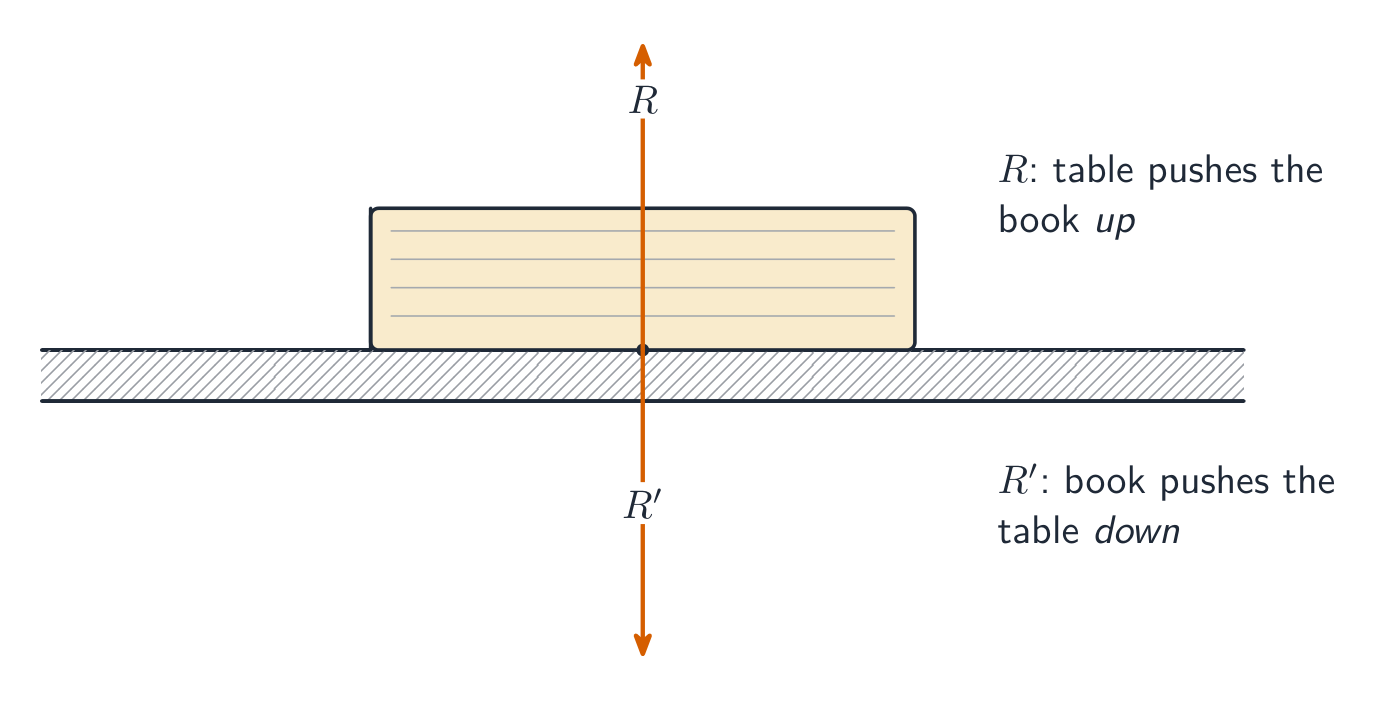
Pares de la tercera ley de Newton: R sobre el libro (hacia arriba) y R-prime sobre la mesa (hacia abajo)
Stopping a car · Detener un coche
Friction is what brakes a car. Set a speed and brake — the car keeps moving while the driver reacts, then friction slows it. Double the speed and watch the braking distance quadruple. · La fricción es lo que frena un coche. Establece una velocidad y frena: el coche sigue moviéndose mientras el conductor reacciona, y luego la fricción lo ralentiza. Duplica la velocidad y observa cómo la distancia de frenado se cuadruplica.
Which best describes a drag (viscous) force? · ¿Cuál describe mejor una fuerza de arrastre (viscosa)?
Drag is the resistance a fluid (liquid or gas) exerts on something moving through it. Friction is the solid-on-solid case. · El arrastre es la resistencia que un fluido (líquido o gas) ejerce sobre algo que se mueve a través de él. La fricción es el caso de sólido sobre sólido.
Drag grows with speed
- At rest there is no drag.
- The faster you go, the bigger the drag force becomes.
Velocity-time graph for an object falling through air
La resistencia crece con la velocidad
- En reposo no hay resistencia.
- Cuanto más rápido te mueves, mayor se vuelve la fuerza de resistencia.
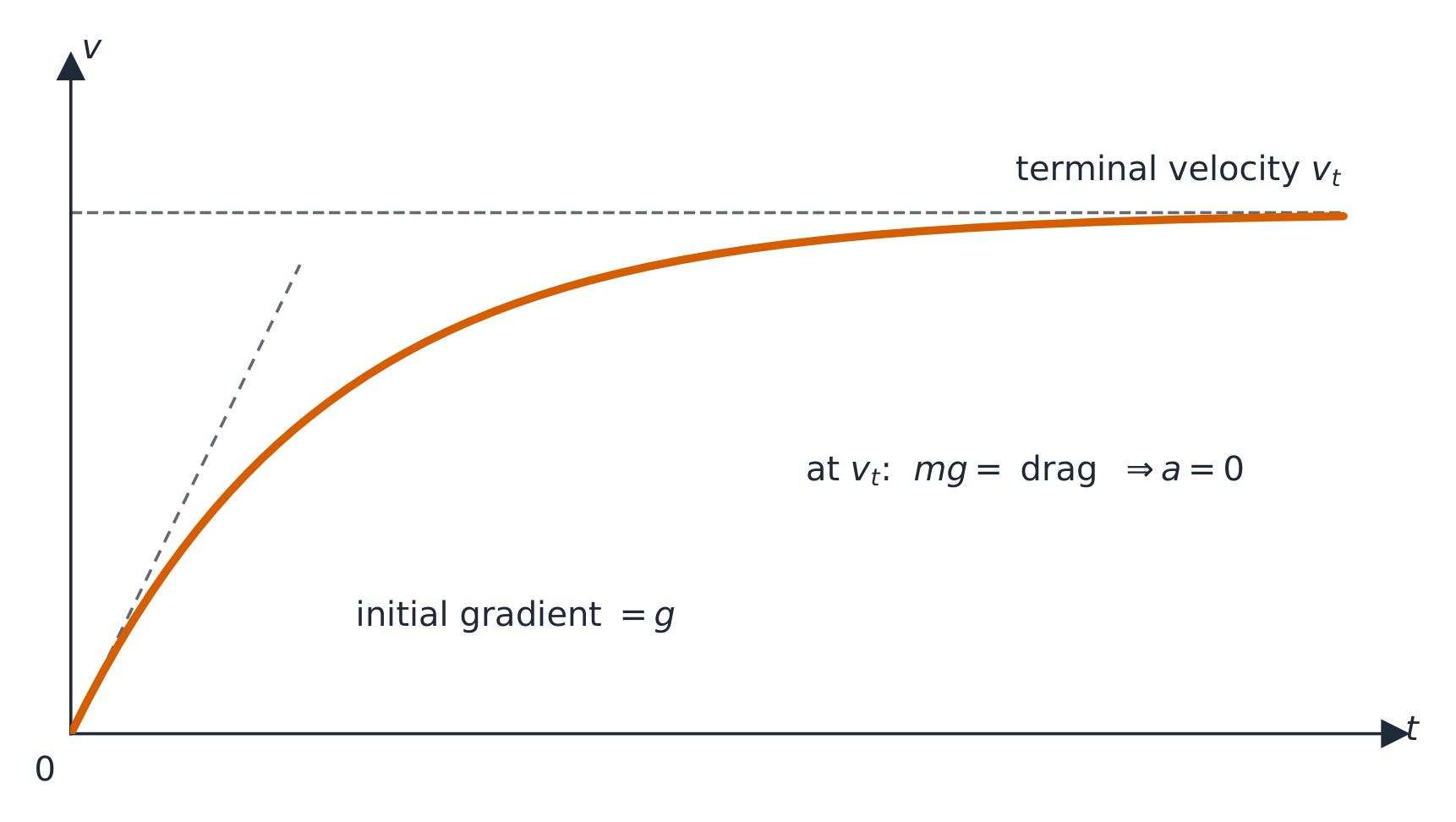
Gráfico de velocidad-tiempo para un objeto cayendo en el aire
The drag force on a falling object grows as its speed grows. · La fuerza de arrastre sobre un objeto en caída aumenta a medida que aumenta su velocidad.
Yes — at rest the drag is zero, and it increases with speed. That is what eventually balances the weight. · Sí: en reposo el arrastre es cero, e incrementa con la velocidad. Eso es lo que eventualmente equilibra el peso.
Three forces on a ball falling in a liquid
- Weight $W$ — down, always the same.
- Upthrust 浮力 $U$ — up, the same at every speed (it depends only on the liquid pushed aside).
- Drag $F$ — up, opposite to the motion, and growing as the ball speeds up.
- Exam habit: draw each force as a labelled arrow from the ball, and never add a "motion" arrow.
A free-body diagram shows only the forces on the object — the same idea for a falling ball
Tres fuerzas sobre una bola cayendo en un líquido
- Peso $W$ — hacia abajo, siempre el mismo.
- Empuje 浮力 $U$ — hacia arriba, el mismo a cualquier velocidad (depende únicamente del líquido desplazado).
- Resistencia $F$ — hacia arriba, opuesta al movimiento, y creciente mientras la bola acelera.
- Hábito de examen: dibuja cada fuerza como una flecha etiquetada partiendo desde la bola, y nunca añadas una flecha de "movimiento".

Un diagrama de cuerpo libre muestra solo las fuerzas sobre el objeto — la misma idea aplica a una bola que cae
A steel ball is falling through oil. Which forces act on the ball? Select all that apply. · Una bola de acero cae a través de aceite. ¿Qué fuerzas actúan sobre la bola? Selecciona todas las que correspondan.
Three forces: weight down, upthrust up, and drag up (opposite to the motion). There is no separate force of motion — the ball moves because of its velocity, not because a force pushes it along. · Tres fuerzas: peso hacia abajo, empuje hacia arriba y arrastre hacia arriba (opuesto al movimiento). No existe una fuerza separada de movimiento; la bola se mueve debido a su velocidad, no porque una fuerza la impulse.
Falling to terminal velocity
- Start: only weight (and upthrust) act, so the resultant force is largest and the acceleration is largest.
- Middle: drag grows, the resultant force 合力 shrinks, so the acceleration falls.
- End: upward forces equal the weight → zero resultant force → constant speed.
Cayendo hasta la velocidad terminal
- Inicio: solo actúan el peso (y el empuje), por lo que la fuerza resultante es máxima y la aceleración es máxima.
- Medio: la resistencia crece, la fuerza resultante 合力 disminuye, por lo que la aceleración baja.
- Final: las fuerzas hacia arriba igualan al peso → fuerza resultante cero → velocidad constante.

Reach terminal velocity · Alcanzar la velocidad terminal
Jump and watch the air-resistance arrow grow until it balances the weight — then the speed is constant. Open the parachute and the much bigger drag drops the diver to a slow, safe terminal velocity. · Salta y observa cómo la flecha de resistencia del aire crece hasta equilibrar el peso; entonces la velocidad es constante. Abre el paracaídas y la mucha mayor resistencia arrastra al paracaidista a una velocidad terminal lenta y segura.
Put the stages of a fall through air in order, from the moment of release. · Ordena las etapas de una caída a través del aire, desde el momento de la liberación.
Drag starts at zero and builds with speed until it cancels the weight, ending the acceleration. · El arrastre comienza en cero y aumenta con la velocidad hasta que cancela el peso, terminando la aceleración.
At terminal velocity, the drag force is equal to the ____. · A velocidad terminal, la fuerza de arrastre es igual a la ____.
Drag = weight, so the resultant force is zero and the speed stays constant. · Arrastre = peso, por lo que la fuerza neta es cero y la velocidad se mantiene constante.
At terminal velocity the acceleration is zero — not the velocity. The object is still moving, and it still loses height. A common exam error is "the forces are balanced so it stops".
A la velocidad terminal la aceleración es cero — no la velocidad. El objeto sigue moviéndose y sigue perdiendo altura. Un error común en los exámenes es decir "las fuerzas están equilibradas así que se detiene".
Worked example: terminal speed in oil
A small steel ball of weight $0.050\ \text{N}$ falls through oil. The upthrust on it is $0.010\ \text{N}$, and the drag is $F = kv$ with $k = 0.080\ \dfrac{\text{N s}}{\text{m}}$. Find the terminal speed.
- At terminal speed the resultant force is zero: $W = U + F$.
- So $F = 0.050 - 0.010 = 0.040\ \text{N}$.
- Then $kv = 0.040$, giving $v = \dfrac{0.040}{0.080} = 0.50\ \dfrac{\text{m}}{\text{s}}$.
- Check: in a liquid, forgetting the upthrust gives $v = 0.63\ \dfrac{\text{m}}{\text{s}}$ — the wrong answer, and a lost mark.
Ejemplo resuelto: velocidad terminal en aceite
Una pequeña bola de acero de peso $0.050\ \text{N}$ cae a través de aceite. El empuje sobre ella es $0.010\ \text{N}$, y la resistencia es $F = kv$ con $k = 0.080\ \dfrac{\text{N s}}{\text{m}}$. Encuentra la velocidad terminal.
- A la velocidad terminal la fuerza resultante es cero: $W = U + F$.
- Así que $F = 0.050 - 0.010 = 0.040\ \text{N}$.
- Entonces $kv = 0.040$, lo que da $v = \dfrac{0.040}{0.080} = 0.50\ \dfrac{\text{m}}{\text{s}}$.
- Comprobación: en un líquido, olvidar el empuje da $v = 0.63\ \dfrac{\text{m}}{\text{s}}$ — la respuesta incorrecta, y una pérdida de puntos.
A ball of weight $0.12\ \text{N}$ falls through a liquid. The upthrust is $0.030\ \text{N}$ and the drag is $F = kv$ with $k = 0.30\ \dfrac{\text{N s}}{\text{m}}$. What is its terminal speed, in m/s? · Una bola de peso $0.12\ \text{N}$ cae a través de un líquido. La fuerza ascendente es $0.030\ \text{N}$ y la resistencia es $F = kv$ con $k = 0.30\ \dfrac{\text{N s}}{\text{m}}$. ¿Cuál es su velocidad terminal, en m/s?
At terminal speed $W = U + kv$, so $kv = 0.12 - 0.030 = 0.090\ \text{N}$ and · y $v = \dfrac{0.090}{0.30} = 0.30\ \dfrac{\text{m}}{\text{s}}$. · A velocidad terminal $W = U + kv$, así que $kv = 0.12 - 0.030 = 0.090\ \text{N}$ y $v = \dfrac{0.090}{0.30} = 0.30\ \dfrac{\text{m}}{\text{s}}$.
Energy at terminal velocity
- The kinetic energy is now constant, but the object keeps losing height.
- That lost gravitational PE turns mainly into thermal energy 热能 of the fluid — not into extra speed.
Energía a la velocidad terminal
- La energía cinética ahora es constante, pero el objeto sigue perdiendo altura.
- Esa energía potencial gravitatoria perdida se convierte principalmente en energía térmica 热能 del fluido — no en mayor velocidad.
As a parachutist falls at terminal velocity, the lost gravitational PE turns mainly into: · Cuando un paracaidista cae a velocidad terminal, la energía potencial gravitatoria perdida se convierte principalmente en:
The kinetic energy is constant, so the falling PE cannot become KE — it heats the air (and the parachutist) through drag. · La energía cinética es constante, por lo que la PE en caída no puede convertirse en EC: calienta el aire (y al paracaidista) mediante el arrastre.
Cruising at constant speed
- A car at steady speed has zero resultant force: driving force = total resistance.
- On a slope, the driving force must also balance the component of the weight along the slope, $W\sin\theta$.
- Going faster means more drag, so more driving force — and more power 功率, since $P = Fv$.
On a slope the driving force works against drag and against part of the weight
Crucero a velocidad constante
- Un coche a velocidad constante tiene fuerza resultante cero: fuerza motriz = resistencia total.
- En una pendiente, la fuerza motriz también debe equilibrar la componente del peso a lo largo de la pendiente, $W\sin\theta$.
- Ir más rápido significa más resistencia, por lo que se necesita más fuerza motriz — y más potencia 功率, ya que $P = Fv$.
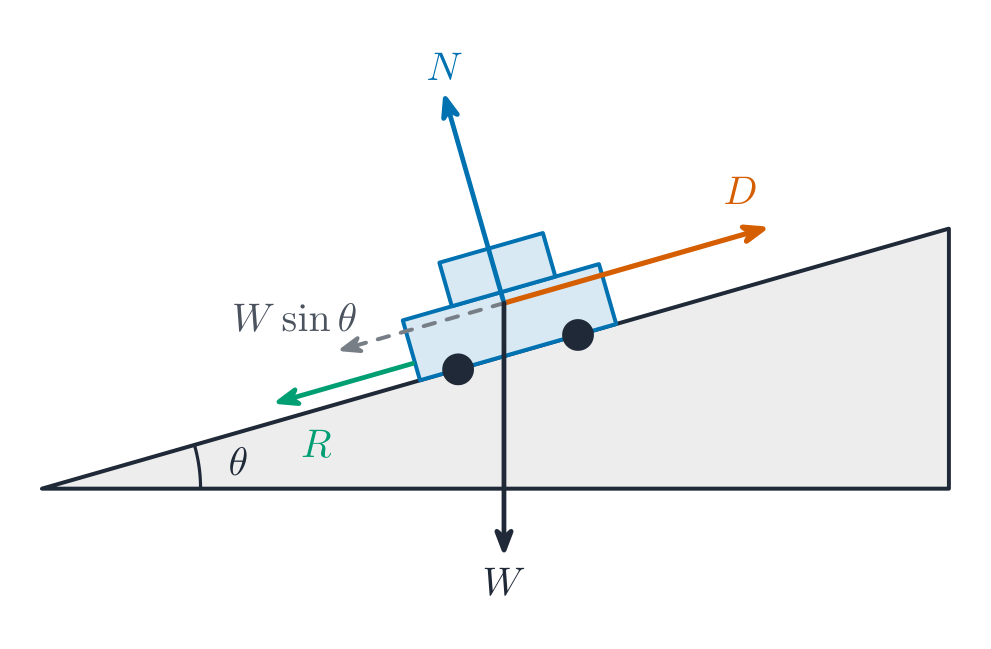
En una pendiente, la fuerza motriz trabaja contra la resistencia y contra parte del peso
A car cruising at a higher steady speed needs more power because the drag is larger. · Un coche que circula a una velocidad constante mayor necesita más potencia porque el arrastre es mayor.
Higher speed → larger drag → a larger driving force is needed → more power (power = force × velocity). · Mayor velocidad → mayor arrastre → se requiere una fuerza motriz mayor → más potencia (potencia = fuerza × velocidad).
Worked example: power up a slope
A car of mass $1200\ \text{kg}$ climbs a slope of $5.0^\circ$ at a steady $25\ \dfrac{\text{m}}{\text{s}}$. The total resistive force is $900\ \text{N}$. Find the useful output power of the engine.
- Steady speed → the driving force $D$ balances everything pulling back.
- Weight component down the slope: $mg\sin\theta = 1200 \times 9.81 \times \sin 5.0^\circ = 1030\ \text{N}$.
- So $D = 900 + 1030 = 1930\ \text{N}$.
- Power: $P = Dv = 1930 \times 25 = 4.8 \times 10^{4}\ \text{W}$ (about $48\ \text{kW}$).
- Check: using $mg$ instead of $mg\sin\theta$ would give a driving force bigger than the car's whole weight — impossible on a gentle slope.
Ejemplo resuelto: potencia cuesta arriba
Un coche de masa $1200\ \text{kg}$ asciende por una pendiente de $5.0^\circ$ a velocidad constante de $25\ \dfrac{\text{m}}{\text{s}}$. La fuerza resistente total es $900\ \text{N}$. Encuentra la potencia útil de salida del motor.
- Velocidad constante → la fuerza motriz $D$ equilibra todo lo que tira hacia atrás.
- Componente del peso cuesta abajo: $mg\sin\theta = 1200 \times 9.81 \times \sin 5.0^\circ = 1030\ \text{N}$.
- Así que $D = 900 + 1030 = 1930\ \text{N}$.
- Potencia: $P = Dv = 1930 \times 25 = 4.8 \times 10^{4}\ \text{W}$ (aproximadamente $48\ \text{kW}$).
- Comprobación: usar $mg$ en lugar de $mg\sin\theta$ daría una fuerza motriz mayor que el peso total del coche — imposible en una pendiente suave.
A lorry climbs a slope at a steady $20\ \dfrac{\text{m}}{\text{s}}$. The total resistive force is $2000\ \text{N}$ and the component of its weight along the slope is $3000\ \text{N}$. What useful output power does the engine deliver, in kW? · Un camión sube una rampa a una velocidad constante de $20\ \dfrac{\text{m}}{\text{s}}$. La fuerza resistente total es $2000\ \text{N}$ y la componente de su peso a lo largo de la rampa es $3000\ \text{N}$. ¿Qué potencia útil de salida entrega el motor, en kW?
Steady speed, so the driving force is $2000 + 3000 = 5000\ \text{N}$. Power $P = Fv = 5000 \times 20 = 1.0 \times 10^{5}\ \text{W} = 100\ \text{kW}$. · Velocidad constante, por lo que la fuerza motriz es $2000 + 3000 = 5000\ \text{N}$. Potencia $P = Fv = 5000 \times 20 = 1.0 \times 10^{5}\ \text{W} = 100\ \text{kW}$.
You've got it
- drag grows with speed; friction is between solids, drag is from a fluid
- terminal velocity: upward forces (drag + upthrust) = weight, so zero resultant force and constant speed — zero acceleration, not zero motion
- the lost gravitational PE becomes thermal energy of the fluid, not kinetic energy
- steady speed on a slope: driving force = resistance + $W\sin\theta$, and $P = Fv$
Lo has entendido
- la resistencia crece con la velocidad; la fricción es entre sólidos, la resistencia proviene de un fluido
- velocidad terminal: fuerzas hacia arriba (resistencia + empuje) = peso, así que fuerza resultante cero y velocidad constante — aceleración cero, no movimiento cero
- la energía potencial gravitatoria perdida se convierte en energía térmica del fluido, no en energía cinética
- velocidad constante en una pendiente: fuerza motriz = resistencia + $W\sin\theta$, y $P = Fv$